Showing posts with label Random Snippets of Information. Show all posts

Thursday, 10 June 2021

Recent reads: "Cakes and Ale" by Somerset Maugham

I would describe this as almost a perfect novel. Not a great deal happens, but there are enough unexpected twists to keep the reader occupied, and the character-descriptions are splendid.

   The story: The narrator is Ashenden, a name that Maugham used in others of his stories. Edward Driffield, a famous writer (loosely based on Thomas Hardy) has recently died, a biography is planned, and Ashenden is approached for information, because they had met when Ashenden was a boy and Driffield was a struggling unknown author living in the same village. 
   Ashenden reflects on this, and also on how they met again several years later in London, when he was a medical student and Driffield was at long last beginning to achieve some recognition. But it quickly become clear that the biographer (a literary hack called Alroy Kear, who is mercilessly dissected) will be producing a fundamentally dishonest book, because he intends to leave out all the most controversial aspects of Driffield's life; particularly the strange case of his first wife, Rosie, a former barmaid.
   There are marvellous depictions, in a restrained but lethal manner, of the horrors of growing up in a village riven by social snobbery, the awful people hovering on the fringes of the London cultural scene, and the ridiculous tourists visiting Driffield's last home; now preserved as a shrine to his memory. 
   All in all; a wonderful novel, which I would unhesitatingly recommend to anyone.  


Thursday, 11 June 2020

An antislavery campaign, 1792

In this cartoon of 1792, James Gillray imagines George III and the royal family joining the boycott of slave-grown sugar by drinking their tea without sugar. King George declares it "Delicious!" and Queen Charlotte urges her daughters to remember the "poor blackamoors", and "Above all, remember how much expense it will save your poor Papa!" The princesses do not look convinced.
.

Gillray seldom lost an opportunity to ridicule the royal family: invariably portraying George III as ludicrously mean and penny-pinching, Queen Charlotte as grotsquely ugly, and the Prince of Wales as a lecherous glutton. How very different from most media coverage today! 

Monday, 18 May 2020

Saints against the plague


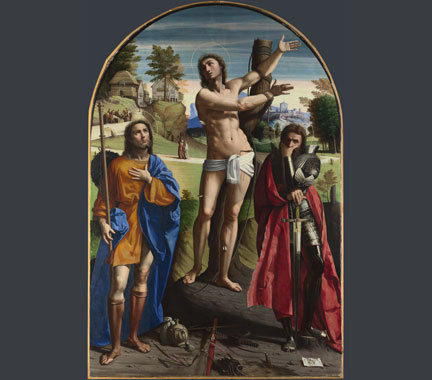
Two saints whose aid was traditionally invoked against the plague were Saint Roch (or Rocco) and Saint Sebastian.
.
.Saint Roch 43" - 1876
Saint Roch is said to have been born in Montpellier in the south of France in the 14th century. He went on a pilgrimage to Rome, where the plague broke out, and he healed many of the disease before catching it himself. He was first succoured by a dog, and recovered. He then returned to his native town, but he had been away so long that no-one recognised him and he was thrown into prison, where he died. Saint Roch is shown pointing to the plague-spot on his thigh, and holds a pilgrim's staff. He is accompanied by a dog.
.
.File:Antonio Pollaiuolo 003 cropframe.JPG - Wikimedia Commons
Almost nothing is known for certain about Saint Sebastian. He is supposed to have been an early Christian martyr, who was shot with arrows during the persecution of the Emperor Diolcletian, though he recovered from this and was battered to death instead. He is portrayed as a scantily-clad young man full of arrows, tied to  dead tree. It is possible that his connection with the plague is that the arrows, and the fact the he recovered from them, symbolise the invisible arrows of the disease. He has of late become something of a Gay icon.
  
Here are Rocco and Sebastian together with Saint George, in an Italian Renaissance painting in the National Gallery in London.

.Saint Roch | Saints | National Gallery, London

I wonder if Saints Roch and Sebastian are suitable saints to be invoked for protection against the Corona virus? Or do we stand in need of new saints?

Sunday, 15 March 2020

Women's Work

The woman on the right is carding wool; that is, working it between two instruments like large hairbrushes covered with little hooks, to disentangle it and ensure the fibres all point in the same way, producing a kind of fuffy sausage.
   The lady on the left is spinning the result on what was called the "Great Wheel", an important invention of the later Middle Ages. 
.Image
Spinning was always done by women, and was their main occupation after farmwork, which is why an unmarried woman became known as a Spinster. Weaving cloth was usually done by men; but a woman weaver was known as a Webster. Other surnames originating in the woollen industry include Fuller and Dyer. Fulling involved trampling the woollen cloth to pre-shrink it; using "fuller's earth" in the process. After this, cloth would be stretched out on a "tenter frame" to preserve its shape whilst drying: hence the phrase "to be on tenterhooks".
   
   From the earliest mediaeval times, raw wool and woollen cloth constituted the vast majority of English exports, until overtaken by cotton at the end of the 18th century. Very many of the great churches and monasteries were built on the profits of the woollen industry; almost all of which would have passed through women's fingers!  

Incidentally, the shadowy figures in the background show that this document is a "Palimpsest": a previously-used parchment that had been carefully scraped so that it could be used again. Parchment was too valuable to be thrown away!

Monday, 16 December 2019

Roman Names: an introductory note

A Roman aristocrat of the 1st century B.C.; the "classical" period most studied as history, and whose version of Latin we are taught at school, would normally have three names. Prominent examples are Caius Julius Caesar, his assassin Marcus Junius Brutus, and the dictator Lucius Cornelius Sulla.
   The first of these was the personal name, and would probably only be used when a boy was spoken to by his mother, or when as an adult was addressed in a fully formal manner.
   The second was the name of the tribe, or clan. Roman politics for many generations was dominated by a handful of great aristocratic clans, of which the Julii, Cornelii and Junii are examples.
   The third is known as the "cognomen". It was often a kind of nickname, perhaps dating from centuries earlier, in a form of latin that had become archaic, to distinguish between the different branches of the great clans. A cognomen would be inherited, and as a result some became quite comical. Thus "Caesar" meant "hairy", whereas Julius Caesar was bald. The cognomen of Lucius Domitius Ahenobarbus meant "bronze-beard", whereas all Roman aristocrats of the classical period were cleanshaven. The famous orator and writer Marcus Tullius Cicero (who was not an aristocrat, but came from an obscure family of provincial gentry) bore a cognomen that literally meant "chickpea", probably indicating a prominent pimple or wart on the face! 
   An extra name, known as an agnomen, might also be awarded for some great military feat. At the end of the 3rd cetury B.C. the great general Publius Cornelius Scipio was awarded the agnomen of Africanus after his defeat of Hannibal at the battle of Zama.

   Things were confused by adoptions and consequent changes of name. The most famous came about when Caesar, who had no son to succeed him, named as his heir his sister's son, called Gaius Octavius. This young man changed his name, first to Octavianus, and then to Gaius Julius Caesar; and in 27 B.C. the Senate granted him the agnomen of Augustus. He is usually called the first Roman Emperor (1), though in fact he neither he nor his immediate successors ever acknowledged any such title.
   Augstus had no son, and his grandsons all died young, so for his military campaigns he relied upon his two stepsons, who came from the great aristocratic Claudii clan. They were the brothers Tiberius Claudius Nero Drusus (2) and Gaius Claudius Nero Drusus. After the death of Gaius, his son, another Gaius Claudius Nero Drusus, won significant victories on the Rhine frontier, and was granted the agnomen of Germanicus. His son acompanied the armies as a child, dressed in a miniature military uniform that caused the soldiers to give him the nickname Caligula ("Little boots") (3). The younger  brother of Germanicus, another Tiberius Claudius Nero Drusus (4), sent the legions to conquer Britain in 43 A.D., and was given the agnomen of Britannicus. He himself adopted as his heir his stepson, Lucius Domitius Ahenobarbus (5), who duly changed his name to that of his stepfather.  

   Daughters would merely have a feminine version of their father's clan-name: thus Caesar's daughter was called Julia, Cicero's daughter was called Tullia, and so forth.

This proliferation of very similar names creates problems for historians, who therefore tend to settle on a single name for convenience. Thus Gnaeus Pompeius Maximus (the agnomen meaning "Greatest") is generally known as Pompey, and the five men indicated above by numerals are the first five Emperors, now known under the names of Augustus, Tiberius, Caligula, Claudius and Nero. 

Sunday, 1 December 2019

150 Years Ago!

Report on an election of November 1869, from the "Shrewsbury Chronicle":-

"The proceedings of the day were devoid of much of the drunkenness and disorderly conduct which has, too frequently, been witnessed on such occasions. The cause of this undoubtedly was that the successful candidates put themselves forward otherwise than by the old system of bribery and "open" public houses. Another reason was that the polling places were not, as formerly, held at public houses, a mode of conducting an election which could not but tend to bad results"

In November 1794 the same newspaper published a report that "No intelligence whatever has now been received from the British Army since Tuesday." This never fails to raise a smile nowadays. It did of course mean "no information", though in fact the Flanders campaign, which it refers to, was exceptionally badly planned and executed, and convinced the future Duke of Wellington, who was present, of the need to take military matters much more seriously.

Saturday, 8 June 2019

King Louis of England?

It is often asserted that the last invasion of England was in 1066, but this is by no means the case.
When King John's disastrous reign finally came to an end in 1216, his son and heir, Henry, was no more than nine years old, and without any sign of being a forceful character. The boy was now crowned as Henry III; but many of the barons who had rebelled against John were of the opinion that Louis, the younger son of Philip Augustus of France (the greatest of the French mediaeval kings) would make a much better King of England.
   Louis was already in England, and was willing to take the crown. But William Marshal, Earl of Pembroke, the most respected knight of his age, remained loyal to the ruling family, and attacked and defeated Louis and his supporters at Lincoln in May 1217
.
Image result for Battle of Lincoln.

Soon afterwards, French ships in the Channel were defeated off Dover. Louis withdrew to France, and as a result of the death of his brother became King Louis VIII of France in 1223. But, without the determination of William Marshal, England could easily have had a King Louis I.
   Young King Henry III now enjoyed a reign of 56 years, one of the longest in British history. But "enjoyed" is probably the wrong word, since he displayed complete ineptitude for the job. For a while he was little more than a prisoner and puppet of Simon de Montfort. But Henry's very incompetence proved to be of crucial constitutional importance, since it resulted in the first appearance of an English Parliament.

Wednesday, 24 April 2019

The Lion on the Cheesegrater

Reading James Davidson's splendid book, "Courtesans and Fishcakes: the consuming passions of classical Athens", I discover that the Athenian brothels offered a service called, "The lion on the cheesegrater". What on earth might this have been? Nobody seems to know. Imagination boggles!

Saturday, 22 September 2018

Dante meets a Pope in Hell

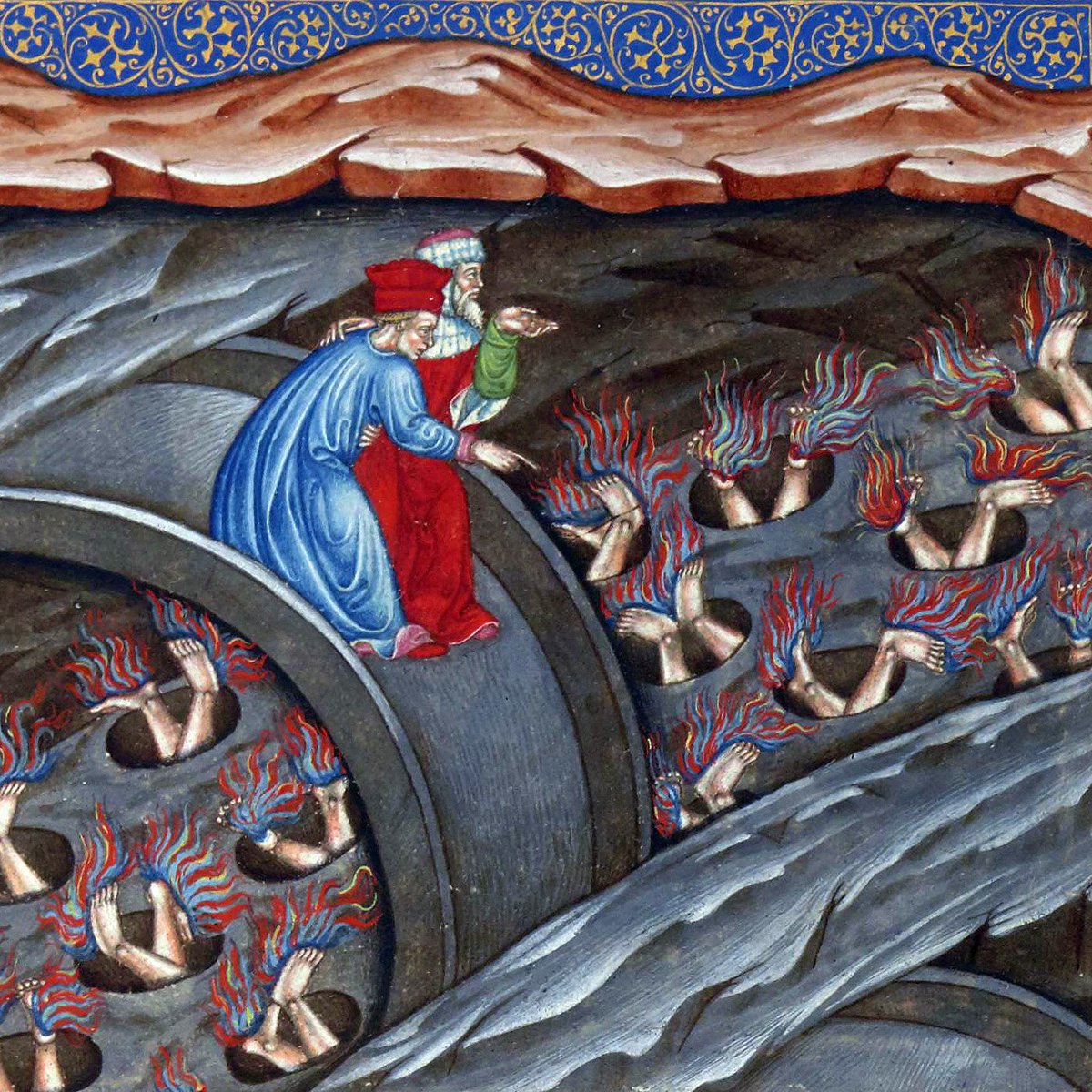
In one of the lower circles of Hell, Dante, guided by Virgil, meets Pope Nicholas III, a notoriously corrupt Pope, upside-down in a pit of flames.


Dante wrote the "Inferno", the first book of his "Divine Comedy", around 1310. He set the story at Easter in the year 1300, when the Pope was Boniface VIII, whom Dante particularly hated and despised. He accordingly has Nicholas mistake his visitors and exclaim, "What! Are you here already, Boniface?" 
   Nicholas then prophesises that disaster will soon overtake the Papacy. The disaster had already begun when Dante was writing, because in 1305 a Frenchman was elected Pope, as Clement V. He never set foot in Italy and eventually settled at Avignon. Dante was not to know that for the next sixty years all the Popes would be French, little more than puppets of the Kings of France, and that the Papacy would not return permanently to Rome until 1415.  

Sunday, 24 June 2018

The Bridge at Avignon

Everyone has heard of the famous bridge which does not cross the river Rhone at Avignon, in the south of France. The well-known song, "Sur le pont d'Avignon" dates back at least to the 16th century, in a number of differenr versions. 
  The bridge itself was constructed in the 12th century by Saint Benezet (the Provencal version of the name "Benedict"), a humble shepherd boy who, according to legend, heard angelic voices calling him to go to Avignon and build a bridge. Questioned by the local bishop, he proved his divine inspiration by lifting, single-handed, an enormous block of stone to start the project. Wharever the truth behind this story, work on the bridge began in 1177 and it was completed eight years later.
   The picture below gives a misleading impression of the vast scale of the project. What appears to be the far bank is in fact a long, narrow island in the middle of the Rhone, which did not exist in the 12th century. In fact the bridge ran all the way to the white tower seen on the right: almost a thousand yards long, with 22 arches, running in an S-shaped curve so as to base the piers on avialable shoals of gravel in the river bed. 
But currents in the river meant the shoals kept shifting, and arches in the bridge collapsed several times over the centuries. This problem was intensified in the 14th century, as temperatures began to fall in what is known as "the Little Ice Age". After 1680 the bridge was abandoned.
   The tower is all that remains of a castle built by Philip IV of France (Philippe le Bel) in 1302, to control the river crossing. He was, incidentally, the King who destroyed the Templar knights, and was responsible for bringing the Popes to Avignon.

   Halfway along what is left of the bridge today is the little chapel of Saint Nicholas. A lower chapel used to contain the relics of Saint Benezet, but these were lost in the French Revolution.

The bridge today provides a fine view of the cathedral and the Palace of the Popes; provided there are not too many crowds of tourists!

Thursday, 5 April 2018

The Byzantine Mosaic Tradition in Italy

Mosaic artists from Constantinople were active in Italy over several centuries, leaving marvellous works which have survived the turmoil of the times.
Here is the Byzantine Emperor Justinian and his wife, Theodora with her court; created in Ravenna in the sixth century


Then, half a millenium later; King Roger of Sicily is portrayed crowned by Christ. This is in Palermo, from the early twelfth century.


Justinian's generals succeeded in reconquering Italy from the Goths, in an attempt to restore the Roman Empire, but this came at enormous cost in the devastation of the country. In later centuries, the Lombards occupied northern Italy, and the holy Roman Empire was established by Charlemagne and his successors. 
    Meanwhile Arab forces conquered Sicily. Roger overran the island and established a spectacular but short-lived kingdom which combined Greek, Arab, Norman and Jewish elements. 

In fact, both of these monarchs' families were flagrant interlopers. Justinian succeeded to the Imperial title on the death of his uncle, Justin, a peasant soldier from the Balkans who had risen to the throne through the army. Roger was from the second generation of a family of Norman knights, the de Hauteville brothers, who terrorised sounthern Italy in the 11th century.

Monday, 12 February 2018

The Very Short Government of 1746

February 10th-12th is the anniversary of the shortest-lived government in British history, in 1746. What happened was that the Prime Minister, Henry Pelham, was so annoyed at the complete lack of confidence in him shown by King George II that the entire cabinet resigned in protest on February 10th. The King then asked William Pulteney the Earl of Bath, and Lord Granville to form a government; but the pair were unable to attract any men of substance to join them, and had no chance of securing a majority in Parliament; so that after just two days they gave up, and the King had no option but to ask Pelham back. 
   Horace Walpole's comment on the episode was that "Men dared not walk the streets of London for fear of being press-ganged as a cabinet minister", and the satirists of the time had fun arguing that the Pulteney-Granville government would have to be rated the best in our history, since during its time in office it had not stolen a penny from the public purse, had not enacted a single oppressive law, had never engaged the country in a disastrous war, etc etc.
  Henry Pelham then remained as Prime Minister until his death eight years later. Although farcical, this incident was of considerable constitutional significance, since it showed that the King's right to choose his ministers was not absolute, but constrained by party political realities. 

Henry Pelham remains one of our least-remembered Prime Ministers. Consider this: very many people have heard of Bonnie Prince Charlie, but how many could name the Prime Minister who defeated his 1745-6 Jacobite Rising? Henry Pelham, of course!

Wednesday, 31 January 2018

The Tsar's titles

The full title of the last Tsar, Nicholas II, reflects the vast multi-racial empire which he ruled. It ran (with a few minor omissions) as follows:-

"Emperor and Autocrat of all the Russias: Tsar of Moscow, of Kiev, of Vladimir, of Novgorod; Tsar of Kazan, Tsar of Astrakhan, Tsar of Poland, Tsar of Siberia, Tsar of Georgia; Lord of Pskov; Grand Duke of Smolensk, of Lithuania, of Volhynia, of Podolia and of Finland; Prince of Estonia, Livonia, Courland, Bialystok, Karelia, Tver, Perm, Viatka, Bulgaria and other countries; Lord and Grand Duke of Lower Novgorod, of Tchernigov, Riazan, Polotsk, Yaroslav, Vitebsk, Mtislav and all the region of the North; Lord and Sovereign of the countries of Iveria, Cartalinia, Kabardinia and the provinces of Armenia; Sovereign of the Circassian Princes and the Mountain Princes; Lord of Turkestan."

This reflects how the Russian Empire was built up over the centuries; in contiguous territories, similar to the trans-continental expansion of the U.S.A., rather than scattered worldwide like the British Empire. Kazan and Astrakhan, on the Volga, were conquered by Ivan the Terrible in the 16th century; and this was followed by an expansion all the way across Siberia to the Pacific, overcoming and incorporating the Stone Age tribes encountered on the way, in much the same way as the United States defeated the Red Indian tribes.  The drive into the Baltic territories was begun under Peter the Great in the early 18th century. The ancient Kingdom of Poland was carved up between Russia, Prussia and Austria at the end of the century, and Finland was acquired from Sweden at the end of the Napoleonic Wars. At the same time as this, Russia took over the Trans-Caucasian kingdoms of Georgia and Armenia; but the mountain tribes of the Caucasus mountains: the Chechens and others, proved formidable foes; and it took half a century of bitter fighting before they finally submitted to Tsarist rule. Finally the Moslem emirates of Central Asia, present-day Kazkhstan, Uzbekistan and the others, here called "Turkestan", were conquered with enormous slaughter in the 19th century, leaving only the buffer-territory of Afghanistan between the Russian Empire and British India.

Image result for Russian-Empire

What is truly remarkable is that after the chaos of the Russian Revolution and civil war, Leninand the Bolsheviks managed to hang on to almost all this vast empire. Only the western fringes in the Baltic and Poland were lost, and even this loss proved temporary. Stalin was able to regain most of them in 1945, and even protected his neo-Tsarist empire with a string of Communist-ruled buffer-states. It was only under Gorbachev that the empire was lost as the Soviet Union broke up.
   Unlike the British, who are taught to be ashamed of their empire, the Russians are very proud of theirs. They do not forgive Gorbachev for losing it, and support Putin's attempts to regain control over it.


Friday, 29 September 2017

A.E. Housman and Heroin!

Did you know that the poet A.E. Housman,best known for his "Shropshire Lad" cycle of poems, once took heroin?
   When he was in hospital with serious heart trouble over Christmas 1935, it was given to him as a soporific; which shows how very different medical procedures were eighty years ago! From this experience of the drug, Housman made the interesting comment, "I learnt what it is to be totally deprived of intellect".
   As far as is known, he felt no inclination to renew the experience, and he died the following spring.

(Source: Peter Parker: "Housman Country")

Friday, 30 June 2017

The Bridge at Mostar

Mostar, in what is now Bosnia, was famous for its great bridge over the river Neretva, built for the Ottoman Sultan Sulemein the Magnificent in the mid-16th century.
This is a photograph my father took of the bridge 40 years ago:-

Unfortunately the bridge was destroyed by shellfire in November 1993, in the wars that followed the collapse and disintegration of Yugoslavia. A film showing the fall of the bridge can be seen at a local bookshop.
Since then, the bridge was reconstructed and reopened in 2004, and is once again a tourist attraction. I took these pictures this year:-


Although the new bridge manages to resemble the ancient one as far as is possible, somehow it doesn't have the same effect.  

Friday, 27 January 2017

The Man in the Iron Mask and the Lerins Islands

The Lerins islands are a group of small islets in the Mediterranean, close to the south coast of France. There is a fortress with a fine view across the sea to Cannes. 


The famous "Man in the iron mask" was imprisoned here in the later 17th century. After a while, his guards were so fed up with having to live in this environment that they demanded to be transferred to Paris!

The prisoner did not in reality wear an iron mask, but a velvet one. Exactly who he was, and why he was imprisoned, remains a mystery. He was arrested in 1669, when he was aged about 30, by order of the Minister of War, the Marquis de Louvois, and held first of all at Pignerol (now in Piedmont), a top-security prison for major political offenders, and then at other prisons until his eventual death in the Bastille in 1703. There it was later reported that two musketeers were always on duty in his cell, to shoot him immediately if he ever removed his mask or attempted to speak about anything other than his immediate personal needs. When he died, he was buried the very next day (under the name of "Marchioly"), his clothes and furniture were burnt and the walls of his cell whitewashed. Clearly even more than thirty years after his arrest, he was considered a danger to state security. But why?

   On the arrest warrant his name was given as Eustache Dauger, a name that means nothing to historians. This only deepens the mystery, because it was stressed that he was "only a valet". At Pignerol he was allowed to act as a servant to a genuinely important detainee, the disgraced former Superintendant of Finances Nicholas Fouquet, who was imprisoned there from his fall in 1661 until his death in 1680. But if Dauger was no more than a servant, why were these extreme measures taken to conceal his identity and prevent him speaking? Presumably there was a danger someone might recognise him for who he really was, or at least be struck by his strong resemblence to someone famous and important. Alternatively, why was he not quietly killed, to save all this trouble?  

   Inevitably there have been sensational theories about his identity. The most famous stems from the great French novelist Alexandre Dumas, who suggested (in a follow-up historical novel to "The Three Musketeers") that he was the elder twin brother of Louis XIV, and should by rights have succeeded as King. A completely opposite theory is that he was Louis XIV's biological father (Louis XIII having been estranged from his wife for some time before her unexpected pregnancy) and had been attempting to blackmail the French government with this revelation. If the mysterious prisoner did in fact strongly resemble Louis XIV, it would certainly explain the mask, and the possibility that he was a close relative would explain the King's reluctance to have him killed. But we shall probably never know the truth behind the legend.


Saturday, 1 October 2016

Eve and the Serpent

The story of how the serpent tempted Eve used to puzzle theologians. How did it speak to her? And when God cursed the serpent to "crawl on its belly" in future, did this imply that it originally had legs? This mediaeval illustration answers one of these problems, by giving the serpent a human face: a rather feminine one, with long hair and a magnificent crown. Why?


"Eve's tempter thus the rabbins have expressed,
 A cherub's face; a reptile all the rest"
    (Alexander Pope: "Character of Sporus")

Sunday, 7 August 2016

The Shrewsbury Parliament, 1283

King Edward I sumoned the third Parliament of his reign at Shrewsbury in the autumn of 1283. It was attended by a large number of lords, plus bishops, knights representing the shires of England and burgesses from the corporate towns. The reason for meeting there was because of Shropshire's proximity to the border with Wales. Edward's campaign to conquer Wales had led to the death of Prince Llewellyn ap Gruffudd the previous year, and then in June Llewellyn's younger brother Dafydd, after a career devoted to changing sides, had finally been captured near Llanberis, at the foot of Snowdon, in June. Edward was determined to make an example of him, and the Parliament was accordingly summoned to witness Dafydd's trial and execution.
   The verdict was inevitable. Dafydd was found guilty of treason, and sentenced to be dragged at a horse's tail through Shrewsbury, hanged, cut down whilst still conscious, disembowelled, and his body cut into quarters and fed to the dogs. Such a savage and degrading punishment had never before been visited on someone of such high rank: as the chroniclers noted, with a touch of unease, it was "in previous times unknown".

   A few days after disposing of Dafydd, King and Parliament decamped to the home of Edward's Chancellor, the Bishop of Bath and Wells, Robert Burnell, in a village a few miles outside Shrewsbury, which is still called Acton Burnell. Victorian constitutional historians believed that this was the first occasion when the Lords and Commons met separately, with the knights of the shires taking the momentous decision to place themselves alongside the town burgesses in the Commons; but there seems to be no certainty about this.
    Burnell, a career cleric, had been a member of Edward's household since the 1250s, and was now one of his most trusted advisors. Amongst other things,he drew up the Statute of Westminster, regulating how future Parliaments should be conducted. Edward tried several times to have him made Archbishop of Canterbury, only to have the appointment vetoed by the Pope, who, justifiably, objected to Burnell's immoral personal life (he had fathered five illegitimate children!) and the way he had accumulated vast personal wealth by blatant simony. He died in 1293.

These are some pictures of the surviving mediaeval buildings at Acton Burnell. In 1284 Bishop Burnell was given a "licence to crenellate" his house; that is, to build battlements; but it isn't really a castle. (In this way it is comparable with the contemporary Shropshire "castle" at Stokesay, which was built by another of Edward's friends: the wool-merchant Lawrence of Ludlow). What Burnell built for himself was a refined and sophisticated mansion, whose very lack of defensibility showed how the country was becoming more peaceful.


Nearby is the church of St. Mary, built at the same time; but little remains of the large stone barn where the Parliament is supposed to have met.

Wednesday, 29 June 2016

The Accrington Pals

July 1st is the centenary of the start of the Battle of the Somme. On that first day, almost 20,000 British and Empire troops were killed and twice as many wounded. For many of them, this was their first experience of combat.

    This is one of the saddest stories of that day.
This monument is the Valhalla of the "Accrington Pals" (officially the 11th battalion of the East Lancs Regiment) at Serre, near the northern end of the 16-mile front. The battalion was raised in the small Lancashire town as part of Lord Kitchener's appeal for the creation of a "new army" in the autumn of 1914. Every man was a volunteer: there was no conscription yet. They were trained and saved up for the big offensive of summer 1916. About 25 officers and 800 men of the battalion would have gone into attack "over the top" on that first morning, and 21 officers and 564 men were lost. No ground was gained. Back in Accrington the rumour spread that all their men had been killed, and angry crowds besieged the town hall, demanding to be told the truth. 
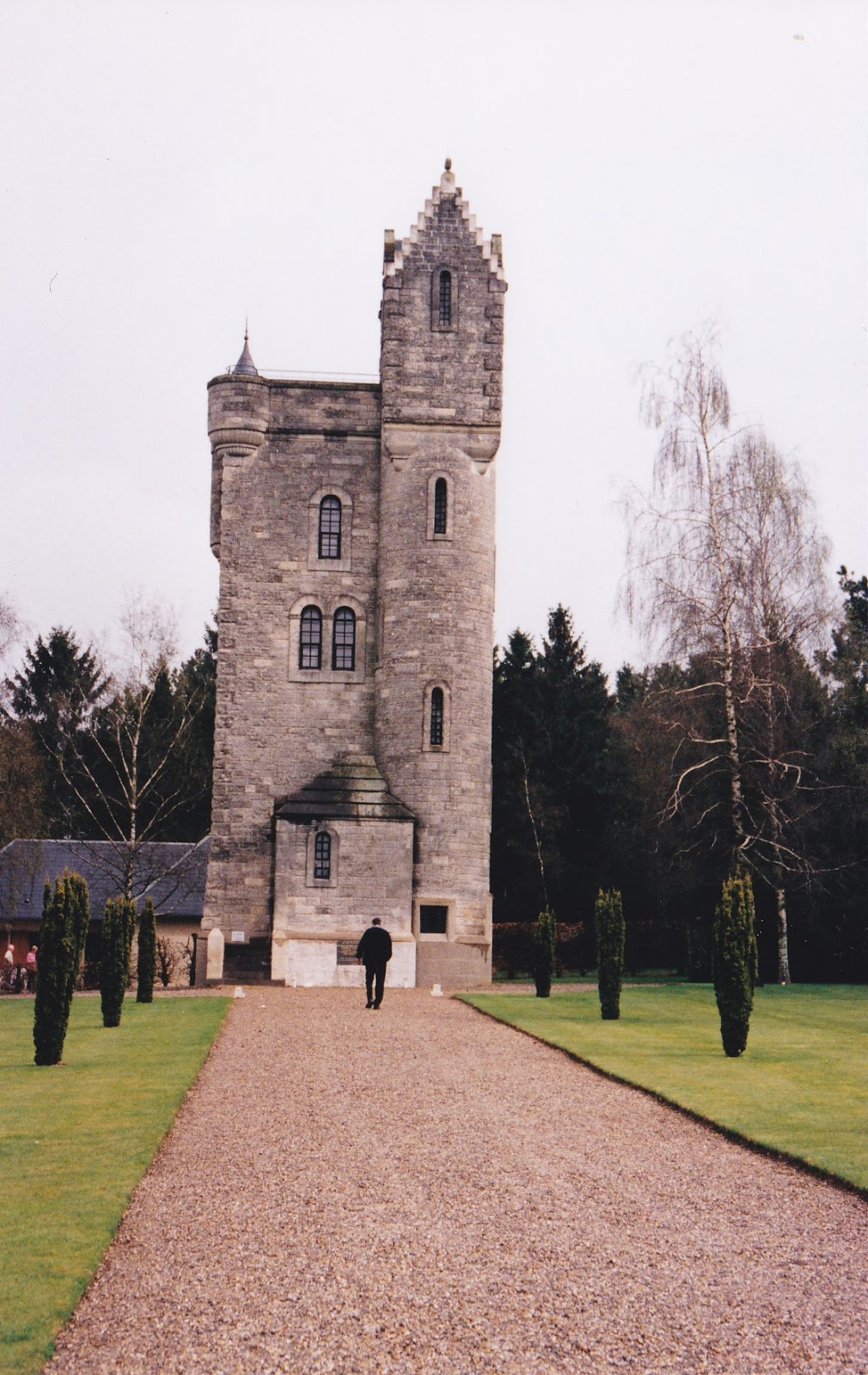
   A few miles to the south, near Thiepval, the 36th (Ulster) division fought an epic battle when some units fought their way through the German front-line trenches only to be cut off and slaughtered by a counterattack. The "Ulster Tower" now stands on the site as a memorial.
This happened just a few weeks after republicans in Dublin staged the Easter Rising in the hope of receiving German weapons and support, and Ulstermen have not forgotten it.
     More than thirty other battalions also suffered more than 500 casualties on July 1st 1916. Popular attitudes towards the war, the military high command and the governing elites at home changed irrevocably as a result.

(The folksinger Mike Harding has recorded a song, "The Accrington Pals", which can be found on youtube) 

Wednesday, 13 April 2016

Paedophilia: Several details you probably didn't know

In the ancient world and the middle ages, it was common amongst the nobility for very young boys and girls to be formally betrothed, and even married.
    The man who was to become King Henry VII of England was born when his mother (Margaret Beaufort, the daughter of the Duke of Somerset, through whom Henry derived his very sketchy claim to the throne) was certainly no older than 14. There is a famous scene in Shakespeare's "Richard III", where Richard successfully woos Anne Neville, having killed her husband, Edward, Prince of Wales. In fact, Anne would have been about 16 when she met Richard: she had married Edward when she was 14 and he was 17. (He was almost certainly killed in the battle of Tewkesbury, aged 18; not murdered by Richard). Although very little is known about Anne personally, there is no reason to believe that she resented being passed like a trophy between the houses of Lancaster and York. As a daughter of the mighty Earl of Warwick, "Warwick the Kingmaker", she would have known what was expected of girls of her class.
   When Henry VIII married his fifth wife, Katharine Howard, in 1540, he was 49 and in poor health, and she was probably no older than 16 (her exact age is not known). She had previously been betrothed to Francis Dereham, and, it transpired, was not a virgin. She had even experienced sexual games with her music teacher when she was only 13. Her later flirtations with Dereham and with Thomas Culpepper led to all three being executed for treason in early 1542. She seems to have been a rather stupid girl, behaving so recklessly, but nowadays we would regard it as intolerable that someone so young should be placed under such pressure.

Before the Victorian period, there was no legal definition of the age of consent. It was generally assumed to be about 10 or 12, and Victorian London was reported as crawling with child prostitutes of both sexes. The campaigning journalist W. T. Stead drew the public's attention to the situation by a stunt in which he purchased a young girl from her mother and took the child with him to Paris; subsequently publicizing it in a series of sensational articles entitled "The Maiden Tribute of Modern Babylon". It seems that there was some knowing collusion from the girl's mother in the stunt, but it succeeded in attracting great attention. Shortly afterwards, the 1885 Criminal Law Amendment Act raised the age of consent to 16; and the radical M.P. Henry Labouchere inserted an amendment to make "gross indecency" between men a criminal offence. Up to this point, it was unclear whether such behaviour was illegal.

   In the USA the age of consent varied considerably between different states. When Jerry Lee Lewis, one of the great original rock-n-rollers, came to tour Britain in 1958,he brought with him his wife, who was said to be 15, but, it transpired, was really only 13. There was an outcry in the press and the tour was called off after a couple of concerts. 

   It was under the 1885 Act that Oscar Wilde was convicted, though since he was accused of indecency with teenage youths he would nowadays be branded a paedophile and would receive a much longer sentence and no sympathy from anyone. The same would apply to Sir Roger Casement; hanged as a traitor after the Easter Rising in Dublin, and now regarded as a patriotic hero and martyr in Ireland; but whose sexual proclivities were revealed in his diaries, which were deliberately leaked to the press before his trial.
   In any case, the word "paedophile" is misused by the media. It only means someone who likes, or is attracted to children; analogies being a bibliophile, who loves books, a philosopher, who loves knowledge, and a philatelist, who loves postage stamps. There is a different word, "pederast", for someone who has sex with children. As far as I know it was first used by the 17th century writer John Aubrey, where he applied it to Francis Bacon, the Lord Chancellor and philosopher (and according to some, the true author of Shakespeare's plays). Aubrey wrote the word in the original Greek, and called Bacon's harem of boys his "Ganymedes", after the beautiful boy beloved by the god Zeus - which, of course, is why one of the satellites of Jupiter bears this name.

   Is it too much to hope that a clear distinction between paedophiles and pederasts might be drawn by the media?