Showing posts with label Stories. Show all posts

Tuesday, 8 September 2020

Puss in Boots: A Fairy Tale Retold

The miller's youngest son set out to seek his fortune, accompanied only by his cat, Puss. After they had walked for several days, they noticed a royal cortege approaching, and Puss told the young man to undress and jump into a nearby river.
   Puss then ran up to the King's coach, calling, "Help! Help! My master, the Marquis of Carabas, was bathing in the river, and robbers have stolen his clothes!"
   The royal carriage stopped, and the King motioned to the young man to stand up in the water, which fortunately was deep enough to come up to his waist.
   "Goodness!" exclaimed the princess,who was accompanying her father, "What a handsome young man!"
   "That's as maybe", said the King, "But I don't think I've ever met the Marquis of Carabas. Do any of you know him?" he asked the courtiers. But it turned out that none of them had ever met such a person either.
   "I must say", mused the Lord Chamberlain, "He doesn't strike me as being a nobleman. Look at his hair! Look at his hands! Now then", he said to the young man, "Can you name any nobleman who will vouch for you?"
   But of course the miller's youngest son couldn't.
   "He doesn't talk like a Marquis either!" was the Lord Chamberlain's verdict. "And if he is a Marquis, why does he choose to bathe in this muddy river? Hasn't he any lakes or streams on his estates?"
   The King considered. "Now look here, my man", he pronounced eventually, "I've no idea who you are. We'll give you some clothes to make you decent, then you'd better be on your way. If you really are the Marquis of Carabas, then I apologise, but you surely understand we can't be too careful with strangers in these dangerous times".
   So the Lord Chamberlain gave the miller's youngest son a set of clothes and a few coins, and warned him not to come near the King again. 
   "The cat, however, is a different matter", said the King. "Just fancy: a cat that talks! Would you like him as a pet, my dear?" he asked the princess.
   "Oh, yes please daddy!" she exclaimed.
   So the miller's youngest son walked disconsolately away, but Puss was taken to the palace, where he lived happily ever after.

Saturday, 11 January 2020

The salutary tale of Ed Punch

Despite his impeccably middle-class background, Edwin was always fascinated by organized crime and the activities of gangster leaders. This led to his hanging around in the bars and clubs of Soho, hoping to be noticed by the Kray twins and their associates, who at this time were enjoying the heyday of their power in the district. This made him feel superior to his less adventurous friends.
   For a long time he was simply ignored, but one evening a thief who was being pursued by the police thrust a piece of jewellery into his hand with the words, “Hold that for me, mate!” Quite probably he had mistaken Edwin for someone else in the gloom. The police arrived shortly afterwards and questioned everyone on the premises, but Edwin, with his respectable appearance and accent, was allowed to leave without being searched.
   He felt immensely proud of his coolness under pressure. A few days later he was approached by two threatening-looking men in dark suits who hustled him into a car and demanded that he handed over the stolen item to them. For a wild moment he considered answering them with snarling defiance, but common sense prevailed. Managing to show no trace of the gnawing fear he felt inside, Edwin answered them respectfully and politely, complied with their wishes without protest, and indicated that he was willing to undertake any similar work in the future. Feeling, probably correctly, that his real name of Edwin Prosserly, was nowhere near hard enough for a would-be gangster, he told them that he was called Ed Punch. His self-regard increased greatly in consequence.
   Before long he was approached again. Edwin sensed that he was being tested, with increasingly important tasks. He was asked to dispose of a pistol, which he duly chucked into the Thames near Windsor early one Sunday morning. Was it, he wondered with a thrill of vicarious danger, a murder weapon? For this task he was rewarded with a considerable amount of money in old banknotes. He decided to devote himself to this new, exciting and potentially lucrative life; and he dropped out of college.
   He rented a flat in Old Compton Street, where shortly afterwards he was required to play host to Tony, a young man he had never met before. Edwin felt very uneasy in Tony’s presence, and took great care not to annoy him, for the young man showed every sign of being a psychopath. He was most relieved when after a couple of weeks Tony disappeared and was not seen again.
    Other tasks followed over subsequent months. He drove getaway cars and later disposed of them, he kept account-books for semi-literate criminals, and occasionally vacated his flat when it was required for other purposes by persons unknown. He was well paid for his work, but the tension was beginning to take its toll. He could sense that, although the mobsters occasionally found him useful, he wasn’t really one of them and never would be: he was just a middle-class kid who thought it was cool to hang around with gangsters, and that they might cast him off or betray him at any moment, without a second thought. And did he really want to spend the rest of his life in company with men like Tony?
     Then one day the police conducted a swoop and arrested the entire gang. They were all interrogated separately, on a charge of involvement in a murder. It should surprise no-one that Edwin was the first to crack and turn Queen’s Evidence in return for immunity from prosecution.


    He is believed to be living in South Africa under an assumed name.  It is safe to assume that he never admits to ever having been called Ed Punch.  .
.
.

Saturday, 6 July 2019

The Unquiet Grave

The new vicar had organised a working party to bring some order to the long-neglected churchyard, and we began the daunting task of hacking our way through the brambles and the ground-ivy. In one particularly dank and overgrown corner we uncovered some broken chunks of granite, pinkish in colour, that must once have surrounded a grave. But the only one nearby was still mostly bare earth, which the surrounding weeds had only just begun to colonise.
   "Well, isn't that odd!" said Philip, our vicar. He turned to our oldest member, who had lived in the village all her life, and asked, "Do you know anything about this, Polly?"
   Polly considered. "I remember that when I was a little girl my grandmother said I must never go down to this corner of the churchyard", she said. "She didn't tell me why; but I learnt from other people that it had something to do with the lady who used to own the pub, ages ago. Perhaps she was buried here".
   "The pub? You mean the empty place at the edge of the village? Nobody lives there now: it's been vacant for ages".
   "Yes. The Queen's had been plenty of different owners over the years, but none have stayed long. Some have died, and the rest have just moved away, without saying why".
   "But it can't be anything to do with her", someone argued. "Because this grave is clearly very recent. Look at that bare earth."
   "Unless, of course, it's been deliberately disturbed!" someone else contributed, clearly with the intention of introducing a frisson of fear.
   "Well, it's all a mystery", said Philip, "We'd better just continue with our work for now. Then before our next meeting we can ask around and see what we can find out. I'll have a look in the parish records".  

On the way home I asked Polly, "The Queen is a rather odd name for a pub, surely? Shouldn't it be the Queen's Head, or something like that?"
   "Yes, it is odd. Various landlords over the years tried to change the name, but something always went wrong. They put up a new inn sign, and it got blown down: that sort of thing".
   "There's certainly no sign there now!"
   "No. Granny said there was once a sign there, and a very nasty one it was. The face on it looked nothing like any queen she'd ever heard of: really ugly, and quite frightening. Children used to dare each other to throw stones at it, she said; but somehow they never quite had the nerve, and their parents used to warn them not even to think about doing it!"
   "And what became of the lady who ran it?"
   "I never found out. Granny wouldn't tell me. I think there were odd stories going around the village, but I never found anything out".  

I must have been thinking too much about Polly's story, because that night I experienced a frightening dream. I was standing in the churchyard, beside the grave, which however was now covered with its granite.  But something stirred beneath, and suddenly, to my inutterable horror, the stones rose up, cracked and fell away. The earth below was heaving, as if a giant mole was about to throw up its hill. But what emerged was not a mole. I watched, unable to move, as a dark figure clawed itself out from under the soil and rise to its feet. It was stooped, and a little less than human size. I couldn't see its face, but somehow I knew it was a woman, and of a great age. I was terrified that she would turn and see me, but instead she gathered her ragged black clothing around herself and drifted, rather than walked, towards the village. At this point I awoke in a sweat of fear. It was still night-time outside. I did not dare open the curtains even when it was broad daylight, from an irrational terror that she might be there, peering into the room.

At the next meeting of our gardening group, Philip told us, "I've been thinking about that grave. The surrounds are all broken, but I don't see how you could break granite in pieces without a heavy sledgehammer, and these have been snapped as if they were rotten twigs or biscuits. It's very strange. Oh, and I found something unusual in the archives. One of my predecessors was asked to conduct an exorcism! It came from the landlord at the pub. He said a ghost had been peering through his windows and frightening his children".
   "And did he exorcise the ghost?"
   "No: he rather pooh-poohed the idea; he thought it was all silly superstition. Soon afterwards the landlord put the pub up for sale and left the village".
   At this stage I thought I'd tell them about my dream.
  "Aye, that's what would have happened!" said Polly. "Granny said that the lady would come back, to see who'd taken her pub. Maybe she was just being curious, but I don't like to think of what might happen if she ever got in!"
  "Oh, and one other thing", said Philip. "I had a dream rather like yours. Then, the next day, looking round the church, I discovered that a small amount of the communiion wine had been left in the chalice. I've no idea how this happened: it's most irregular. I wondered what to do. Then, on an impulse that I can't properly explain, I went and sprinkled it on that grave. Looking back, I know it was very silly; and you must promise you won't tell the archdeacon, please! I wonder what will happen now?"

We all wondered. The answer was, and still is, absolutely nothing. We try to avoid that corner of the churchyard, but the last time I looked, the grave had not been disturbed any further, and weeds had continued to colonise it. Whether Philip's unorthodox behaviour had had this effect, I cannot say. But the pub is still unoccupied and up for sale. I doubt if anyone familiar with the village will be buying it.

Monday, 4 March 2019

The last man to discover an alien life-form

Magro looked across the greensward. It always reminded him of home, and it was hard to remember that this wasn't Earth, that the plants beneath his feet weren't grass, and that the trees in the distance were wholly foreign.  Amongst the trees stood one of the enigmatic buildings with which the expedition had become familiar: a cylinder of silvery metal, somewhat higher than a man, capped with a dome, without any visible windows or doors. None of the humanoid beings who inhabited this planet was currently in sight.
   As well as feeling nostalgic, Magro felt depressed. They had been on this planet for almost a hundred of its days, and yet they had discovered nothing useful at all; about how its climate might change with the seasons, about its ecology and geology, about its wildlife (if any), and least of all about its inhabitants. After endless tests, the air was finally recognised as breathable and the crew had been able to remove their helmets. But the water from the streams and the fruit on the trees were still out of bounds: they contained no obvious poisons, but there were chemicals which it was feared might cause stomach disorders. Then there were the inhabitants ......
   The crew had met them soon after landing, but were yet to make any meaningful contact with them. Someone had christened them the "Noids", for they looked distinctly humanoid. They were about the same height as humans, and they were entirely hairless. It was impossible to distinguish betweeen men and women, and there were never any children on view. They all dressed alike, in a simple shift reaching to the feet, so they gave the impression of gliding as they moved. They had ever been heard talking to each other.
   Infuriatingly, they showed no interest in making contact with their visitors. They ignored the spaceship entirely, and when they encountered the crew they bowed slightly and then moved on. They appeared to walk around randomly, in ones and twos, never in groups. They were never heard to utter a sound, and were never seen eating or drinking. Whatever did these strange people do? Magro wondered, for perhaps the hundredth time.
   Azarin, one of the crew, came running towards him. "I've just discovered something!" he called, gabbling in his excitement. "I saw one of the Noids entering a cylinder!"
   "Go on!"
   "Yes! He walked up to it, and suddenly a door opened and in he went! And I looked, but I couldn't see any sign of a door at all! So I sat outside for ages, waiting for him to emerge, but he never did. What do you think's going on?"
   "How can I say? For all we know, it could just be a lavatory! They aren't very big, those cylinders: no room for more than two or three people inside."
   "No. Unless, of course, they contain steps going down underground".
   At this point Telemar, the commander of the mission, who must have been listening to the conversation after approaching unobserved, intervened to say, "Has it occurred to you that all this has been set up for our benefit? A scenario very close to life on earth has been specially created here; only they haven't got it quite right.
   "Consider: the air is breatheable, but contains too many rare gases. The water has trace elements that make it unsafe to drink. These plants under our feet look like grass, but they aren't. The fruit on the trees could be eaten, but the chances are that you'd be spending a long time on the toilet afterwards. Then again: there aren't any animals or birds. There aren't even any insects! I haven't seen an insect. Have you? And as for the Noids... have you never suspected that they might be robots? They aren't the slightest bit interested in our spaceship. Can you imagine chimpanzees, or even cattle, completely ignoring a strange new object that suddenly appeared in their territory?
   "So: whoever might be in charge of this planet: how are they doing this? and even more importatly, why?" 
   "We could try forcing some truth out of them!" Azarin said.
   "How?"
   "Well, we could kidnap one of the Noids. We wouldn't hurt him: just take his clothes off, perhaps, and see what he'd got underneath. Anyway: make him communicate. Or we could blast our way into one of the cylinders. Or perhaps ignore the Noids entirely, set up the heavy digging equipment, and see if there's anything useful to be had here".
   Telemar shook his head. "No; for a variety of reasons. Firstly, because, as you well know, we're strictly forbidden to use violence towards indigenous inhabitants unless we're in serious danger. Which at the moment, we're not; though we might be if we followed your suggestions. Whoever set up this ridiculous planet for us must be extremely intelligent; extremely powerful. Who knows what might follow if we started to get aggressive? Intergalactic war maybe?"
   "Well,have you any bright ideas?" Magro asked.
   "None at all. And in any case, we'll be leaving this planet soon enough."
   "Leaving? whatever for? are we running out of food, or what?"
   "Yes, but there's more to it than that. You don't understand the politics of it. Voyages like this are fantastically expensive. It was made clear that this was our last shot, and if we didn't discover something really profitable, that would be it. Even the food for the trip was cut back, to save money, so we can't stay here much longer even if we wanted to. And what's happened? We've discovered a planet that makes no sense, inhabited by creatures (if they are really creatures!) which make even less sense. So we'll go home having achieved precisely nothing. And that will be that. Goodbye to any further explorations". 
 Magro looked across the grass that wasn't grass, through the trees that weren't trees. The spaceship stood there, shining and silent and redundant.


Sunday, 16 December 2018

Department Store Christmas

It wasn't long till closing time, but Martin was so sunk in boredom and lethargy that he couldn't even summon up sufficient energy to loook forward o the weekend. Nothing was happening; absolutely nothing. When he'd first taken up the job in the Bathroom Accessories department of BSDM (formerly the Kingdom department store, since taken over by a conglomerate) he'd put it down as something temporary; useful work-experience; but all he'd learnt to date was that he'd rather sweep the streets, or even live on the streets, than spend any longer in such an institution. More than once he'd considered simply walking out, but had rejected that as very boring and unoriginal. What he really wanted was to be sacked: not for some petty misdeed, but for something specatacular and original (but of course non-criminal; he didn't want his future prospects too blighted); something that would cause his name to be remembered for ever; to live on in legend amongst all the grey, tedious people of  BSDM. But what? He had no idea. His mind wandered round aimlessly.
    Then Muriel, his typically grey and tedious departmental head, shuffled up to him and addressed  him in her usual irritating whiney voice.
   "Oh, Michael!" she said, getting his name wrong as usual, "I wonder if I could ask the most enormous favour of you? I've got a dreadful migraine and I'm going to have to go home early. The thing is, after we close there's a meeting for the heads of department. Please say you'll go and stand in for me: there's no-one else to do it. I'm afraid you'll find it terribly dull, but someone's got to be there. Please say yes!"
   Nothing like filling me with enthusiasm, thought Martin. But before he could think of an excuse not to be there, Muriel continued, ""You'll be meeeting the new boss, Mr Armitage. He's only been CEO for a few weeks. He's a very interesting man, but a word of warning! You must never call him anything but 'Chief''; that's what he expects. Got it? And don't ever disagree with him in public; he can't stand that!"
   Martin brightened up a bit. That could be something: a man sacked for standing up to the boss, telling him he was talking rubbish and offending protocol by addressing him by his name: people would remember that! Perhaps the unions might get involved, and call a strike over unfair dismissal! Perhaps it would make the papers! So, rather against his better judgement, he agreed to go along.

He arrived at the committee room in good time. The only person he recognised was Derek, the cynical head of Books and Stationery, whosr department was on the same floor as Bathroom Accessories. Martin explained about Muriel's migraine.

   "Well well, who'd have thought it?" Derek responded. "Muriel having to go home with a migraine just before the weekend! You astonish me! I wonder whether she'll be fully recovered come Monday morning? Don't bet on it! Now, did Muriel tell you anything useful about this meeting?"
   "She said it might be boring. And I was to call Mr Armitage 'Chief' and never contradict him".
   "Both correct! You've never met our beloved fuhrer, have you? Well, he says he likes to be on first-name terms with everybody, and welcomes free discussion, but that's only to make him sound trendy and democratic. So he may call you Martin, but you must never under any circumstances call him Reggie: he hates the name!"
   Across the table a fat, balding red-faced man was holding forth loudly.
  "Roger, from Shoes", said Derek. "A foot-fetishist, naturally, but a gay foot fetishist .... My advice would be, avoid all contact. Unless you like that sort of thing, of course. It looks like he's downed a few! He despises our Reggie: he really does!"
   The people around the table rose to their feet. The Chief was arriving! Martin looked at him closely: a short man with piercing blue eyes which swept rapidly round the room. Behind him there walked a youngish lady with black hair and a surprisingly short skirt.
   "Jane, from Cosmetics", whispered Derek. "Everyone's bet to be the next Number Two. Selected on bra size. Now,she'll agree with everything Armitage says, and with a bit of luck Roger will disagree with everything. This could be rather more fun than I expected!"
   Mr Armitage took his seat at the head of the table, and said, in a strange nasal voice, "I see we've got a new face among us. Stand up and intoduce yourself, laddie. It's first names here, we're all friends, don't be shy!"
   What a revoltingly condescending way of talking, thought Martin. But he explained about Muriel's absence and how he was there to represent Bathroom Accessories. "My name's Martin, Chief", he concluded, and sat down inwardly seething. He'd chickened out! He hadn't intended to say "Chief"! He'd have to do better than that if he wanted to be remembered!

The early parts of the meeting were deadly dull. Martin knew absolutely nothing about the isues under discussion, and had nothing to contribute. He tried not to doodle too obviously on the paper in front of him, though at times this was all that was keeping him awake. Then eventually Mr Armitage announced, "Next item: the Christmas display. Now I don't need to remind you that it's a big thing in this town: all the big stores compete to have the best display with a Christmas theme; it brings a lot of kudos and it's good publicity. So this year let's really go for it with somethingtruly original. Any bright ideas tostart us off?"

   "A Victorian Christmas?" said someone.
   "Been done! Many times! Boring!"
   "American Christmas?"
   "Scandinavian Christmas?"
   "Come on, guys! This is pathetic! If that's all we can think of, we might as well go completely over the top and have an Australian Christmas!"
   No doubt this was meant sarcastically, but Roger pretended to take it seriously, and began to discourse to no-one in particular about how puzzled archaeologists of the distant future would be to discover evidence that Australians had celebrated a midsummer festival by featuring an old man dressed in furs, riding a sleigh drawn by animals not native to that country. However, Jane, perhaps alerted by an impatient look on her boss's face, cut Roger short by saying, "I think that's a great idea, Chief! Santa at a barbecue on the beach! That would be different!"
  Martin's brain suddenly started whizzing. He remembered how someone had once told him that, when confronted with a silly idea, the best counter was not to contradict it but to extend it to its logical conclusion, so everyone could see how absurd it was. At this point his surrealist imagination took over.
   "I think it's a great idea too!" he announced, "There's such a lot we can do with it! A barbie on the beach, yes! And Santa come arrive from the sea on a surfboard! Wearing a red wetsuit! Surrounded by dolphins and sharks! All smiley, and with little red and white hats! And what about his helpers? Koalas, perhaps? Or if it's a night-time scene, we don't want reindeer! How about kangaroos?"
   He was on his feet by this time, making expansive gestures, and could have carried on longer, getting more and more outrageous, but Mr Armitage said quietly, "That's fine, Martin: don't get too carried away! We'll all give it some serious thought before the next meeting; okay?"
   The remainder of the meeting contained little of interest, and as they were filing out, Mr Armitage said, "Oh, Martin, a word with you, please!"
   Now I'm for it! thought Martin. But at least I've done something they'll remember, and I can leave this dump!
   Mr Armitage took him by the elbow as they walked off down the corridor. "Now, Martin", he said, "I like a kid with some guts and enthusiasm, who has ideas and isn't afraid to say what he thinks. Have you ever thought of putting in for a job up at headquarters? We could do with some new blood and fresh thinking. Bear it in mind. Don't let me forget, Jane!"
    "Thank you very much, Chief!" said Martin..

Friday, 2 November 2018

Emily

Emily sprinkled the chocolate shards on her breakfast cappuchino and wondered what picture the random blotches would conjure up in her mind today. But she had no time to waste daydreaming, so she took a quick snap of it with her mobile and then slurped it down before hurrying off to work. Later on, she could observe it at leisure, or even discuss it with her friends to see what they made of it.
Sometimes it was a fish, and once it was a rodeo rider whirling a lariat, but most often it was a dog. Emily loved dogs. Yes, this one was a dog: a short-legged, flop-eared little mutt, standing on its hind legs and looking straight at her. A dachshund or terrier of some kind; how cute!
Examining the photo again before she went to bed, Emily noticed that the dog appeared to be wearing glasses, and carried a bag or basket in its left paw. So, a cartoon dog. Perhaps the pictures she’d seen on previous days had been cartoon creatures too. Now that was an idea: stories about cartoon animals and people that came to life on a cup of cappuchino! She could become a famous children’s author! Emily thought that she might have the imagination to write a story, but doubted whether she would have the time or the energy. She enjoyed her job, which was an important and responsible one, and well remunerated, but it could be very exhausting, and often she felt completely drained when she came home. This was one of those evenings. As she sat slumped in her chair, she wondered what was in the dog’s bag, and the answer came into her head, “Cocaine”. Now that would make it something very different, she mused: a cartoon for adults, dark and probably violent …..
In bed, waiting to go to sleep, she wondered; Why did cocaine suddenly occur to her then? Was it something to do with that colleague at work, a senior director, no less, whom they suspected of being a user? And didn’t he once hint to her that she might like to visit him and try some? But Emily didn’t want to go there, and she had avoided the issue by pretending that she hadn’t understood the hint.
She was still picturing the little dog with the mysterious basket when she fell asleep.      

Saturday, 26 August 2017

Stories: Under the hill, over the hill

"Look, you might think me very old-fashioned, but I always understood there were certain formalities to be gone through on these occasions. You should tell me your name and then boldly challenge me to come forth and defend my hoard: not try to sneak in like you’ve just done. So what is your name? Tristan? Oh, SIR Tristan! I do apologise: no offence intended. And my name? Well, men once called me Chrysophylax: Chrysophylax the Golden, whose wings beshadowed the sun. Rather poetic, don’t you think? If a touch overblown. My real name, of course, couldn’t possibly be pronounced in your language, so I won’t even try. And while we’re on the subject, Sir Tristram: that sword you’re swinging about; does it have a name too? No? not even something crude and vulgar, like “Skullsplitter”? Sad. In my younger days, the warriors who came to challenge me all had swords with names; and some were supposed to have ancient lineage, made by the dwarves or whatever, or were even said to be magical. Absolute tosh, of course; but still quite romantic. Ah well; times change.
   "Now, if we want to do this properly, you should challenge me to fight. Denounce me as a thief and murderer, and tell me you’re going to kill me and take away my ill-gotten gains. But I must point out that, although the accusation is by and large true, I haven’t actually done any plundering and slaughtering for a great many years. It was all a very long time ago; and in any event, I don’t see why it gives you any right to take my treasure for yourself. Or you could be more up-to-date, and talk about the serious deflationary effects of keeping all this gold locked away out of circulation, and how international liquidity would be greatly improved by releasing it onto world markets ….. What? You’ve never even heard of economics, or monetary theory? No, clearly not. Forget it; it’s my fault. I just presumed things out there must be more advanced than they actually are. Heigh-ho.
   "Moving on from there: may I ask, Sir Tristan, why you decided to come? Because dragon-fighting is a game for young warriors, or at least it was. Teenage heroes: many of whom, frankly, were just kids with more guts than sense. Don’t say they’re letting the oldies in on it nowadays: that would NOT be a great idea! I’m no expert in humans, I admit; but it’s obvious you’re not exactly in the first flush of youth. Take the way you swung that sword at me when you came in; quite an effort, wasn’t it? I can tell you’re not as fast as you once were. Shoulders getting stiff, are they? Bit of the old back trouble? Knees start to hurt if you stay en garde too long? And maybe the mailcoat feels rather tight around the waist, but getting a bigger one would be too much of an admission? So what made you come here, and try to get your hands on my treasure? Do you need the money? Or are you trying to recapture the glories of your youth: prove to yourself you can still do it? Or perhaps a bit of both? That’s my suspicion anyway.Now don’t get offended; I quite understand; because I’m getting old too. I’m not sure quite how old, but it must be hundreds of your years, if not thousands. But the notion that dragons are immortal is mythical. We age, just like everyone else, though it takes much longer. Look at me: I haven’t been outside this cave for I don’t know how long. I’m amazed anyone even remembered I was here. And these wings, which once beshadowed the sun; I don’t know whether they’d fly at all now. Not so much golden as rusty these days! Hah!
   "So there you have it: we’re both of us past our best, aren’t we? All washed up. Headed for the scrap-heap. Here we both are, together in my lair under the hill, but at the same time we’re over the hill! That’s a nice ironic little paradox for you, isn’t it?
   "I’m not going to fight you, Sir Tristan. Maybe I’d beat you, maybe you’d beat me; but either way, it’d be an embarrassment. Two old cronks bashing away at each other till they both run out of breath or one of them drops dead with a heart attack! Not good! So I’ve got a better suggestion for you.This treasure, now. It took a lot of looting, burning and general rapine to accumulate it all, and I won’t pretend I didn’t enjoy doing it: in fact it was tremendously enjoyable. But, as I told you, that was all over long ago, and nowadays I don’t seem to do anything except lie here and count it. And I can tell you for a fact, hunting down and collecting something is much more fun than spending years just owning it: it’s not the same thing at all. Sometimes I do wonder why I bother to keep it all, and do you know, I really can’t think of an answer? When you look back on life, you realise that you had set yourself various goals, and some of them you had achieved, only perhaps they weren’t quite as exciting as you expected, and the rest you realise you’ll never achieve now. So what I’m proposing to you is this: instead of fighting for my gold, why don’t you just take as much of it as you can carry, and go home? You can tell people you’ve killed me, for all I care. They’ll probably believe you, and I doubt very much whether anyone will actually come up here to check. If you want, you could make the story more exciting by saying I put a dying curse on the treasure, or something like that. And who knows, when you’re really old, you might come to believe yourself that you once actually killed a dragon. And if everyone, including you, believes it happened, then it’s just as good as if it really did happen, isn’t it?
   "So go ahead; take what you want: I won't stop you".

………………………………...................................

Some time later, the dragon awoke from a doze and thought to himself, Really, that all got pretty tedious, didn’t it? I sometimes wonder what the world’s coming to, when I have to explain the most obvious things, practically spell them out word for word, not just to children but even to adults. I think that as I get older, I don’t get more patient and tolerant, but less! But then he thought, No, it’s not fair to blame poor old Tristan; it’s not really his fault he was so ignorant: it’s just that no-one ever bothered to teach him anything.
   In any case, he may have been a bit over the hill, but he still tasted quite nice!
 

Monday, 29 August 2016

Revenge

Everybody called him Sasha: he was never sure whether he had any other name. He could never remember a time when he had not been hungry or afraid. His earliest memories, which still resurfaced in his dreams, were of fighting: men shooting, buildings burning and bodies in the streets. He could barely picture his parents, who had both disappeared around that time. When the fighting had finished he was brought up by a woman who said she was his aunt, though she treated him more like a servant: setting him to chop firewood or shovel away snow, never giving him enough to eat and beating him if he complained. Eventually he ran away, and lived for a while by begging and stealing until he was big enough to get a job at Mr. Fenstein’s factory. He earned little there, for after years of malnutrition he was not strong enough for heavy tasks. His workmates jeered at him for his weakness and also because he could hardly read or write, and girls looked scornfully at his ragged clothes.
Then there was more fighting, and soldiers occupied the town. They spoke a strange language, but Sasha learned to pick it up; and when they found he was always willing to help them in return for food, they laughed and said he was a lad with promise. After a while they took him away for training.
The training was tough, and many of the duties very unpleasant, but Sasha never complained. Why should he? The barracks were far more comfortable than the doss-house which had been his home, and the food and clothing were the best he had ever enjoyed. For the first time in his life he was able to get washed and shaved properly, and have a decent haircut. Finally, when the training was completed, he was ordered to report to the railway station for transfer to his place of assignment.
As he dressed in his brand new uniform and looked at himself in the mirror, Sasha for the first time in his life felt a sense of pride. Now at last he had status: he was somebody! He walked through the streets and noticed that people who had once treated him with contempt now regarded him with wariness, even fear; and stepped off the pavement to make way for him. It made him want to smile, but he thought it best to keep his expression stern and hard. Now he was showing them! Now he could get his own back! And if Mr. Fenstein or anyone else failed to show him proper respect, he’d quickly demonstrate to them who was the boss now!
Sasha reached the station, where a train was drawn up. Much of it consisted of cattle trucks, but not for him! Oh no! He’d be travelling in a proper carriage with his new comrades, the other men of his unit!
It would probably be a long journey, because the destination painted on the train was somewhere he’d never heard of: Auschwitz.     

Wednesday, 25 May 2016

The Master of the Angels

(This story is based on a dream I had. It appears to be set in Italy in the early days of the Renaissance)

When Lorenzo di Prato heard the rumour that his only daughter considered herself betrothed to the young painter Tancredi, he was not pleased. He considered it entirely unfitting that he, a respected and prosperous cloth-merchant, should have his family linked by common gossip to a struggling and penniless artist. This was not the future he envisaged for his child. So when he confronted Gianetta and she could not deny her friendship with the young man,he had the girl shut away in a convent till she should come to her senses.

Tancredi was saddened, and also felt insulted. Admittedly he was as yet unknown, but he was sure his prospects were good. Had he not been comissioned to work on the altarpiece for the new church? It would depict the Assumption of the Virgin Mary, and he was to paint one of the side-panels. He was certain this would establish his reputation as an artist, and quickly lead to fame and wealth. But also he truly loved Gianetta, and now he missed her greatly. As the days and weeks passed withou her, he became more and more depressed. He began to neglect his work; which increasingly he became aware was dull and uninspired, yet he was unable to do anything to improve it. He took to hanging around the gates of the convent for hours at a time, hoping for a sight of his beloved; but the walls were high and windowless, and no man could enter without permission.

Gianetta was also lonely and unhappy. To ease her grief, she took to praying in quiet places away from the nuns. Especially she liked to climb to the top of the campanile, where there was a small platform: the only place in the convent from which it was possible to catch a glimpse of the city outside. Here she would pray fervently for help and deliverance. And here one day her prayers were answered, as two winged Beings descended in majesty from the skies and took her hands, and then in an overwhelming miracle glittering wings grew from her own shoulders, and together the three of them rose beyond the prosaic earth and soared upwards into the cloudless blue.

The only person who saw them was Tancredi, from his lonely vigil outside the convent gates. As soon as they had risen beyond his sight he rushed back to the church and seized his brushes, and he painted his panel before the vision could fade from his memory. It showed three angels in brilliant colours. It was much the best part of the altarpiece, and its fame spread far and wide, so that his reputation was established and he was known ever afterwards as the Master of the Angels. But he never married Gianetta, for the poor girl was now incurably insane and was never again able to leave the security of the convent. Most of the time she was quiet, but occasionally she would escape the vigilance of the nuns, and then she would climb the tower of the campanile and would be found on the platform at the top, wildly invoking the heavens whilst uncontrolled tears filled her eyes.

"Fly!" she would call, "Oh, fly! Please, fly!"

Saturday, 26 September 2015

The Wizard and the Sword

Udlotwyn was seated outside his cottage in the warm sunshine when he sensed coming towards him up the hill a sword with a man. When they were within sight he knew that his fears were justified.
    The man proved to be a youth; probably not more than about seventeen. He rode a good horse, but rode it clumsily, suggesting it did not belong to him: probably he had stolen it somewhere. But it was the sword he wore that worried Udlotwyn, for the sword was a demon.
   In past aeons, there had been many demons in the world, but now there were few: it was many years since Udlotwyn had seen one. They had come from Outside, he had been told, and the mighty wizards of past ages had striven to trap and imprison them, to preserve the world from the chaos and destruction they brought. He guessed that this one had been imprisoned in a sword ("Not a wise thing to choose!" he thought), and then buried deep in the earth for safety. Perhaps this youth had turned it up with his plough, and now he imagined he was possessed of a mighty weapon; but in fact the sword was possessing him. It would urge him on to deeds of violence, telling him that he could become a mighty hero, but in fact it would drain him dry, and when he was no more than an empty husk it would discard him and find a new bearer. In the meantime, he,Udlotwyn, would have to be very careful, for the demon in the sword would doubtless seek to kill him. Demons always hated wizards.
     Udlotwyn put forth his powers, out of practice though he was. Ignoring the youth, who would be under the sway of the sword, he concentrated on the most vulnerable target: the horse. By the time it reached the cottage,the horse was convinced it had gone lame in its right fore hoof and was limping badly.
   "Ho, wizard!" called the youth, brandishing his sword, "Bring me out your treasure, or I shall kill you now,rather than later, and slowly, rather than quickly!"
   That's the demon talking, thought Udlotwyn: how else would he know I'm a wizard? But the demand for treasure shows that the youth still has a mind of his own, otherwise he would have killed me immediately instead of wanting treasure. If I proceed carefully I may yet escape with my life.
    "Greetings, Sir Knight!" he said, "My treasure you are welcome to take, for what would an old man like me want with treasure? But it is hidden, and many spells are needed to unlock it,which will take time. But I see you horse is lame: you will not be able to ride far with him unless I cure him. I have food inside, and good water in my well. Pray you: stay a while in my humble cottage while I release the treasure".
   The youth dismounted, and being unaccustomed to riding, he had to return the sword to its scabbard in order to descend. Immediately the demon's hold over him was reduced, and Udlotwyn had little difficulty in persuading him that he was both hungry and thirsty. When the youth had come inside the cottage and was seated at the table, Udlotwyn placed before him not just bread, but the choicest wines and sweetmeats such as might be set before a monarch. Udlotwyn could sense the sword screaming Do not trust him! it's a trick!, but the youth's greed was now in full control of his mind, and it was not long before he had fallen into a deep drugged slumber.
    Udlotwyn unbuckled the youth's sword-belt and, taking care not to touch the sword with his hand, carried it to the back room and locked it in. He then returned to the sleeping youth and caused him to walk, all unawares, out of the cottage and mount his horse, where Udlotwyn secured him to the saddle. The animal was now recovered from its imaginary lameness, and he gave it a slap and commanded it to walk on. When the youth awoke,he would have forgotten everything that had passed. Udlotwyn hoped that the owner of the horse would not punish him: without the sword he seemed to be a harmless enough young man. Udlotwyn then returned to his cottage, sat down and wondered what to do next.
       Once, long ago, he reflected, the world was full of magic; but over the centuries it has all seeped away, and soon there will be none left. It is many years now since I met a wizard: maybe I am the last one. And this sword, perhaps, is the last demon remaining at large. But with no more wizards, who will be able to control even this single solitary demon? I must now watch over it, for as long as there is life in me.
     He entered the back room and with great reluctance drew the sword from its scabbard. Instantly he perceived the power of the demon as it spoke in his mind. Take me, master! it said. Together, none can resist our strength! Together we shall rule the world! But Udlotwyn knew it was only a deception. The demon in the sword would use him to spread death and destruction, and eventually, though it might take many years, in the end it would drain him dry and abandon him. But what could he do? It was said that in the past there had been mighty wizards who could expel demons, back to the Outside from whence they came. But I do not have that power, he thought: nor is there anyone remaining who could instruct me.
     He could still feel the sword tempting him with visions of power and glory, but although there was turmoil in his mind,he managed to resist, and decided on a plan. I must keep the sword here, he thought:  and then I must stay here to guard it; if necessary till the end of my life. But I must also place it somewhere even I will be unable to retrieve it, for I do not know whether I shall always be able to resist its temptations.
    He took the sword from its scabbard. Immediately it resumed speaking to him, promising wealth and glory. He felt his mind tottering as he walked across the back garden to the well. The sword guessed his intent. No, master, no! it shrieked, do no reject this chance! You can rule the world! You can restore the glorious days of magic! It took the last vestiges of Udlotwyn's will to take the cover off the well and drop the sword down. He heard it splash into the water far below. He the picked up several large stone and dropped them down until he was sure the sword was buried. He was utterly exhausted as he replaced the cover.
   He could still hear the voice of the sword, but it was now distant and faint. Maybe it would be best, he thought, to have a new well dug, in a different part of the garden. I shall say that the water from the old well is bad. As the men dig out a new well, I shall use the earth to fill in the old one. I had better do that part of the work myself, lest they should hear the sword and be tempted to look for it.
    He settled down to start his vigil. He would be there a long time.

Monday, 2 March 2015

The labours of Hercules in Shropshire

Many thousands of years ago, when half of Britain was covered in ice, the River Severn flowed north, into the Dee estuary. But then, when the ice retreated, the god Zeus spoke to Hercules and said, “It is my desire that the Severn should now flow southwards. Take your club and beat out a new channel for the river”.
Hercules took his club and began his labour at the northern end of the new river-bed. But the god of the northern marshes, fearing that his wetlands would be drained, sent out his reed-girls to distract Hercules. And the reed-girls said, “Stop your work, Hercules, and come with us, and we will show you pleasures beyond imagining!” But Hercules answered, “Go away! Come back when I’ve finished!” and he continued with his work. But he was thinking so much about the beauty of the reed-girls that he beat out his channel shallower than he intended, so some of the wetlands survive to this day.
As Hercules worked further southwards, the river god, annoyed that he had not been consulted, sent river-nymphs to distract Hercules. The river-nymphs danced round Hercules and sang, “Stop your work, Hercules, and come with us, and we will show you pleasures beyond imagining!” But Hercules answered, “Go away! Come back when I’ve finished!” But he was so confused by the nymphs dancing in circles around him that he lost all sense of direction, and the course of the river-bed he was beating out, through where Shrewsbury now stands, instead of being a straight line, now ran in great loops and meanders.
Hercules now reached a line of hills and began to beat a passage through them. But the god of the hills, foreseeing that men would come and cut down his trees to fire their furnaces, and blacken his rocks with their smoke, sent woodland dryads to distract Hercules. The dryads sang, “Leave your work, Hercules, and come with us, and we will show you pleasures beyond imagining!” But Hercules answered, “Go away! Comeback when I’ve finished!” But he was so eager to sample the pleasures that the dryads had promised that he stopped he work early, so that the Ironbridge Gorge was narrower than intended, and it remains a place of fierce and dangerous waters to this day.
At last Hercules finished his labours, and the Severn now flowed southwards in a new path. And Hercules went and sat down to rest in the Quarry gardens, and he called out, “Ho! Reed-girls and water-nymphs and tree-dryads! I’m finished at last! Where are the pleasures beyond imagining that you promised me?” But there was no answer, for they had all gone away. And Hercules smashed his club on the ground in frustration, causing a great pit which is now the Dingle gardens. But eventually he fell asleep, exhausted by his labours.
The god of the River Severn saw him asleep and thought, “Now I’ll have my revenge! Reject the pleasures offered by my water-nymphs, did he? Not to mention the reed-girls and dryads too! I’ll cast a spell on him so that he’ll never be able to enjoy such pleasures again!” And he cast the spell, but Hercules did not realize it till he awoke.

Men came and erected a statue of Hercules, which you can still see in the Quarry today. This angered the river-god, and he was angrier still when he realized that, thanks to the labours of Hercules, he now faced a very long and weary route to the sea. His anger continues to this day; and every few years he sends down a flood, which often fills the Quarry garden and surrounds the statue of Hercules, but he has never yet managed to topple it. And if you go to the Quarry, you can still see Hercules, naked, with his lion-skin and mighty club and his gigantic muscles – but if you look closely you will notice that, thanks to the river-god’s curse, the only clothing he is obliged to wear is an improbably tiny fig-leaf.

Tuesday, 25 November 2014

In a Strange Land

Cerdic and Zar walked on through the jungle, marveling at the peculiar vegetation. The gravity was much the same as on Earth, but the space-suits, which regulations obliged them always to wear on unexplored planets, were cumbersome and hampered their movements. There were paths leading in various directions, and they wondered who, or what, had made them. But that could come later. Their task for now concerned Vallon, who had disappeared the day before, leaving nothing except his helmet. They had been sent out to find him, or, failing that, to discover what misfortune had befallen him.

Zar paused to look at a huge, brilliant red, trumpet-shaped flower on a bush alongside the path. An insect-like creature the size of a humming-bird flew in, searching for nectar. It feasted for a brief moment, but then the trumpet closed in on it and trapped it. The bush also folded in on itself, the better to enjoy its meal undisturbed.
   "Ugh!" said Cerdic, "Like a Venus fly-trap, but much bigger! This planet is a dangerous place!"
   "I wonder what attracted it?" said Zar. "Was it the colour, or the scent, or what?"
   "No way of telling, as far as the scent's concerned," said Cerdic, "We can't take our helmets off to investigate."
   "Why not? All the instruments say the air here's quite clean: plenty of oxygen. I'd love to breathe proper air again, after all those months on the ship!"
   "Vallon must have taken his helmet off, and look what happened to him!"
   "We don't know that anything happened to him! He just hasn't come back; that's all. He may be walking around here somewhere, enjoying the flowers!"
   "Then why's his radio not working? Why hasn't he been in contact, if only to reassure us that he's all right?"
   "Has it occurred to you that perhaps he doesn't want to come back? Now that after all that time cooped up on the ship, he was free again? He wanted to enjoy it as long as he could. Now maybe he'll turn up again, safe and sound!"

They came to the place where Vallon's helmet had been found. "No sign of any violence anywhere here", said Cerdic, "And no damage to the helmet. It looks like he just took it off, dropped it and walked on"
   "It's like I said, then", replied Zar. "I'm willing to bet he's still alive and unharmed, looking at the scenery, probably not far from here. Let's keep walking, but keep our eyes open. By the way, I wonder who made these paths?"
   "That's what I'm wondering too", said Cerdic.

After a while they came across a space-suit lying on the track. It could only have belonged to Vallon. But of the man himself there was no sign.
   "He obviously found it an encumbrance", said Zar, "So he dropped it and went on without it. I can see his point: these things are really awkward in full gravity".
  "I don't like it at all!" protested Cerdic. "Haven't you noticed something really strange? To get out of your space-suit, you have to take it to pieces, but this one's fully assembled. Now, why would he take it apart, get out of it, and then go to all the trouble of putting it back together again? It's almost as if he'd been sucked out of it somehow. We'd better scout around a bit more, and then take it back to the ship for proper analysis if we still don't find him".

Before they had gone much further, Cerdic stopped and muttered, "Now isn't that odd!" Zar, when he looked, was just as surprised, for what stood before them was a large apple tree, complete with very appetising-looking fruit.
   "What on earth is that doing here?" exclaimed Zar.
   "It's not on earth, that's the problem! So far we haven't seen a single plant that looks anything like our vegetation, and now we find this! Can you explain it?"
   "No."
   "There's only one possibility I can think of, and it's very worrying. It's as if something here has been observing us, penetrating into our minds, discovering what we want, and then creating this tree just for us ..... Hey, what are you doing? Stop it!"
   He shouted this because Zar had started to remove his helmet.
   "It's forbidden!" Cerdic shouted.
   "I don't care!" Zar replied. He took a deep breath. "Ah, the air's beautiful! So good to breathe properly again! Now let's have a look at those apples. I haven't tasted fresh fruit since we set out!"
   "It's a trap!"
   "Why are you so suspicious? Look; quite possibly something here is reading our minds, but why shouldn't it be friendly? I'm prepared to trust it, anyway. Now, let's try these apples ..... hmm, they smell all right ..... taste all right too! Delicious, in fact! Why don't you try one?"
   "I'm reporting you when we get back! You're disobeying the most basic instructions! You shouldn't be let out at all!"
   "I've had enough of you! Look, man; don't you realize? We've found a Garden of Eden here! Vallon saw that. Perhaps he won't come back at all now. I can see his point. I'm off! You might see me again; or then again, you might not. Goodbye!"
   Zar ran away through the bushes. Cerdic tried to follow, but, handicapped by his cumbersome helmet, soon lost sight of him.

Zar trotted on, headed for he knew not where, breathing in the pure, clean air, rejoicing in the vegetation and insects around him. Already he had almost forgotten about Vallon, and Cerdic and the ship. There were no more of the fly-trap plants to be seen. Although he was on an alien planet, the plants and flowers seemed in an odd way familiar, reminding him of the countryside of his childhood on Earth. The buzzing insects were brilliantly coloured. He was certain the planet was happy, and friendly. But then it came into his mind; if this was indeed Eden, and maybe he was Adam, then there was something missing. Where was his Eve? If the planet could indeed read his mind, it would sense what he needed. She must surely be here somewhere! Then he saw her.

She was reclining amidst the vegetation, in what resembled a deck-chair, though it was probably a gigantic flower. She was very beautiful: the first beautiful woman he had seen since he boarded the ship all those months ago. She belonged to him.
   Zar dropped his helmet and climbed up onto the chair-like flower, and laid down beside her. He kissed her. Her arms wrapped round him in tight embrace and her mouth clamped immovably onto his. And then the flower folded around them and the enzymes from her mouth entered his body, dissolving the tissues until every bone had been liquefied, and sucking them all out until the empty spacesuit could be discarded, as Vallon's had been.

Thursday, 18 September 2014

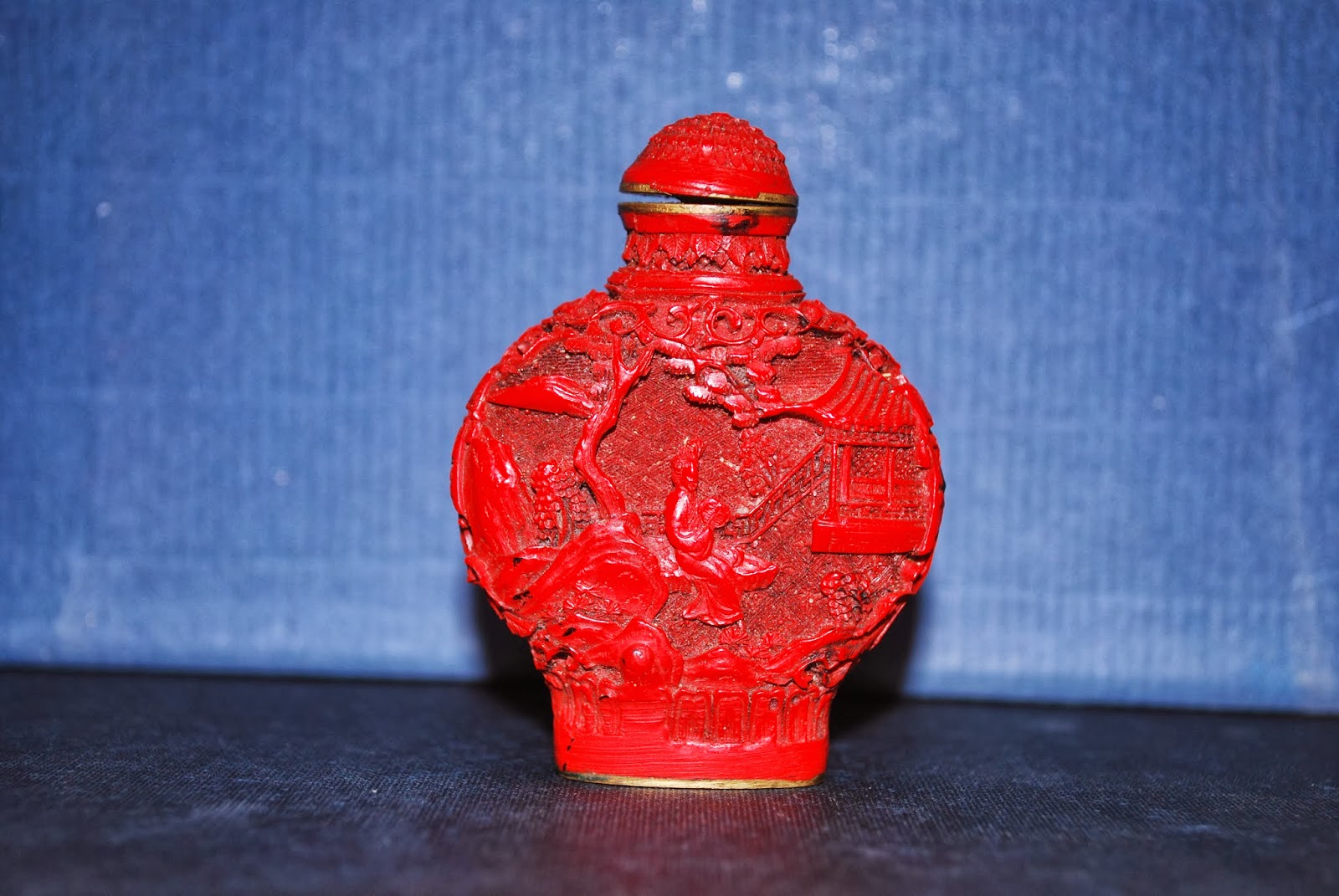
A Snuff Bottle


George read through the advertisements in the local paper.
     “For sale: several Chinese works of art: soapstone carvings, ink painting of bamboo, blah, blah, amber snuff bottle ….. Hmm, now that might be worth investigating!”
     He had yet to find a really good amber snuff-bottle to add to his collection. Of course, the chances were that this was just some rubbishy modern piece; but even so, it would be silly to let the chance slip away. He dialled the telephone number given on the advert. A woman’s voice answered. He gave his name, and then, in order not too sound too eager, asked about some of the other items first, and only came to the snuff bottle as if was an afterthought.
     The woman gave him a brief description of the object. “It's about two inches high, with a carving of a dragon on it. There's some Chinese writing on the bottom, but of course I can't read it. It's a beautiful golden colour, and it's got a stopper with a little spoon for the snuff", she told him. "I really can’t say how old it is; I’m not an expert at all! You see, I’ve inherited all these things from my aunt, and I need to dispose of them as quickly as I can, because I live abroad. Why don’t you come and have a look at it? And if you think it’s any good, you can have it for ….. what shall we say? ….. fifty pounds? Fine! How about next Tuesday? Three o’clock?  Now, how to get here: do you know Foxton? Well, go out from there on the Brackenford road, and after a couple of miles you’ll see a turning on your left, just opposite the bus stop. Go down there, and after a few hundred yards there’s a big holly hedge on the left and a sign saying Bluebell Cottage. That’s where I am. Park your car in the drive. If no-one answers the bell, it probably means I’m in the back garden, so come and look for me. See you then!”
     After he had put the phone down, it suddenly occurred to George that he might have heard the woman’s voice before, but he couldn’t  quite recall the circumstances.

     As he drove out on Tuesday, George reflected on his possible good luck. The description of the snuff bottle had genuinely excited him: it had sounded exactly like the real business! He wondered how he might turn the situation even more to his advantage. Should he, for instance, regretfully inform the woman that her snuff bottle was a modern fake, but, rather than make the visit fruitless, he would take it off her hands for thirty pounds? or perhaps only twenty?
    He found Bluebell Cottage without difficulty. It was the only building down a narrow country lane. As predicted, a ring of the front door bell brought no response, and he wandered round into the secluded back garden. This also seemed deserted.
     “Hello, George!” came a voice from behind him. He spun round.
     “You!” was all he could manage to say.
     “Yes, George, it’s me! It’s been a long time, hasn’t it? I rented this cottage specially to meet you again, and here you are. I remembered how you used to collect snuff bottles, and I just had to pray you hadn’t given up the hobby. I hope you appreciate the research I put in, to make sure I could describe one that you’d want! So here we are together again, after all those years. It’ll be just like old times. Well; not quite like old times….”
     And she drew a small pistol from her pocket.

Monday, 30 January 2012

Visions

In his dreams he saw many strange and wonderful things, and when he woke he tried to turn his visions into poems, though he found that most escaped his memory soon afterwards. But as time progressed, and the drug increased its hold, his visions brought darkness amidst the beauty. He saw a pavilion, set in marvellous gardens above a river, but he knew it was doomed to destruction. He saw himself on a mountain peak near his friend’s home in the Lake District, and listened to the music of the bells ringing in the valleys below, but the songs the bells sang were songs of death. He saw a young bride entering the castle of her elderly widower husband, and she was very lovely, but her stepdaughter saw in her face the yellow unblinking eyes of a serpent. All these things he was tried to record, which helped to relieve his pain. Each time his apprehension increased, but he could not abandon his search now.

After a while, waking and dreaming seemed to merge, and he was left unsure which was which. Sometimes when he walked through the streets at night, plagued by the insomnia resulting from the opium, he thought he had found the wondrous city that he had so long sought, only it was no longer marvellous, but sinister and haunted. Evil lurked around every corner, watching him from a distance, just out of his sight, and the people he met (but could not speak to, nor did they speak to him) were not noble heroes and ravishing beauties, but ghosts, who wore the masks of death. He realised he was being punished for his temerity. His awareness of guilt deepened, until he came to feel he had committed a crime so monstrous, so horrible, that even he could not be told what it was. I have blasphemed against the gods, he thought: no, it is far worse than that: my crime somehow threatens the very basis of the universe; and my punishment will be like none that has ever existed before.

He only knew of one way which might allow him to escape from these horrors: he must set them out in a poem, which would tell of a man who is guilty of a terrible crime and justly suffers an equally terrible punishment, but is eventually redeemed by his suffering and pardoned. Such an ending would provide him with at least some hope of release. But what precise crime would the man in his poem have committed, since he could not know it himself? He consulted his closest friend; also a poet, but more down-to-earth in his ideas. And William pondered for a while, and then said, “I was reading the other day about a sailor who was marooned on a desert island by his shipmates, who were disgusted by the fact that he had shot an albatross. It appears that sailors regard this as a very wicked act, and also an extremely unlucky one”.
"Thank you, William", said Samuel, "I shall write the poem, and I shall call it 'The Ancient Mariner'"

................................................

Readers will have noticed in this references to Thomas de Quincey's "Confessions of an English Opium Eater" (1822) as well as to Coleridge. What put me in mind of it was not 'The Ancient Mariner' or "Kubla Khan", but 'Christabel", a less-well-known Coleridge poem (where we also meet the stepmother with the eyes of a serpent). These are the opening verses of the second part of that poem:-

"Each matin bell, the Baron saith,
Knells us back to a world of death.
These word Sir Leoline first said
When he rose, and found his lady dead.
These words Sir Leoline will say
Many a morn to his dying day.

So hence the custom and law began
That still at dawn the sacristan
Who duly pulls the heavy bell
Five and forty beads must tell
Between each stroke; a dying knell
Which not a soul can choose but hear
From Bratha Head to Windermere.

Said Bracy the bard; so let it knell!
And let the drowsy sacristan
Still count as slowly as he can!
There is no lack of such, I ween,
As well fill up the space between.
In Langdale Pike, and Witch's Lair,
And Dungeon-ghyll so foully rent,
With ropes of rock and bells of air
Three sinful sextons' ghosts are pent
Who oft give back, one after t'other,
The death-note to their living brother;
And oft too, by their knell offended,
Just as their one! two! three! is ended,
The devil mocks the doleful tale
With a merry peal from Borrowdale".

From the topographical references, Coleridge would seem to be listening to the bells from somewhere around Ambleside, at the head of Lake Widermere; probably in the hills above Wordsworth's Dove Cottage. But despite the charming nature of the scenery, he has given us what I regard as the most sinsiter lines of poetry in the English language: the only cheerful note is attributed to the devil. This is why I have speculated as to what might have prompted his visions.

Wednesday, 27 July 2011

Conversation

"The most frightening experience I ever had", said Nigel, "was when I was a student, living in lodgings in a scruffy part of town. I woke up in the middle of the night and found a man sitting on the end of my bed. It was too dark to see clearly, but it looked like he had a knife. He asked me, "Where's the drugs, then?" I was terrified"
"Did you think he was a burglar or a policeman?" asked Martin. "Because if you thought it was the police, you should have demanded to see his search-warrant".
"I don't know what I thought. I was trembling all over and I couldn't even think straight, let alone talk coherently".
Martin said, "If I was sure it was a burglar, I'd have said the drugs were hidden in the kitchen, and I've have taken him there. Then I'd have grabbed the big kitchen knife, and I've had said, "I'm a trained fencer, so now I've got the advantage over you!", though I suppose that legally I should have told him to clear out rather than just go for him".
"It's all very well for you to talk! You weren't there! I bet you'd have been every bit as scared as I was! In the end he went away, but by that time I was a gibbering wreck! I couldn't sleep the rest of that night, and I couldn't face staying in those lodgings any longer. I went and dossed down with a friend until I found somewhere else to live. I still have nightmares about it".
"So this intruder: he didn't find the drugs, then?" But Martin hardly bothered to listen to Nigel's reply. He was running through in his own mind how he would have seen off the intruder, or, if the man did after all prove to be a policeman, the sensation he would create in court with his brilliant orations in his own defence.

Saturday, 2 July 2011

Making Contact

Michael gazed idly through the window of the train as it dawdled its way across the Welsh countryside in the drizzle and deepening gloom of an October afternoon. Until he arrived at his destination there was nothing he could do, but his mind was too preoccupied to settle to read a book. This was his very first mission: to locate his contact and deliver the message he had been given, which was “It’s snowing in Venice”. What might that mean? Nobody had seen fit to tell him, and he suspected he wasn’t supposed to enquire. He didn’t even have a proper address for the contact, or a physical description: only that his name was Jones and that he lived in a certain Welsh village whose name Michael was by no means sure of pronouncing even remotely correctly, since it consisted largely of Ws and double Ls. Nor had he been given any idea of what was supposed to follow once his message had been delivered.
It had occurred to Michael that this might well turn out to be not a real assignment at all, but some kind of trial to test out his reliability and usefulness. Quite likely he was supposed to display initiative in first of all locating the contact and then in following any instructions he might be given in return - perhaps another message? perhaps a package to deliver, or some other task to fulfil? Or perhaps above all he was supposed to use his judgement as to whether the contact was a man to be trusted? Maybe even now assessors were lurking and watching, to report on how he performed? - in which case the mysterious Jones was doubtless one of the assessors.
For as long as he could remember, Michael had known this was the career he wanted. As a small boy he had been fascinated by disguises and codes and invisible writing. His school friends had noticed, and had given him nicknames like “James Blonde” and “006 ½, licensed to hurt”, and he had learnt from this not to reveal his ambition to become a spy - at least, not until he met someone who might be useful in his ambition, and even then only by making cryptic hints rather than stating it openly. To this end he had worked hard to pass his exams and had assiduously sought to make the best contacts. And it had worked: eventually he had been interviewed and presumably secretly vetted. And here he was.
The train finally arrived. It was now quite dark outside. A few lights shone in the village behind the little station. No-one else left the train. The only person about was the man at the ticket window. Michael approached him.
“I wonder if you could help me: I’m looking for Mr Jones”.
“Ooh, there’s plenty of us called Jones here! There’s Jones the milk, and there’s Jones the gas and there’s Jones the bread; and me, I’m Jones the train!”
This, thought Michael, is clearly a test I‘ve been set. I shall need to show persistence and thoroughness, and at the same time be very discreet in my enquiries, so as not to raise suspicion. I’d better start here.
“I’m sorry I can’t be more precise”, he said, “The fact is, I didn’t expect to be here at all. I was supposed to be going to Italy, but it was cancelled at the last minute. The weather’s terrible there. They say it’s snowing in Venice!”
An expression of gradually dawning comprehension crept over the railwayman’s face. “Ooh, it’s Jones the spy you’ll be wanting! D’you know, you’re the third person who’s been asking for him this week?”
Somehow, Michael had not expected intelligence work to be like this.

Friday, 11 June 2010

Hands

If you’re a real Sherlock Holmes, you can learn a lot about people by looking closely at them. In the old days, of course, you could always tell miners by the coal-dust ingrained in their skin, and weavers had bad front teeth because of what they called “kissing the shuttle”. It even applies to some trades today: an antique dealer once joked that he could always spot his fellow-tradesmen by their baggy trousers, caused by kneeling down to take a closer look at the furniture. But hands are the main thing for clues. Manual workers’ hands look quite different. There’s a story from the Russian revolution that the Red Guard used to patrol around Petrograd stopping strangers and examining their hands. If a man had hard hands, he was a worker and they’d buy him a drink; but if he had soft hands it meant he was a bourgeois and they beat him up. But Lenin had to put a stop to this, because so many of the Bolshevik leaders had soft hands!

My wife once managed something on these lines. She was brought up on a farm, and when she told this to a chap we’d just met, he said he was a farmer too, on the Surrey-Sussex border; but after he’d gone she said to me, “Did you see his hands? He’s never milked a cow in his life!” He wasn’t THAT kind of farmer, you see; the sort who has to milk his own cattle. I thought Sherlock Holmes would have been proud of her.

Now where was I? Oh yes. I think you could apply this to a whole lot of different professions if you knew what you were doing. You could probably spot musicians, for instance, and even guess the instrument. The fingertips and nails for playing stringed instruments would be a dead give-away. And teachers would always have chalk underneath the fingernails of the hand they used to write on the blackboard, though I don’t expect this applies any more.

People who’ve played a lot of sport can also be distinctive. Yes, I’m trying to come to the point. Everyone knows that rugby forwards tend to have horrible cauliflower ears from all that time in the scrum. Olympic throwers will have overdeveloped muscles on one side of the body, and so will tennis players and fencers. And footballers have often had knee operations, though of course this isn’t easy to spot when they’re just walking around. As regards hands: I remember a reporter once telling the American gymnast Kurt Thomas that someone could probably stub out cigarettes on his palms and he wouldn’t feel a thing. Cricketers also have hands like old boots. Do you remember when Darren Gough was on “Strictly Come Dancing”? In one of the early rounds, a judge complained that he had big thick hands that looked inelegant. He must have felt like saying, well of course I’ve got big thick hands; I’m a fast bowler, what do you expect? It didn’t stop him winning in the end, though. And cricketers often have broken fingers: I’ve known one or two with fingers sticking out at ridiculous angles. And if you do a lot of bowling you develop calluses on the spinning fingers, and these can get ripped and be very painful.

I’m sorry it’s taken me so long to get to the point, officer. I know I’ve been waffling away,
but that’s because I’m just as upset as you are: I’m sure you’ll understand. As regards this particular person, I don’t think I’ve ever seen him before; in fact, I couldn’t tell him from Adam; though of course when the body’s got no head, you can’t be certain. But I’m prepared to bet that he was a slow-left-arm bowler.

Friday, 11 December 2009

Stories: Winterwood

Winterwood

Jinna scrambled over the stones of what had once been a wall and looked down the slope to the snow-covered wood below. Not a single print of any kind disturbed the whiteness, and only a gap like a low archway through the trees showed her where the path ran. The light was lowering and gloomy beneath the leaden sky and the prospect filled her with deep uneasiness. But she patted her coat and felt the slight bulge from the inner pocket. There it lay, the great jewel. She must carry it safely through the wood to the other side, and whatever her fears she could not turn back now. Setting her face in determination, she half walked, half slithered downwards, and ducking under the laden branches, entered the Winterwood.

Inside it was very quiet. The trees were packed so densely that there was little snow underfoot, but the darkness was greater. She could trace where the path wound about, and there were dimples in it, as if feet had already passed that way: feet too small for humans, but making patterns unlike any animal Jinna had ever seen. She continued downhill until she reached the bottom of a valley, and saw there was a frozen stream that she must cross. She listened carefully for the sound of trickling water, which would mean thin ice that might break under her weight. If she got her feet wet, they would freeze. But there was no sound. Jinna realised that since she had eneterd the Winterwood, the silence had been broken only by the sound of her boots and her own breathing. Somehow this was more even more oppressive than any noises of living things moving around her. She sensed that here in the wood it was always winter, and nothing that she would recognise as a living creature ever came there. Fighting back her mounting fear, she crept across the ice and up the bank on the far side.

The path now climbed until she came to the summit of a low ridge where the trees opened out. There was nothing in the clearing except an immense log, the remains of some tree fallen long ago, looking like the body of a frozen dinosaur beneath its covering of snow. The light was better here, and Jinna paused for a rest. For reassurance she patted the lump in her coat, and then acting on sudden impulse reached into the pocket and pulled out the great jewel. She held it up, and even in this dimness it burned and sparkled with its internal radiance. Never had she seen anything so dazzlingly beautiful. She must save it, at all costs! But its glory only made her surroundings seem more threatening. The trees appeared to close in on her. She sensed that the Winterwood hated and feared the jewel; would smother its light if it could. Over to her left came a sound, and then another: the first she had heard since entering the wood. Maybe it was only the soft thump of snow falling from overburdened branches, but Jinna feared it might be ....... she knew not what, but something immeasurably threatening. She realised she had made a serious blunder. Quickly she returned the jewel to her pocket and pressed on.

The path twisted right, then left. Fear stalked behind her, and she walked faster and faster, panting with weariness and mounting anxiety, never daring to glance back. Then after an age, up ahead, amidst a thicket of smaller trees, she glimpsed another archway and knew that this was the end of the wood at last. With her escape in sight, panic finally overcame her. She ran. Through the archway she ran: branches clawed at her face and snow cascaded over her head and back, but she escaped, freed from the Winterwood for ever, out onto the grassland beyond.

For a while she simply stod there, panting with relief, and then once again she felt for the little bulge in her pocket. There was nothing. She tore open her coat and plunged her hand into the pocket. It was empty. In mounting desperation and terror she searched every pocket; every inch of her clothing, uselessly; once, twice, many times. Nothing. There could be no doubt: the jewel was gone.

Gradually she managed to subdue her terror, and steeled herself. She knew what she must do. Somewhere, somehow, she had dropped the jewel, and she must find it again. Trembling with fear and reluctance, she forced herself back to the archway between the trees and re-entered the Winterwood; retracing her steps, examining the snow on each side, stumbling with weariness and terror, tears frozen on her cheeks, until at last her strength gave out and she fell forward on the snow and she died.

But then the clouds rolled away and the snow melted. Flowers blossomed in the grass. Jinna felt warm sunlight on her face, and looked up in wonder to see birds playing on the budding branches. Then a Voice, so enormous that it filled the horizons but was at the same time gentle, spoke to her.
"You have done well", said the voice.
"But I failed", said Jinna. "I lost the jewel in the Winterwood".
"No. You were victorious. There never was a jewel. There never was a Winterwood. But you fought on till the very end. You have triumphed. We can now proceed to the next test".

Wednesday, 25 November 2009

Stories: "In the Gardens"

"In the Gardens"

I left the crowds milling around near the entrance, picnicking on the lawns or lying by the flowerbeds in the warm sun, and wandered off into the glades. After a while I came upon a long avenue of great chestnuts in bloom, all scarlet and white, and at the end stood the Crimson Pagoda. I walked towards it and saw it was very tall. But it was not what I had come to see.

There were fewer people in this part of the gardens, and they were mostly middle-aged or elderly. Some were walking about with a purposeful air, but most were sitting silent and alone on benches under the trees. I approached one greyheaded man, and when he showed no sign of acknowledging my presence, coughed discreetly to attract his attention.

"Excuse me", I ventured apologetically, "Could you tell me the way to the Queen's House, please?"

He glanced up. There was an annoyed expression on his aquiline face. "Over there through the trees", he said, making a vague gesture with his left hand, and then closed his eyes to indicate the interview was over. Somewhat daunted by this abrupt reception, I walked quickly away.

There was a path that seemed to run in the direction indicated, but it proved to be very serpentine and confusing. No-one had bothered to putup signposts in this part of the gardens. After a while I became convinced that the path was doubling back on itself, so I abandoned it and tried to cut across country. The grass was long and damp. Bluebells carpeted the shady places and there were snowy islands of cow-parsley. Huge clumps of holly and rhododendron loomed up to block a straight path. After I had wandered for some time I caught sight of the Crimson Pagoda, and realised I must have walked in a circle.

I felt hot and tired as well as irritated by my mistake, but I did not intend to be defeated so easily. A glance at my watch told me that it was only ten minutes past three, and I did not need to leave the gardens for quite some time yet.

I tried asking the way again, this time from an old lady with a stick, but her reply was not very helpful. Now my travels took me into untended thickets of willow, where I soon became hopelessly disorientated; then I found my way barred by dense hawthorn all strewn with may-flowers. There was still no sign of the Queen's House. I wished I had taken the trouble to map of the gardens before setting out. Soon the familiar outline of the Crimson pagoda came into view again.

I lost track of how many times I wandered around in these meaningless circles, and after a while I was no longer certain I could even find my way back to the entrance. My feet were burning and I badly needed a rest. There was a secluded wooden bench beneath a gigantic copper beech. The leaves cast dappled shadows and the air was very still. I saw down, stretched out my legs, turned my face skywards and closed my eyes. The Queen's House would just have to wait .......

I snapped awake suddenly and looked at my watch. It still said ten past three and had plainly stopped, but this caused me no great alarm. Even if I was completely lost, I would be rescued eventually. The park-keeper must surely come round and usher everyone out before locking up for the night. Meanwhile the day was still warm, and it was very pleasant just to sit and let the scents of spring waft over me. When I had rested I could resume my search, if I wished. What was so special about seeing the Queen's House anyway? No doubt it was worth a visit, but it would be empty: everyone knew it was many years since the Queen had lived there .....
The sun hung motionless in the sky and the warm afternoon lasted for ever .....

An unwelcome noise disturbed my reverie. It was a young fellow asking his way to the Queen's House. His face, his tone of voice, his whole manner irritated me. "Over there through the trees", I said, waving my arm at random. "You can't miss it" I was glad to be rid of him.