What I love about these little illustrations is that they show how mediaeval people believed that everyone in the past dressed and behaved just like they did. Indeed, it is possible to date the illustration by the clothes the warriors and nobles are wearing.
Here is David slaying Goliath and cutting off his head. It gives us a good idea of the equipment a knight of the 12th or 13th century would wear!
Here Delila is cutting off Samson's hair.
This is Noah's Arc. The dove is returning with a branch. The flood is receding, but many of the people in the water are clearly not dead yet!
From the Apocrypha: Judith has just murdered the tyrant Holofernes: a suitably bloodthirsty representation..
This depicts the murder of Julius Caesar.
This is the suicide of Nero. Without the caption underneath, we might well think it was King Saul.
A double suicide this time. Mark Antony stabs himself, whilst Cleopatra is bitten by not one, but two asps.
Finally, here is the Greek poetess Sappho reading her works to her friends.
We shouldn't laugh at the artists' ignorance of the past. We all know now that people in past centuries dressed differently from us, but one of the most difficult tasks of a historian is to explain how people in past centuries didn't necessarily think like us either: they often had wholly different priorities and ethical standards. Many historical novelists and makers of epic films fail lamentably in this respect!
Showing posts with label Art. Show all posts
Tuesday, 27 September 2016
Saturday, 1 March 2014
Evangelists
Saints are always portrayed in such a manner that we can easily recognise them. Some are shown with their instruments of martyrdom (Saint Catherine with her spiked wheel), and others with well-known attributes (Saint George in full armour). Pictures of the evangelists who wrote the four gospels, not surprisingly, show them writing; but they are also distinguished from each other by each being attended by his own particular animal.
Saint Mark's emblem is a lion
Saint Mark was also the patron saint of Venice, and the Venetian empire at its height left the sign of the winged lion throughout the Greek islands. ("They veil the plumed lions on the galleys of Saint Mark" - G. K. Chesterton: "Lepanto")
This one is from Corfu.
Saint Luke's emblem is a bull. But there is the unusual tradition about Saint Luke that he once painted a portrait of the Virgin Mary, so he is sometimes depicted doing that rather than writing his gospel. (How he was able to paint the young Mary and the infant Jesus from the life is not explained) In this picture it is only the bull in the bottom left-hand corner that tells us that the painter is meant to be Luke.
Luke's painting is said to be in a monastery in Cyprus. It is so sacred that it is kept covered, and only unveiled once a year.
Saint John has an eagle
and Saint Matthew has a man; though with his wings he could be mistaken for an angel.
We can add to these Saint Peter and Saint Paul, who are also easy to identify. Saint Peter has a bushy white beard and hair, and he always carries a pair of large keys. These are the keys of heaven and hell, given to him by Christ himself; which has been the foundation of the Papal claim to supremacy.
Saint Paul, by contrast, has a rather thin black beard and a bald forehead, often with a single lock of hair upon it. He often carries a sword as well as a book, referring to the tradition that he was beheaded during the persecution of Christians under the Emperor Nero.
I hope to describe more saints in a later post.
Saint Mark's emblem is a lion
Saint Mark was also the patron saint of Venice, and the Venetian empire at its height left the sign of the winged lion throughout the Greek islands. ("They veil the plumed lions on the galleys of Saint Mark" - G. K. Chesterton: "Lepanto")
This one is from Corfu.
Saint Luke's emblem is a bull. But there is the unusual tradition about Saint Luke that he once painted a portrait of the Virgin Mary, so he is sometimes depicted doing that rather than writing his gospel. (How he was able to paint the young Mary and the infant Jesus from the life is not explained) In this picture it is only the bull in the bottom left-hand corner that tells us that the painter is meant to be Luke.
Luke's painting is said to be in a monastery in Cyprus. It is so sacred that it is kept covered, and only unveiled once a year.
Saint John has an eagle
and Saint Matthew has a man; though with his wings he could be mistaken for an angel.
We can add to these Saint Peter and Saint Paul, who are also easy to identify. Saint Peter has a bushy white beard and hair, and he always carries a pair of large keys. These are the keys of heaven and hell, given to him by Christ himself; which has been the foundation of the Papal claim to supremacy.
Saint Paul, by contrast, has a rather thin black beard and a bald forehead, often with a single lock of hair upon it. He often carries a sword as well as a book, referring to the tradition that he was beheaded during the persecution of Christians under the Emperor Nero.
I hope to describe more saints in a later post.
Saturday, 15 December 2012
Nativity
Christmas is fast approaching. We are all familiar with the traditional Christmas story, but often do not realise how contradictory are the scriptural accounts of the birth of Jesus, and how much of the story is based on tradition alone.
The gospels of Mark and John make no mention of the nativity at all, and Luke and Matthew tell wholly different stories. Neither puts a date on the year of Jesus's birth, presumably because they did not consider this to be very important. Indeed, Matthew confuses things by bringing King Herod into his story, since by Roman chronology Herod died in 4 BC! Luke tells us that John the Baptist began his preaching "in the 15th year of the Emperor Tiberius" (AD 28-29), and that Jesus met him "when he was about 30 years old". The only point of agreement about the nativity is the Jesus was born in Bethlehem; which is in itself a little puzzling, since Jesus clearly began his ministry in Nazareth, by the Sea of Galilee, a long way to the north of Bethlehem. Matthew and Luke give completely incompatible genealogies for Jesus. They cannot even agree about the name of Joseph's father (Matthew gives it as Jacob; Luke as Heli) - which in any case seems a bit pointless, since both stress that Jesus was not Joseph's son anyway. Neither of them says at what time of the year the nativity took place: it is only a tradition that it was at the end of December; though it seems fitting that the God-child should be born just after the shortest day of the year: a time of renewed hope.

It is Luke's account which is the best-known. He begins his story with the miraculous birth of John the Baptist to Mary's elderly "kinswoman", Elizabeth. Then we have the Archangel Gabriel appearing to Mary; "the decree from Caesar Augustus that all the world should be taxed", "when Quirinius was governor of Syria" (which appears to refer to a census taken in 6 AD) causing Joseph and Mary to travel to Bethlehem; the lodging in the stable, and the adoration of the shepherds after they have seen the angel. After the nativity we have the circumcision of the baby Jesus in the Temple in Jerusalem, accompanied by various prophesies, and the return to Nazareth.
Matthew's story is quite different. There we have an angel appearing to Joseph, and there is no mention of a stable for the birth in Bethlehem. The most famous part of Matthew's story is the appearance of the "wise men" or "magi" before King Herod, enquiring about the Christ-child, since they "have seen his star in the east". Matthew nowhere calls them kings, nor does he even tell us how many they were: the notion that there must have been three of them is only a deduction from the fact that they presented the baby Jesus with the three symbolic gifts. There seems to be some confusion about the whole story of the star. Around 6 BC there was a major conjuction of the planets, which astrologers would have interpreted as predicting an event of major importance. (Some scholars have speculated that it might refer to the appearance of Halley's Comet in 12 BC). The New English Bible translates "magi" as "astrologers", which is appropriate. Herod, angry and alarmed, orders the slaughter of all children in Bethlehem (an action which, though lacking support from any other historical source, would have been quite in accordance with what is known of Herod's character!), but Joseph and Mary are forewarned in a dream and escape into Egypt. They do not return till Herod is dead, when they decide to settle in Nazareth, because it is safer. This appears to contradict Luke's story that they came from Nazareth in the first place, and does not tally with Luke's account of the circumcision in the Temple, which Matthew does not mention at all. (Neither, incidentally, makes any reference to the Holy Family travelling on a donkey, which forms such a touching scene on so many Christmas cards)
It is clear that we have here two completely different accounts of the nativity, which cannot be reconciled.
I have been told that, for a Jew, the notion that God could descend from the heavens to beget a child on a human mother would be horribly blasphemous. The Greek and Roman gods, by contrast, did this sort of thing all the time; which perhaps helps to explain why the early Christian missionaries met with great hostility from Jews, but were more successful in converting gentiles.
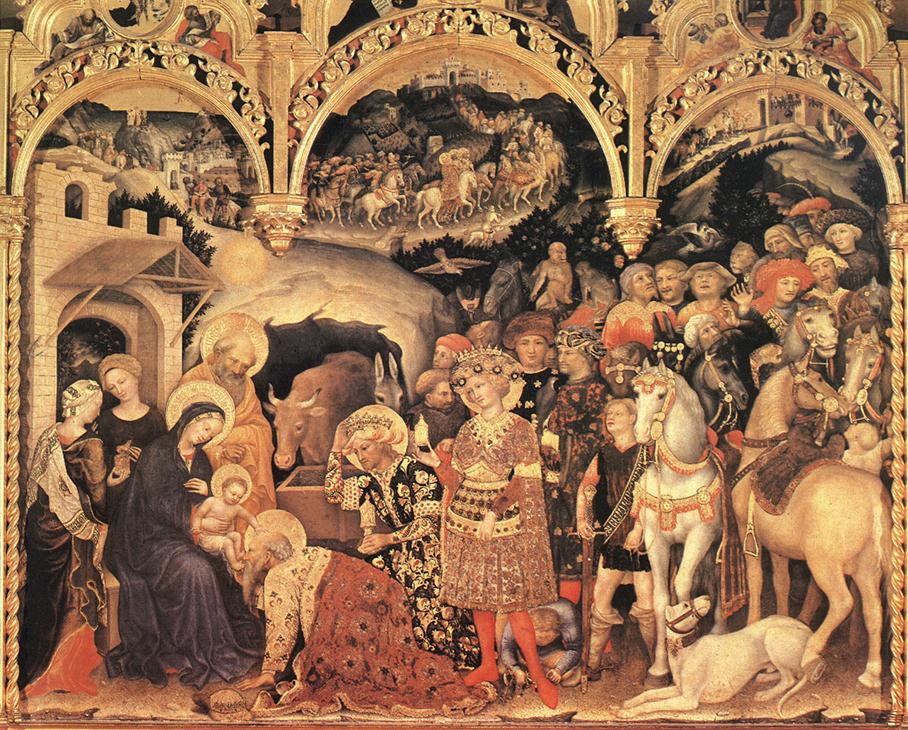
The Nativity has inspired great art over the centuries. The first picture here is by Piero della Francesca (c.1420-92), the second by Sandro Botticelli (1444-1510), the third by Andrea Mantegna (1431-1506), and the fourth by Gentile da Fabriano (1370-1407). All have certain features in common, quite apart from the rustic setting. The Virgin Mary wears her traditional colours; a blue cloak over a red dress; and Joseph is an old man; often rather detached from the scene. The baby Jesus, oddly enough, always appears to be several months old; certainly not a newly-born infant!
At a very much lower artistic level, illuminated Santa Claus figures are going up all over buildings even as I write, but I have yet to see any portrayal of the Christian Nativity at all. Perhaps this is as it should be: we are celebrating a consumerist festival called "Xmas", and for this Santa Claus is a suitable multi-faith symbol: perhaps the only supernatural figure that all children are encouraged to believe in. Every year around this time there are reports of teachers being officially censured for telling their little charges that he doesn't really exist! So Santa's red and white (the Coca-cola colours!) have rightly replaced the Virgin Mary's red and blue as the colours of the festive season.
Monday, 14 March 2011
Annunciation
The story from St Luke's gospel of the appearance of the Angel Gabriel before the Virgin Mary, to announce to her the forthcoming birth of Christ, was always a favourite subject for painters. Let's examine a few examples and see how common approaches to portraying this subject persisted over the years.
First, here is a mediaeval altarpiece, now in the Uffizi in Florence, by Simone Martini (c.1284-1344)

Next, a picture from the early Renaissance, by Fra Angelico (c.1400-1455), another Florentine,
Next, two works from the High Renaissance; the first by Sandro Botticelli (1446-1510),

and the second by Leonardo da Vinci (1452-1519)

Now a later work: an Annunciation in the Baroque style by Philippe de Champagne (1602-74)

Obviously these paintings become steadily more lifelike, and less formal and stylised, but at the same time they have a number of features in common.
The scene is usually set neither indoors nor outdoors, but in a kind of loggia or cloister. There is often garden visible somewhere. The setting appears rather opulent for a girl who is about to marry a carpenter! The visitation catches Mary by surprise: in many paintings she is seated and has just been reading a book. But what would she have been reading? It would be the prophecy in Isaiah: "Behold, a virgin shall conceive..."
Mary's colours are always the same: whatever the circumstances, she wears a red dress with a blue gown or cloak over it. Her head-covering is always white. (Sometimes in Flemish paintings her hair hangs loose, to show she is unmarried, but this is less common in Italian art). The reason for this uniformity of dress is exactly the same as why characters in modern cartoons always wear the same clothes: it is so people will recognise her!
The Archangel Gabriel usually enters from the left of the picture. He is fair-skinned, long-haired and beardless (Byzantine theologians considered angels were the equivalent of eunuchs!) and sprouts enormous bird-wings from his shoulder-blades. He wears an ankle-length gown. He is usually making a gesture of blessing towards Mary.
A few other features may also appear on the painting. Sometimes there is a single ray of light, almost like a laser, shining down from heaven onto Mary's head. There may be a white dove in flight above, symbolising the coming of the Holy Spirit. Often there is a white lily somewhere in the picture, to symbolise Mary's purity.
Here is the scene as a relief carving, from Fountains Abbey in Yorkshire

The earliest surviving pictures of the Annunciation are many centuries older than those shown here. Artistic styles may change, but the essential approach of artists to this subject has changed very little over the ages.
First, here is a mediaeval altarpiece, now in the Uffizi in Florence, by Simone Martini (c.1284-1344)

Next, a picture from the early Renaissance, by Fra Angelico (c.1400-1455), another Florentine,

Next, two works from the High Renaissance; the first by Sandro Botticelli (1446-1510),

and the second by Leonardo da Vinci (1452-1519)

Now a later work: an Annunciation in the Baroque style by Philippe de Champagne (1602-74)

Obviously these paintings become steadily more lifelike, and less formal and stylised, but at the same time they have a number of features in common.
The scene is usually set neither indoors nor outdoors, but in a kind of loggia or cloister. There is often garden visible somewhere. The setting appears rather opulent for a girl who is about to marry a carpenter! The visitation catches Mary by surprise: in many paintings she is seated and has just been reading a book. But what would she have been reading? It would be the prophecy in Isaiah: "Behold, a virgin shall conceive..."
Mary's colours are always the same: whatever the circumstances, she wears a red dress with a blue gown or cloak over it. Her head-covering is always white. (Sometimes in Flemish paintings her hair hangs loose, to show she is unmarried, but this is less common in Italian art). The reason for this uniformity of dress is exactly the same as why characters in modern cartoons always wear the same clothes: it is so people will recognise her!
The Archangel Gabriel usually enters from the left of the picture. He is fair-skinned, long-haired and beardless (Byzantine theologians considered angels were the equivalent of eunuchs!) and sprouts enormous bird-wings from his shoulder-blades. He wears an ankle-length gown. He is usually making a gesture of blessing towards Mary.
A few other features may also appear on the painting. Sometimes there is a single ray of light, almost like a laser, shining down from heaven onto Mary's head. There may be a white dove in flight above, symbolising the coming of the Holy Spirit. Often there is a white lily somewhere in the picture, to symbolise Mary's purity.
Here is the scene as a relief carving, from Fountains Abbey in Yorkshire

The earliest surviving pictures of the Annunciation are many centuries older than those shown here. Artistic styles may change, but the essential approach of artists to this subject has changed very little over the ages.
Friday, 25 February 2011
James Gillray
I would like to introduce Britain's greatest-ever political cartoonist, James Gillray (1756-1815). Here are three of his works:-

This one is dated June 1792, and is entitled "Sin, Death and the Devil", a reference to a scene in Milton's "Paradise Lost". It refers to a struggle for power between the Prime Minister, William Pitt the younger (on the left) and the Lord Chancellor, Lord Thurlow. Between the two is Queen Charlotte, wife of King George III. This must be the most revolting portrayal of a Queen of England ever!

This one, published in November 1798, consists of double caricatures of seven prominent leaders of the opposition Whig party. It was a constant theme of Gillray's that the Whigs were traitorous supporters of the French Revolution, and wished to bring revolution to Britain too. So here charles James Fox doubles as Satan, the playwright-politician Sheridan as Judas, the Duke of Norfolk (a notorious alchoholic) as Silenus; and, in the lower row, George Tierney as "the lowest spirit of hell", Sir Francis Burdett as "Sixteen-string Jack" (a famous highwayman), Lord Derby as a baboon (complete with the French Revolutionary "Cap of Liberty") and the Duke of Bedford as a Newmarket jockey. Gillray clearly had little to fear from the laws of libel! I consider this a particularly brilliant exercise in caricature.

Several of the above figures can be recognised in this cartoon of June 1804, depicting a social gathering of all the opponents of William Pitt's government. Fox and his wife are in the centre, Sheridan and Derby are present, and Norfolk, seated front left, can be identified by the drink in each hand! The notorious Duchess of Devonshire and her sister are immediately behind Fox. But the key figure is the man in the blue coat who is only half shown on the extreme right. This is George, Prince of Wales, later Prince Regent, whose hatred of his father, George III, led him to associate with the opposition. The fat lady on the sofa is the Prince's mistress, Mrs Fitzherbert, who bears on her fan the Prince's emblem of three ostrich feathers. Note also the symbolism of the pictures on the far wall: in the centre, Napoleon as Atlas holding up the world, on the left, George III in shadow, and on the right, a large picture entitled, "Worshippers of the Rising Sun". In point of fact, when George III finally became incurably insane in 1810, the Prince Regent deserted the Whigs and quickly proved to be even more reactionary than his father!

Finally here is a particularly famous one, from February 1805, entitled "The plumb-pudding in danger". Pitt and Napoleon are carving up the world: Napoleon grabs most of Europe, but Pitt, with Britain's superior naval power, takes the oceans.
These cartoons were not published in newspapers. Gillray worked by engraving, which meant that all this elaborate detail had to be scratched with a stylus in mirror- image on metal plates. Prints were then taken from these, coloured in by hand, and sold. At his peak, Gillray was able to produce several of these cartoons in a week; an amazing achievement. But such productivity took its toll, and he became blind and mentally deranged a few years before his death.
Many Gillrays come up for sale nowadays, and a large selection can be found on the internet. I was first introduced to Gillray by a fine biography by Draper Hill: "Mr Gillray the Caricaturist". Some years ago the Tate Gallery in London staged a major Gillray exhibition: it is possible that the magnificently-illustrated catalogue is still available.

This one is dated June 1792, and is entitled "Sin, Death and the Devil", a reference to a scene in Milton's "Paradise Lost". It refers to a struggle for power between the Prime Minister, William Pitt the younger (on the left) and the Lord Chancellor, Lord Thurlow. Between the two is Queen Charlotte, wife of King George III. This must be the most revolting portrayal of a Queen of England ever!

This one, published in November 1798, consists of double caricatures of seven prominent leaders of the opposition Whig party. It was a constant theme of Gillray's that the Whigs were traitorous supporters of the French Revolution, and wished to bring revolution to Britain too. So here charles James Fox doubles as Satan, the playwright-politician Sheridan as Judas, the Duke of Norfolk (a notorious alchoholic) as Silenus; and, in the lower row, George Tierney as "the lowest spirit of hell", Sir Francis Burdett as "Sixteen-string Jack" (a famous highwayman), Lord Derby as a baboon (complete with the French Revolutionary "Cap of Liberty") and the Duke of Bedford as a Newmarket jockey. Gillray clearly had little to fear from the laws of libel! I consider this a particularly brilliant exercise in caricature.

Several of the above figures can be recognised in this cartoon of June 1804, depicting a social gathering of all the opponents of William Pitt's government. Fox and his wife are in the centre, Sheridan and Derby are present, and Norfolk, seated front left, can be identified by the drink in each hand! The notorious Duchess of Devonshire and her sister are immediately behind Fox. But the key figure is the man in the blue coat who is only half shown on the extreme right. This is George, Prince of Wales, later Prince Regent, whose hatred of his father, George III, led him to associate with the opposition. The fat lady on the sofa is the Prince's mistress, Mrs Fitzherbert, who bears on her fan the Prince's emblem of three ostrich feathers. Note also the symbolism of the pictures on the far wall: in the centre, Napoleon as Atlas holding up the world, on the left, George III in shadow, and on the right, a large picture entitled, "Worshippers of the Rising Sun". In point of fact, when George III finally became incurably insane in 1810, the Prince Regent deserted the Whigs and quickly proved to be even more reactionary than his father!

Finally here is a particularly famous one, from February 1805, entitled "The plumb-pudding in danger". Pitt and Napoleon are carving up the world: Napoleon grabs most of Europe, but Pitt, with Britain's superior naval power, takes the oceans.
These cartoons were not published in newspapers. Gillray worked by engraving, which meant that all this elaborate detail had to be scratched with a stylus in mirror- image on metal plates. Prints were then taken from these, coloured in by hand, and sold. At his peak, Gillray was able to produce several of these cartoons in a week; an amazing achievement. But such productivity took its toll, and he became blind and mentally deranged a few years before his death.
Many Gillrays come up for sale nowadays, and a large selection can be found on the internet. I was first introduced to Gillray by a fine biography by Draper Hill: "Mr Gillray the Caricaturist". Some years ago the Tate Gallery in London staged a major Gillray exhibition: it is possible that the magnificently-illustrated catalogue is still available.
Subscribe to:
Posts (Atom)