After the Second World War, a curious document came to light. It was the minutes of a meeting held at the Reich Chancellery on November 5th 1937, at which Hitler addressed his senior commanders on the current diplomatic situation and future strategy. The document was christened the "Hossbach Memorandum", after Colonel Friedrich Hossbach, who wrote up the minutes. Its significance has been debated by historians ever since. Those summoned to the meeting were the Minister for War (Blomberg), the Commanders-in-Chief of the Army (Fritsch), the Navy (Raeder) and the Air Force (Goering), and the Foreign Minister (Neurath).
Looking back over the past couple of years, Hitler would have seen many reasons for thinking that events were moving towards the benefit of Germany. Mussolini's conquest of Abyssinia had exposed Britain and France as toothless against aggression, and at the same time had driven Italy into the German orbit. "Popular Front" governments, in which Stalin had encouraged the Communist parties to collaborate with socialists and liberals, had been elected in France and Spain; but the French Popular Front government had been led by a Jew, Leon Blum, who was hated on the Right and was soon overthrown, whereas in Spain the army rose in revolt in July 1936.
The Spanish civil war proved exceptionally violent, and deeply divided opinion in Britain and France, with the Right supporting Franco's Nationalists and the Left supporting the Spanish government. The Anglo-French response was to adopt a policy of "Non-intervention", which was flagrantly flouted by Grmany and Italy. The Luftwaffe bombed Guernica in April 1937. Once again, Britain and France looked weak.
In June 1937 the Russian purges suddenly took on a new and surprising turn as it was announced that Marshal Tukhachevsky, the commander-in-chief of the Red Army, and several other senior generals had confessed to being Nazi spies and had been executed. The army purge continued with great violence over next couple of years. At the Hossbach meeting, Hitler made no reference to these improbable charges, but by 1941 he was convinced that the Red Army had been beheaded and could no longer be considered a serious fighting force.
In the Far East, the situation also looked promising. Japanese forces had already overrun Manchuria, and in 1937 moved on to seize Beijing and attack Shanghai, a great trading base for Britain. Hitler capitalised on these developments with the Axis Pact with Italy and the Anti-Comintern Pact with Italy and Japan. These agreements greatly weakened the strategic position of Britain and France, since both Italy and Japan had been allied with the Entente powers in the First World War. Britain was further weakened, Hitler thought, by increasing turmoil in India, where Gandhi's campaign of civil disobedience was gathering momentum. Finally, in the U.S.A., after President Roosevelt had been re-elected in 1936, he immediately renewed the Neutrality Act, which prevented America from trading with any state which was at war. Obviously this would hurt Britain and France far more than Germany.
Hitler began his address by speaking of the need to preserve the "racial community" of Germandom, which was under threat in Austria and Czechoslovakia. More space was needed to provide food and vital raw materials, but Germany's world trade was always threatened by British control of the sea. Germany, he said, was threatened by two "hate-inspired antagonists" in Britain and France, who would always oppose a stronger Germany; but British dominance was now under threat from Japan in the Far East and from Italy in Africa.
Germany's problems, he argued, could only be solved by the use of force: the only questions being how? and when?
War, he said, must come before the years 1943-45, while Germany was still ahead in the arms race: after than the position would only get worse. His prime target, the only one he discussed at the meeting, was to be Czechoslovakia. (The Czechs had signed alliances with France and Russia, and he described Czechoslovakia elsewhere as "An unsinkable aircraft carrier in the heart of Germany).
He outlined possible scenarios in which a lightning attack on Czechoslovakia could be carried out without the risk of a simultaneous war with France: perhaps France might collapse into civil war, or France might be at war with another country (presumably Italy). Germany could then seize Czechoslovakia and Austria with impunity.
In any case, Hitler said, he believed "Britain had already written off the Czechs", and France would never go to war without British support. Italy wouldn't support the Czechs, though Mussolini's attitude to Austria wsn't clear. Poland would be too afraid of Russia to intervene.
All this could happen as early as 1938. In the interim, the Spanish civil war should be kept going, because it so disrupted opinion in Britain and France.
The meeting apparently ended with violent arguments beween Hermann Goering and the army leaders.
So why did Hitler call this meeting, and what significance should be attached to what he said? In the 1960s there was a fierce debate about this between Britain's two foremost historians of Nazi Germany; A.J.P. Taylor and Hugh Trevor-Roper.
Taylor, who discounted any ideological content of Nazism, saw Hitler as an opportunist: a man with no detailed plans who was quick to improvise and take advantage of any chances that came his way. Taylor pointed out that none of the scenarios outlined in Hossbach actually came about. He wondered why Hitler would outline his plans to an audience only one of whom was a Nazi (Goering). He thought if the meeting had any purpose beyond a generalised Hitler-rant, it was to stress the likelihood of war in order to counter concerns raised by the Economics Minister, Dr. Schacht (another non-Nazi), about the cost of the rapid programme of rearmament that was now under way.
Trevor-Roper, by contrast, drew attention to certain key points made by Hitler: firstly, his belief that Germany would have to fight not later than 1945, secondly that the first war target would be Czechoslovakia, perhaps as early as 1938, and thirdly that he did not believe that any other powers would intervene to stop it. All these predictions did in fact come true. Although some of Taylor's arguments were justified (the Anschluss with Austria in March 1938 fitted in with Hitler's general scheme, though the details were clearly improvised on the spur of the moment); on the whole I think Trevor-Roper had the better of the argument.
Events on Germany moved fast after Hossbach. Dr. Schacht resigned and economic priority was now given to the Four-Year Plan for preparation for war, led by Goering. Next February Neurath was replaced as Foreign Minister by the Nazi Ribbentrop. At much the same time, Blomberg was forced to resign as War Minister when it was revealed that his wife, whom he had recently married, might once have been a prostitute; and Fritsch was hounded from his position of Commander-in-Chief by the wholly false accusation that he was homosexual. For the first time, Hitler now took direct personal control of the army, working through the colourless and mediocre Keitel.
But perhaps the most significant consequence of the Hossbach meeting happened just a month afterwards, on December 7th, in a directive from General Jodl at the OKW. The German military planners had drawn up "Plan Red", which envisaged an essentially defensive operation against France; and also "Plan Green", for an attack on Czechoslovakia. Germany did not have the military resources to implement both plans simultaneously. Now the order went out that priority was to be given to "Plan Green", because "Plan Red" was unlikely to be needed. So: the German army was to be ready to invade Czechoslovakia; and for those in the military who asked, "What if the French attack while we're doing this?", Hitler would reply, "Don't worry! I'll make sure they won't!" Of course, Hitler had as yet no idea how he would bring this about, but he was sure that something would turn up. This can be taken as evidence for both the Taylor and the Trevor-Roper interpretations.
The climax of Robert Harris's recent historical novel, "Munich" is when the hero, a young British official, is given a pirated copy of the Hossbach Memorandum by an anti-Nazi officer. He attempts to show it to Chamberlain, to warn him about Hitler's aggressive intentions, but the Prime Minister refuses to look at it. I can strongly recommend the novel as a splendid read, but I don't believe this particular episode has any historical basis.
Tuesday, 16 October 2018


Wednesday, 3 October 2018
The Battle of Shrewsbury, 1403
In 1399 Henry of Bolingbroke, Duke of Lancaster, returned from exile, ostensibly to recover his vast family estates, which had been summarly confiscated by King Richard II. However, the venture quickly became a far greater matter, because Richard's support melted away, he was captured by Henry's forces at Flint in north Wales and compelled to abdicate the throne to Henry. The coup was not bloodless: the Earl of Wiltshire and others of Richard's supporters were summarly executed, and a few months later a plot to restore Richard led to the execution of the Earls of Kent, Salisbury and Huntingdon. It was then announced that Richard had died in captivity at Potefract castle, apparently of starvation.
Nothing like this had ever happened before in English history. Edward II had been deposed and killed in 1327, but he had been succeeded by his teenage son. Richard was childless, but it was very doubtful whether this left Henry of Bolingbroke as the heir. He based his claim as being the son of John of Gaunt, Duke of Lancaster, a younger son of King Edward III; but in terms of strict heredity this left him behind the Mortimer family, descendants of Lionel, Duke of Clarence, Edward's second son. Richard had recognized the Mortimers as his preferred heirs. As it happened, Roger Mortimer, the head of the family, had been killed a few years earlier, leaving only an infant son. In 1400 the Welsh leader Owain Glyndwr led a great revolt, and two years later Edmund Mortimer, Roger's brother, was captured by the rebels but then married Glyndwr's daughter!
Henry's coup had been backed by the powerful Percy family, led by the Earl of Northumberland, his brother the Earl of Worcester, and Northumberland's son Henry, immortalised by Shakespeare as "Harry Hotspur". Thanks to Shakespeare we tend to think of King Henry as an old man and Hotspur as an impetuous youth. In point of fact Henry IV was only 33 at the time of his coup and Hotspur was actually slighly older, whereas Henry's son, the Prince of Wales and the future Henry V, was only 12, and still no more than 15 when Shakespeare portrays him carousing with Falstaff.
Why the Percies now turned against King Henry is not clear. They may have felt they had been inadequately rewarded for their support of Henry's coup, especially as the King appeared to be favouring their great rivals in the North; the Nevilles of Westmorland. They may even felt some guilt at their betrayal of Richard. Hotspur perhaps had his own agenda, because he was married to Edmund Mortimer's sister, so his children had a claim to the throne. Matters came to a head after the battle of Homildon Hill in 1402.
The Scottish border was a wild and lawless region, with constant low-level warfare that ranged from cattle-raids to full-scale invasions. The Percies were the main power on the English side along the eastern border (where the saying was that "there was no king but Percy"), and facing them was the great Scottish family of Douglas. Back in 1388 at Otterburn, Hotspur had faced a Scots force under Sir James Douglas and been taken prisoner. Now at Homildon he defeated a major Scottish invasion and took a number of important prisoners, including Archibald, Earl of Douglas. Nobles as important as this were held in honourable captivity until a suitably large sum could be extracted for ransom.
King Henry now demanded that the captives be handed over to him, as was technically his right as sovereign. But Hotspur insisted on keeping Douglas, with the helpful suggestion that any ransom money should be used to free Edmund Mortimer - but that of course was the last thing Henry wanted! As far as the Percies were concerned, the Douglas affair was the last straw.
In early July 1403 Hotspur raised the standard of rebellion; and with him was Earl Douglas, now a close friend. They marched south, picking up support in Cheshire, where King Richard had been popular, and plainly intended to seize Shrewsbury, which would be a valuable base to link with Glyndwr's forces in Wales. Northumberland was believed to be following a few days behind with reinforcements.
Henry Prince of Wales commanded in Shrewsbury, but the guardian of the teenage Prince was Hotspur's uncle, the Earl of Worcester, who marched out with much of the town's garrison to join the rebellion. Hotspur knew the Prince well, and had acted as his mentor in a campaign that recaptured Conwy from Glyndwr. The Prince greatly admired Hotspur as a valiant knight, but now they were enemies.
The depleted Shrewsbury garrison looked doomed, but then in the nick of time the balance was transformed, because the King, moving at unexpected speed, brought his army to Shrewsbury first. Furthermore, there was no sign of Glyndwr, and Northumberland's promised reinforcements had not appeared. Hotspur was thus outnumbered and unable to attack the town, withdrawing a short distance to the north. He took up a position on a slight south-facing slope, probably just west of the present A49 that runs from Shrewsbury to Whitchurch. There were attempts at a peaceful solution, but Hotspur and Worcester felt they could no longer trust any of King Henry's promises, and battle was joined on July 21st.
The battle would have started with the archers on both sides. Hotspur's Cheshire archers, who had the advatage of the slope, were more effective than their royal counterparts, but with Hotspur outnumbered, he knew his only real chance of victory was to kill the King. There was violent hand-to-hand fighting, the royal standard was felled and some knights who wore the King's livery as decoys were killed, but Hotspur had penetrated too far into the enemy lines, and was himself slain. The surviving soldiers of his army melted away as night fell.
It was a very bloody battle. The numbers killed is not known: one chronicler gives the number of dead as 16,000, which seems a gross exaggeration. It may only have been a tenth of this, but of course many of the wounded would later have succumbed to their injuries. The dead were buried in a mass grave.
It is not known how Hotspur died. According to Shakespeare, the Prince of Wales killed him in personal combat, which is unlikely since the Prince was struck in the face with an arrow and seriously wounded earlier in the battle. Shakespeare rather brushes this aside, but in fact the arrow-head remained embedded in the Prince's skull near the nose for some time before it could be surgically extracted.
Shakespeare has the Prince deliver a ringing speech in praise of the dead Hotspur, but this too is rather at odds with what really happened. The Earl of Worcester was beheaded after a brief hearing, and his head struck on a spike on London Bridge. Knights who had fought for the rebels were also beheaded, but the Cheshire archers were too valuable a commodity to be slaughtered in this way. Hotspur's body was taken away and buried nearby at Whitchurch, but the King then ordered it to be dug up and exhibited in Shrewsbury, before being beheaded and quartered and the parts put on display in different parts of the kingdom. He could not risk any rumours that Hotspur was still alive! Earl Douglas, as a Scotsman, could of course not be condemned as a traitor: instead his fighting valour was praised and he was held in honourable captivity for the time being. But back in Scotland he was mocked as a warrior who always lost his battles!
This was far from being the end of King Henry's troubles. He never managed to crush Glyndwr, who captured Harlech and Aberystwyth in 1404 and even called a Welsh Parliament at Machynlleth, where he was crowned Prince of Wales. The Earl of Northumberland, whose tardiness in support of his son suggested he did not really approve of the rebellion, was initially pardoned; but early in 1405 he, Glyndwr and Edmund Mortimer signed a pact to divide the kingdom between them. Another rebellion was defeated, and its leaders executed, including the Earl Marshal, Thomas de Mowbray, and even Richard Scrope, the Archbishop of York. The execution of a senior cleric greatly shocked contemporaries, and the illness which afflicted Henry in later years was widely seen as punishment for this sacrilege. The Earl of Northumberland was finally killed in 1408, and a few years later Glyndwr mysteriously vanished from the scene.
Henry IV was thus never secure on the throne, and the unprecedented slaughter of the great nobility that marked his reign set up hatreds that resurfaced in the Wars of the Roses a generation later.
.......................................................

Earl Douglas strikes down King Henry's standard-bearer. Sir Walter Blount attempts to intervene, while the King is urged to retreat to safety. On the ground, Lord Stafford lies dead. This is one of Graham Turner's splendidly dramatic illustrations in "Shrewsbury 1403"; a detailed account of the campaign by Dickon Whitewood (Osprey Books).
Nothing like this had ever happened before in English history. Edward II had been deposed and killed in 1327, but he had been succeeded by his teenage son. Richard was childless, but it was very doubtful whether this left Henry of Bolingbroke as the heir. He based his claim as being the son of John of Gaunt, Duke of Lancaster, a younger son of King Edward III; but in terms of strict heredity this left him behind the Mortimer family, descendants of Lionel, Duke of Clarence, Edward's second son. Richard had recognized the Mortimers as his preferred heirs. As it happened, Roger Mortimer, the head of the family, had been killed a few years earlier, leaving only an infant son. In 1400 the Welsh leader Owain Glyndwr led a great revolt, and two years later Edmund Mortimer, Roger's brother, was captured by the rebels but then married Glyndwr's daughter!
Henry's coup had been backed by the powerful Percy family, led by the Earl of Northumberland, his brother the Earl of Worcester, and Northumberland's son Henry, immortalised by Shakespeare as "Harry Hotspur". Thanks to Shakespeare we tend to think of King Henry as an old man and Hotspur as an impetuous youth. In point of fact Henry IV was only 33 at the time of his coup and Hotspur was actually slighly older, whereas Henry's son, the Prince of Wales and the future Henry V, was only 12, and still no more than 15 when Shakespeare portrays him carousing with Falstaff.
Why the Percies now turned against King Henry is not clear. They may have felt they had been inadequately rewarded for their support of Henry's coup, especially as the King appeared to be favouring their great rivals in the North; the Nevilles of Westmorland. They may even felt some guilt at their betrayal of Richard. Hotspur perhaps had his own agenda, because he was married to Edmund Mortimer's sister, so his children had a claim to the throne. Matters came to a head after the battle of Homildon Hill in 1402.
The Scottish border was a wild and lawless region, with constant low-level warfare that ranged from cattle-raids to full-scale invasions. The Percies were the main power on the English side along the eastern border (where the saying was that "there was no king but Percy"), and facing them was the great Scottish family of Douglas. Back in 1388 at Otterburn, Hotspur had faced a Scots force under Sir James Douglas and been taken prisoner. Now at Homildon he defeated a major Scottish invasion and took a number of important prisoners, including Archibald, Earl of Douglas. Nobles as important as this were held in honourable captivity until a suitably large sum could be extracted for ransom.
King Henry now demanded that the captives be handed over to him, as was technically his right as sovereign. But Hotspur insisted on keeping Douglas, with the helpful suggestion that any ransom money should be used to free Edmund Mortimer - but that of course was the last thing Henry wanted! As far as the Percies were concerned, the Douglas affair was the last straw.
In early July 1403 Hotspur raised the standard of rebellion; and with him was Earl Douglas, now a close friend. They marched south, picking up support in Cheshire, where King Richard had been popular, and plainly intended to seize Shrewsbury, which would be a valuable base to link with Glyndwr's forces in Wales. Northumberland was believed to be following a few days behind with reinforcements.
Henry Prince of Wales commanded in Shrewsbury, but the guardian of the teenage Prince was Hotspur's uncle, the Earl of Worcester, who marched out with much of the town's garrison to join the rebellion. Hotspur knew the Prince well, and had acted as his mentor in a campaign that recaptured Conwy from Glyndwr. The Prince greatly admired Hotspur as a valiant knight, but now they were enemies.
The depleted Shrewsbury garrison looked doomed, but then in the nick of time the balance was transformed, because the King, moving at unexpected speed, brought his army to Shrewsbury first. Furthermore, there was no sign of Glyndwr, and Northumberland's promised reinforcements had not appeared. Hotspur was thus outnumbered and unable to attack the town, withdrawing a short distance to the north. He took up a position on a slight south-facing slope, probably just west of the present A49 that runs from Shrewsbury to Whitchurch. There were attempts at a peaceful solution, but Hotspur and Worcester felt they could no longer trust any of King Henry's promises, and battle was joined on July 21st.
The battle would have started with the archers on both sides. Hotspur's Cheshire archers, who had the advatage of the slope, were more effective than their royal counterparts, but with Hotspur outnumbered, he knew his only real chance of victory was to kill the King. There was violent hand-to-hand fighting, the royal standard was felled and some knights who wore the King's livery as decoys were killed, but Hotspur had penetrated too far into the enemy lines, and was himself slain. The surviving soldiers of his army melted away as night fell.
It was a very bloody battle. The numbers killed is not known: one chronicler gives the number of dead as 16,000, which seems a gross exaggeration. It may only have been a tenth of this, but of course many of the wounded would later have succumbed to their injuries. The dead were buried in a mass grave.
It is not known how Hotspur died. According to Shakespeare, the Prince of Wales killed him in personal combat, which is unlikely since the Prince was struck in the face with an arrow and seriously wounded earlier in the battle. Shakespeare rather brushes this aside, but in fact the arrow-head remained embedded in the Prince's skull near the nose for some time before it could be surgically extracted.
Shakespeare has the Prince deliver a ringing speech in praise of the dead Hotspur, but this too is rather at odds with what really happened. The Earl of Worcester was beheaded after a brief hearing, and his head struck on a spike on London Bridge. Knights who had fought for the rebels were also beheaded, but the Cheshire archers were too valuable a commodity to be slaughtered in this way. Hotspur's body was taken away and buried nearby at Whitchurch, but the King then ordered it to be dug up and exhibited in Shrewsbury, before being beheaded and quartered and the parts put on display in different parts of the kingdom. He could not risk any rumours that Hotspur was still alive! Earl Douglas, as a Scotsman, could of course not be condemned as a traitor: instead his fighting valour was praised and he was held in honourable captivity for the time being. But back in Scotland he was mocked as a warrior who always lost his battles!
This was far from being the end of King Henry's troubles. He never managed to crush Glyndwr, who captured Harlech and Aberystwyth in 1404 and even called a Welsh Parliament at Machynlleth, where he was crowned Prince of Wales. The Earl of Northumberland, whose tardiness in support of his son suggested he did not really approve of the rebellion, was initially pardoned; but early in 1405 he, Glyndwr and Edmund Mortimer signed a pact to divide the kingdom between them. Another rebellion was defeated, and its leaders executed, including the Earl Marshal, Thomas de Mowbray, and even Richard Scrope, the Archbishop of York. The execution of a senior cleric greatly shocked contemporaries, and the illness which afflicted Henry in later years was widely seen as punishment for this sacrilege. The Earl of Northumberland was finally killed in 1408, and a few years later Glyndwr mysteriously vanished from the scene.
Henry IV was thus never secure on the throne, and the unprecedented slaughter of the great nobility that marked his reign set up hatreds that resurfaced in the Wars of the Roses a generation later.
.......................................................

Earl Douglas strikes down King Henry's standard-bearer. Sir Walter Blount attempts to intervene, while the King is urged to retreat to safety. On the ground, Lord Stafford lies dead. This is one of Graham Turner's splendidly dramatic illustrations in "Shrewsbury 1403"; a detailed account of the campaign by Dickon Whitewood (Osprey Books).
..........................................................................................
The site of the battle is now commemorated with the Battlefield Church and the Battlefield Enterprise Centre. It is believed that the battle itself was fought a little way to the south of the church, on a front about three miles long. A pit containing a mass grave has been discovered.
The site of the battle is now commemorated with the Battlefield Church and the Battlefield Enterprise Centre. It is believed that the battle itself was fought a little way to the south of the church, on a front about three miles long. A pit containing a mass grave has been discovered.
The church is unfortunately not normally open to the public,
 but a key can sometimes be obtained from a small museum at the nearby farm shop. The church was built to hear masses for the souls of the knights killed there. It has a model of the battlefield and the coats of arms of some of the participants, as well as a 14th century Pieta of the Virgin Mary and the dead Christ.

The museum features a model of how Prince Henry might have appeared with the arrow in his face. Imagine how different English history would have been if he had been killed!

The campaign is the subject of an excellent historical novel by Edith Pargeter (who also writes as Ellis Peters): "A Bloody Field by Shrewsbury"

The campaign is the subject of an excellent historical novel by Edith Pargeter (who also writes as Ellis Peters): "A Bloody Field by Shrewsbury"
Saturday, 22 September 2018
Dante meets a Pope in Hell
In one of the lower circles of Hell, Dante, guided by Virgil, meets Pope Nicholas III, a notoriously corrupt Pope, upside-down in a pit of flames.
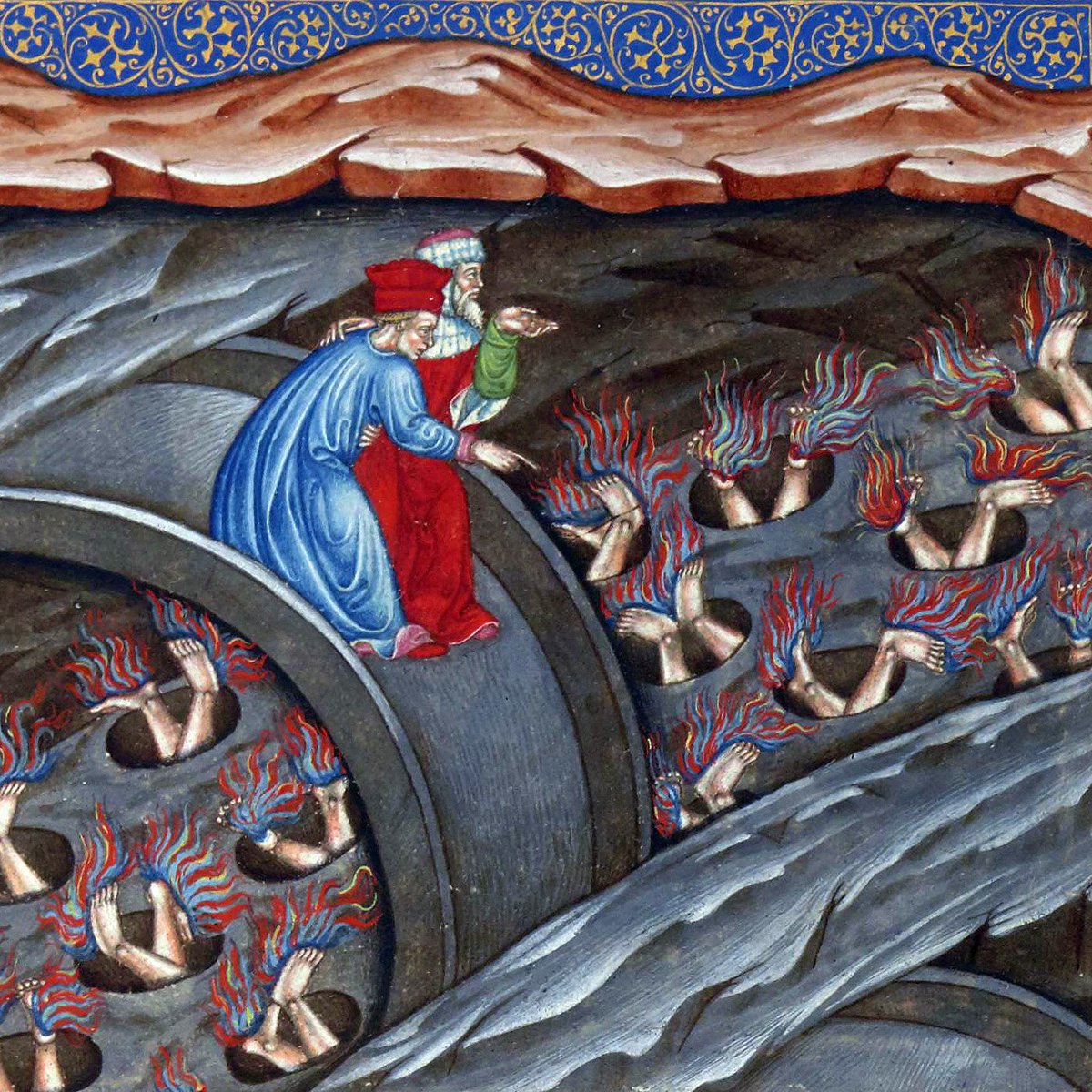
Dante wrote the "Inferno", the first book of his "Divine Comedy", around 1310. He set the story at Easter in the year 1300, when the Pope was Boniface VIII, whom Dante particularly hated and despised. He accordingly has Nicholas mistake his visitors and exclaim, "What! Are you here already, Boniface?"
Nicholas then prophesises that disaster will soon overtake the Papacy. The disaster had already begun when Dante was writing, because in 1305 a Frenchman was elected Pope, as Clement V. He never set foot in Italy and eventually settled at Avignon. Dante was not to know that for the next sixty years all the Popes would be French, little more than puppets of the Kings of France, and that the Papacy would not return permanently to Rome until 1415.
Dante wrote the "Inferno", the first book of his "Divine Comedy", around 1310. He set the story at Easter in the year 1300, when the Pope was Boniface VIII, whom Dante particularly hated and despised. He accordingly has Nicholas mistake his visitors and exclaim, "What! Are you here already, Boniface?"
Nicholas then prophesises that disaster will soon overtake the Papacy. The disaster had already begun when Dante was writing, because in 1305 a Frenchman was elected Pope, as Clement V. He never set foot in Italy and eventually settled at Avignon. Dante was not to know that for the next sixty years all the Popes would be French, little more than puppets of the Kings of France, and that the Papacy would not return permanently to Rome until 1415.
Monday, 10 September 2018
Travel: Avignon

Avignon lies on the west bank of the River Rhone. The city is famous for two things: the bridge that does not span the river, and the Palace of the Popes.
The bridge is older than the palace. It was constructed in the 12th century by Saint Benezet (the Provencal version of the name "Benedict"), a humble shepherd boy who, according to legend, heard angelic voices calling him to go to Avignon and build a bridge. Work began in 1177 and was completed eight years later.
The picture below gives a misleading impression of the vast scale of the project. What appears to be the far bank is in fact a long, narrow island in the middle of the Rhone, which did not exist in the 12th century. In fact the bridge ran all the way to the white tower seen on the right: almost a thousand yards long, with 22 arches, running in an S-shaped curve so as to base the piers on avialable shoals of gravel in the river bed.

The tower is all that remains of a castle built by Philip IV of France (Philippe le Bel) in 1302, to control the river crossing. We will meet him again shortly.
The bridge today provides a fine view of the provided there are not too many crowds of tourists!


The cathedral was first built around 1140.

The gilded statue of the Virgin was placed on top of the tower in the 19th century. This is the west door

After a bitter conflict between the Papacy and King Philip IV, the Archbishop of Bordeaux was elected as Pope Clement V in 1305. He never went to Rome, and for the next 68 years all the Popes were Frenchmen. They built in Avignon the Palace of the Popes, which grew to be the largest building of its kind in western Europe. They lived in great luxury, which appalled and disgusted Petrach when he visited Avignon.

In 1417 the Popes returned to Rome, but Avignon remained papal territory. Only with the French Revolution did the city become part of France, and the Palace of the Popes was then occupied and plundered and used as a barracks. No furniture survives, and of the lavsh decorations, only a couple of chapels

and a few of the Pope's private rooms.


However, nowadays you can be taken on a "virtual reality" tour of the Palace, where the furniture and decoration of all the main rooms is recreated for you. This will take probably a couple of hours, but it is time well spent.
Facing the papal palace is the baroque Hotel des Monnaies


There are several other museums, which I didn't have time to visit. The Musee Calvet on the Rue Josef Vernet is said to be particularly good.
The old city of Avignon is surrounded by its mediaeval walls and gates, but a modern boulevard has been blasted through from the Place de l'Horloge, where stands the Hotel de Ville and the Second Empire theatre,


Interestingly, an attempt is being made to revive the local Provencal tongue, with dual-language street names.

There is also a splendid modern building, les Halles (the market), with a green ecological exterior.


A good way of seeing Avignon is to board the little street-train for tourists, which departs from near the papal palace. The trip round the streets takes about 45 minutes, with a multilingual commentary, and I thought it was good value.
Sunday, 2 September 2018
The Corbets of Moreton Corbet
Origins of the Corbet family.
The name
Corbet is derived from the French “corbeau”:
a raven, or crow (Old Scots: “corbie”).
The family originated in Normandy, where they were followers of Roger de Montgomery,
a great nobleman.
Roger de Montgomery had not accompanied
William the Conqueror at the Battle of Hastings, but when in 1069 Shrewsbury
was attacked by the Welsh, with the help of Saxon rebels, he was created Earl
of Shrewsbury and put in charge there. He summoned “brave and loyal men” from
his own lands in Normandy to help him. One of these was a man probably known as
Hugo le Corbet, and his two sons Roger and Robert FitzCorbet. They were granted
large numbers of manors in Shropshire.
By the time the Domesday Book was compiled
in 1086, Hugh was dead, but Roger and Robert FitzCorbet were recorded as
between them holding more than 40 manors in Shropshire under Earl Roger. The
village that became Moreton Corbet was not one of these, however (see later).
An
examination of a map shows how strategically important the FitzCorbets were,
because Roger held a great swathe of manors immediately west of Shrewsbury and
south of the Severn, with Roger’s manors further south.
In 1102 the FitzCorbets
supported Robert de Belleme, the son of Earl Roger, when he rose in rebellion
against King Henry I, but they were able to make their peace with the King and
kept their lands; and the two brothers were still alive as late as 1121.
Robert’s branch of the family soon died out in the male line; though his
daughter Sibyl became one of Henry I’s numerous mistresses, and bore the king
several children. But Roger’s family produced a great many descendants, of whom
the principal male line became Barons of Caus, a castle in the thinly-inhabited
hill country south-west of Shrewsbury, near the modern border with Wales. (The first
reference to the castle was in the 1130s. It can be found on a map west of the
B4386 road from Westbury to Worthen. It was destroyed by Parliamentary forces
in 1645, though there are still some impressive earthworks. The site is not
open to the public)


Under Henry II, the Marcher Lordships were
organised, which included Caus. The nobles who held these had special powers
and privileges to deal with the danger of raids from Wales. Many of their
castles, such as Ludlow, became very strong. Although Caus was only a minor
lordship, with a relatively small castle, we know that Roger Corbet, Lord of
Caus, refused to pay a special tax in 1159, and again in 1165, on the grounds
that his predecessors had never had to pay such a tax in the past!
In 1298 Sir
Peter Corbet, Baron of Caus, serving the King at the Battle of Falkirk, is
recorded as bearing the distinctive Corbet coat of arms: a black ravens on a
gold shield (In heraldic terminology, “Or, a corbyn sable”). Because no two men
could bear identical coats of arms at the same time, other branches of the
family had coats with two, three or even six ravens.
Sir Peter’s
son, Sir John Corbet, died without male issue in 1347, and the Barony of Caus
became extinct.
Moreton Corbet
The village
which is now Moreton Corbet appears in the Domesday Book as part of the vast
territories granted to Roger of Montgomery, Earl of Shrewsbury. His tenant in
Moreton was a Saxon called Thorold, who held several local manors, and under
him the manor was held by two Saxon brothers, Hunning and Ulviet, who had been
there since before the Battle of Hastings.
The Domesday
Book records:-
“They were
free men. 1 hide pays tax. There is land for 2 ploughs. There are 5 slaves and
1 smallholder. In the reign of King Edward it was worth 10 shillings; now 16
shillings” (A hide would have been between 60 and 120 acres, depending on the
quality of the soil)
By the start
of the 13the century Moreton was held by the family of FitzToret (or Turet) and
was commonly known as Moreton Turet. In 1215 Bartholomew FitzToret joined the
rebellion which forced King John to sign Magna Carta. When John died the next
year, leaving only his 9-year-old son to become Henry III, many of the barons
thought that Louis, the younger son of the King of France, would make a much
better King; but England’s greatest warrior, William Marshall, Earl of
Pembroke, stayed loyal to Henry, and defeated and drove out the French at the
Battle of Lincoln. Bartholomew had supported the rebellion, and forfeited
Moreton as a result, but it was soon returned to him.
About this time, Sir Richard Corbet held the
manor of Wattlesborough as a fief of the barony of Caus. He married Joanna, daughter
and heiress of Bartholomew, thus acquiring Moreton, which eventually became
known as Moreton Corbet. But for a long time it was not the family’s principal
residence in Shropshire, and they also owned land in many other counties. By
1289 their grandson, Sir Robert Corbet, was important enough to be appointed
Sherriff of Shropshire, and then Member of Parliament in 1290 and 1295.
Moreton Corbet Castle
Western Shropshire was a dangerous place in
the Middle Ages, with constant raids backwards and forwards across the Welsh
border, as well as occasional major campaigns. The area thus contains a large
number of castles; some large, but most just small motte-and-bailey affairs.
Moreton Corbet castle was probably built in the 12th or early 13th century. It
was most likely to have been a fortified manor-house rather than a real castle,
though it may have had a moat. Certainly it was never under serious attack at
this time. (A very splendid example of a fortified manor-house on the Welsh
borders can be seen at Stokesay). There would also have been huts for the
villagers, though no trace of these remain. A chapel was consecrated at Moreton
around 1140, by Bishop Clinton, who also founded Buildwas Abbey on the Severn.
The later castle
The Corbets
of Moreton Corbet managed to comethrough the Wars of the Roses unscathed. They
were Yorkists, and Sir Roger Corbet was made a Knight of the Bath at the
coronation of Edward IV’s Queen, Elizabeth Woodville, in 1465. His son, Sir
Richard, fought for King Edward at the battle of Tewkesbury in 1471 and was
knighted on the field. He attended the coronation of Richard III in 1483, but
when Henry Tudor landed in Wales to claim the throne two years later, he
followed his relative Sir William Stanley in changing sides. He paid homage to
henry at Shrewsbury, and led 800 Shropshire men at the battle of Bosworth.
Later, he helped to put down a rebellion in the north in 1489, and died three
years later. His son, Sir Robert, then managed to avoid entanglement in the
rebellion of Perkin Warbeck in 1495, which led to Sir William Stanley being
executed for high treason.
By the dawn
on the 16th century, the family were rich and influential gentry. As
was expected of people of their class, they played their part in governing
Shropshire as Justices of the Peace, sheriffs, officers of the county militia
and Members of Parliament. The Welsh border country became peaceful: Wales was
incorporated into the English system of government by an Act of Union, and the
powers of the Marcher lords were abolished. There was now no need for
fortifications in Shropshire. Instead the Corbets decided to display their
wealth and importance by building themselves a home in the latest style.
The castle
today owes its current appearance to Sir Andrew Corbet (died 1578) and his
successors. Sir Andrew enlarged the gatehouse,

and improved the east range and built a Great Hall. The inspiration may have been his son, Robert; a traveller who had been to Italy and probably brought back news of the new fashions in design. But sadly, Robert died of the plague in London in 1583, and his brother Richard succeeded to the property. He then pulled down part of the Great Hall for new modifications, including on the upper floor a Great Chamber, Parlour and Gallery.

and improved the east range and built a Great Hall. The inspiration may have been his son, Robert; a traveller who had been to Italy and probably brought back news of the new fashions in design. But sadly, Robert died of the plague in London in 1583, and his brother Richard succeeded to the property. He then pulled down part of the Great Hall for new modifications, including on the upper floor a Great Chamber, Parlour and Gallery.
It appears that the work was never
completed. William Camden, writing at the start of the 17th century, tells us:-
“Upon the
same river Roden appears Moreton Corbet, a castle of the Corbets, where, within
the memory of man, Robert Corbet, to
justify his curiosity in architecture, began a noble building, much more large
and splendid than the former (viz: the castle); but death countermanded his
designs, took him off, so his project was left unfinished.”
Disaster
overtook Moreton Corbet in the Civil War. Most of Shropshire was held by gentry
and nobles loyal to the King, including Sir Vincent Corbet, and the only town
supporting the Parliamentary cause was Wem.
But in 1644 Prince Rupert took many of the Shropshire royalist troops to
Yorkshire. Few returned from the disaster at the battle of Marston Moor, and
the Parliamentary forces at Wem were able to strike out. A contemporary source,
“Jehovah Jireh, or England’s Parliamentary Chronicle”, tells us that:-
“In
September 1644, Major Bridgeman, Captain Maurice and their brave force, captured
Moreton Corbet castle with resolute and desperate service: one man lost and
some few wounded”. The castle was badly damaged, there was a fire, and a
royalist counterattack was beaten off.


Sir Vincent
had not been present at the fight, but as a committed royalist who had raised
local forces for the crown, he was fined the very large sum of £1588, with
additional penalties of £80 per year. This put him to such financial straits
that he was obliged to sell of much of his land. He and his descendants ceased
to live at Moreton Corbet, (though they could still be buried there); the
family home in Shropshire now being at Acton Reynald, a short distance away. Sir
Vincent died in 1656.
His son,
another Sir Vincent, benefited from the restoration of the monarchy to the
extent of being elected M.P. for Shropshire in 1679. Moreton Corbet castle it
was left in the hands of a steward and allowed to decay further. In 1690 it was
conveyed to John Kynaston, whose wife is buried there. Their son, Corbet
Kynaston, was a notorious Jacobite, who was suspected of involvement in the 1715 rising;
though of course the rebels never got anywhere near Shropshire. More seriously,
he piled up enormous debts, which greatly exceeded his assets when he died in
1740. The situation had still not been sorted out six years later, and
eventually an Act of Parliament had to be passed to allow his estates to be
auctioned off.
It was this which enabled Moreton Corbet to
be bought in 1748 by a relative, Andrew Corbet of Shawbury Park. When his
great-nephew, another Sir Andrew, inherited the estate in 1796 he drew up plans
to restore the castle, but never put them into effect: instead an artist,
Thomas Girtin, was commissioned to depict the buildings.
In 1897 the castle was described as “a noble pile of ruins”. Today it is under the care of English Heritage..
...............................................................................................................
Timeline
.
1066 Battle of Hastings
1070 Roger de Montgomery made Earl of Shrewsbury, and brings members of the Corbet family to Shropshire
1086 the Domesday Book has Roger and Robert FitzCorbet holding manors in Shropshire under Earl Roger. Moreton is held, under Earl Roger, by Thorold, a Saxon
13th Century The Corbet family inherit Moreton through marriage
1298 Sir Peter Corbet is recorded bearing the distinctive Corbet coat of arms.
1512 Robert Corbet of Moreton Corbet, a rich and well-connected gentleman, dies and is given a magnificent tomb
1529 Roger Corbet a Member of Parliament (again, 1536)
1547 Andrew Corbet knighted. He begins the lavish rebuilding of Moreton Corbet castle
1624 Andrew Corbet M.P. for Shropshire (again, 1628)
1644 Moreton Corbet stormed and badly damaged in Civil War. Sir Vincent Corbet is fined a huge sum and is forced to sell off much of his lands. The family cease to live at Moreton Corbet.
1748 Moreton Corbet bought by Andrew Corbet of Shawbury
Sunday, 19 August 2018
Origins of the Second World War, part 1: Mussolini Upsets the Applecart!
Hitler was appointed Chancellor of Germany in January 1933, but it took him 18 months to establish a single-party dictatorship. Meanwhile the leaders of Europe looked on tensely. Anyone who had read "Mein Kampf" or listened to his speeches knew that Hitler was a man given to violent words; but what foreign policy actions would he attempt now that he was in charge?
Mussolini for one was not overimpressed. He had seized power in Italy a decade earlier and considered himself to be very much the senior figure in the Fascist hierarchy: indeed at the time of his Beer Hall putsch in 1924 Hitler had been little more than a carbon-copy Mussolini, and an unsuccessful one to boot. When the two dictators met for the first time at Venice in June 1934, Mussolini told his friends, "This fellow Hitler's wrong in the head!", and instructed his soldiers to parade before the German fuhrer unshaven and in unpressed uniforms, to indicate his contempt.
Between Germany and Italy lay the small state of Austria. In February 1934 Chancellor Dollfuss, guided by Mussolini, had destroyed the Socialist party and established a dictatorship. Then on July 25th Dolluss was murdered by a group of Viennese Nazis. It is most unlikely that the murder had been ordered by Berlin, but the intention of the killers was certainly an Anschluss: union between Austria and Germany. But Mussolini far preferred a small buffer-state between himself and Germany, and furthermore he had his own fears for Italy about such talk; for at Versailles Italy had been given the Trento, between Lake Garda and the Brenner pass, which was inhabited mostly by ethnic Germans. So he moved his troops up to the Austrian frontier, and Hitler was obliged to stand by passively while in Vienna Schuschnigg, Dollfuss's successor, restored order.
So after two years in power, Hitler's only international success was an entirely legal and peaceful one, when in January 1935 the Saar held a referendum on its future (as was decreed by the Treaty of Versailles) and voted overwhelmingly to return to Germany.
The Western leaders,especially the French, deduced from this that Mussolini could be a useful check to Hitler's ambitions. And although Hitler made no aggressive moves in foreign policy, his words continued to be unsettling, he continued to rearm Germany, and in March 1935 he announced the start of military conscription; a clear breach of the terms of the Versailles Treaty. In consequence a great international conference was held at Stresa in April, hosted by Mussolini and attended by the leading statesmen of France and Britain. The document which emerged, the "Stresa Front", committed the three powers to resist any attempt to change European frontiers by force. At the same time, France signed a pact with the Soviet Union. Hitler appeared encircled and, with luck, tamed. But Mussolini decided to have a war.
Mussolini had no economic reason for starting a war. Italy already had an empire, in Libya, which was run at great cost and at no economic gain (oil had been discovered there, but Mussolini made no attempt to exploit it). Any rational calculation would have shown that Italy was simply not strong or rich enough to be a Great Power: she could follow Germany, or the Anglo-French entente, but could not stand on its own. In the First World War, she had chosen the latter option. But Mussolini, who had the soul of a tabloid journalist, was annoyed at Hitler increasingly supplanting him in the headlines, and wanted to grab some of the attention. Also, he approved of violence per se; he regretted that the Italian people showed little enthusiasm for war, and was determined to remedy it. At the Stresa meeting he was given the impression that France, and perhaps Britain as well, might turn a blind eye to any adventures he undertook in East Africa.
Abyssinia (now Ethiopia) was Mussolini's target. The country was the only independent state in Africa. It was ruled by its Emperor, Haile Selassie, and was a member of the League of Nations. Before the First World War the Italians had gained two adjactent coastal territories, Eritrea and Somaliland, but an attempt to conquer the country had been disastrously defeated at the battle of Adowa in 1896. There was thus a national humiliation to be avenged.

Well before Mussolini embarked on his invasion of Abyssinia, it must have been obvious to all that something aggressive was being planned. Preparations had begun as early as 1932, and the buildup in armaments passing through the Suez canal could not be concealed. In December 1934 a clash over a disputed frontier at Wal Wal, an oasis in the middle of nowhere, provided a pretext for war. In June 1935 Anthony Eden, then a junior Foreign Office minister, went to Rome to try and sort out the looming problem. In order to keep Italy onside against Hitler, Britain offered to support territorial concessions in Abyssinia, but there must be no invasion. Mussolini rejected the offer: he wanted a victorious war, not mere adjustment of frontiers. The British position was complicated at this stage by a government reshuffle that introduced Sir Samuel Hoare as Foreign Secretary. Then in October the Italian invasion began.
This was a test for the League of Nations. A few years earlier, the League had failed to act when the Japanese invaded Manchuria. Hoare now demanded action, and the League duly imposed sanctions on Italy. But these were unlikely to be effective, at least in the short term. Two of the world's strongest economic powers, the United States and Germany, were not members of the League. The U.S.A. refused to get involved at all, and Hitler was of course delighted to see a breach in the Stresa Front. British Foreign Office expertise was divided between those who wanted a strong response and those who feared driving Mussolini into the arms of Hitler. Many old Conservatives had always admired Mussolini; Churchill himself being one of their number. There were also strategic considerations: in the First World War, both Italy and Japan had supported theAnglo-French entente; but what if both these powers were hostile in a future conflict with Germany? As it was, the sanctions imposed did not include oil, nor was the Suez Canal closed to Italian shipping.
Probably the hope was that Mussolini would get bogged down in an Abyssinian war which dragged on for years. But, with the use of aerial bombing and poison gas against weakly-armed native forces, the Italian armies swept deep into the country. The British Foreign Office devised a plan to end the war: part of Abyssinia would be given to Italy, with Haile Selasse left ruling a rump state with access to the sea through British Somaliland. Hoare took the plan to Paris in December 1935, where the French Foreign Minister Pierre Laval welcomed it, and Mussolini seemed prepared to accept it.
But then something unexpected happened. Somehow the plan was leaked to the press, and provoked a chorus of popular outrage in Britain. The Prime Minister, Stanley Baldwin,was forced to repudiate it, Hoare resigned and was replaced by Eden. But the British government was not prepared to risk any tightening of sanctins or military action. The invasion continued, and in May 1936 Haile Selassie fled and Mussolini proclaimed his sovereign, King Victor Emmanuel III, Emperor of Abyssinia. Haile Selassie gave a dignified address to the League of Nations at Geneva, where the Italian delegates attempted to howl him down.
Mussolini's propaganda argued that he was bringing civilization to a primitive country where slavery was still practised; being supported in this by the likes of Evelyn Waugh. He also pointed out, with justice, that Britain and France had conquered huge empires in Africa less than a century earlier, so their criticism was sheer hypocrisy. It could be argued that Mussolini was guilty of no more than anachronism; but anachronism is a serious offence. The age of empre-building had passed.
The result of the debacle was, for Britain and France, the worst of all possible worlds. The League of Nations was now entirely discredited as a force for peace, and was henceforth an irrelevance. The big winner was, of course, Hitler. He was delighted at the rift between Italy and the Anglo-French entente, and was convinced of the weakness of his enemies. In March 1936 he took the enormous gamble of reoccupying the Rhineland with his army, a clear and threatening breach of the Treaty of Versailles, in the expectation that he would face no military response. His generals were very nervous, but he was proved right. As Mussolini increasingly fell into his pocket, he was emboldened to take greater and greater risks. The countdown to the Second World War had begun.
Mussolini for one was not overimpressed. He had seized power in Italy a decade earlier and considered himself to be very much the senior figure in the Fascist hierarchy: indeed at the time of his Beer Hall putsch in 1924 Hitler had been little more than a carbon-copy Mussolini, and an unsuccessful one to boot. When the two dictators met for the first time at Venice in June 1934, Mussolini told his friends, "This fellow Hitler's wrong in the head!", and instructed his soldiers to parade before the German fuhrer unshaven and in unpressed uniforms, to indicate his contempt.
Between Germany and Italy lay the small state of Austria. In February 1934 Chancellor Dollfuss, guided by Mussolini, had destroyed the Socialist party and established a dictatorship. Then on July 25th Dolluss was murdered by a group of Viennese Nazis. It is most unlikely that the murder had been ordered by Berlin, but the intention of the killers was certainly an Anschluss: union between Austria and Germany. But Mussolini far preferred a small buffer-state between himself and Germany, and furthermore he had his own fears for Italy about such talk; for at Versailles Italy had been given the Trento, between Lake Garda and the Brenner pass, which was inhabited mostly by ethnic Germans. So he moved his troops up to the Austrian frontier, and Hitler was obliged to stand by passively while in Vienna Schuschnigg, Dollfuss's successor, restored order.
So after two years in power, Hitler's only international success was an entirely legal and peaceful one, when in January 1935 the Saar held a referendum on its future (as was decreed by the Treaty of Versailles) and voted overwhelmingly to return to Germany.
The Western leaders,especially the French, deduced from this that Mussolini could be a useful check to Hitler's ambitions. And although Hitler made no aggressive moves in foreign policy, his words continued to be unsettling, he continued to rearm Germany, and in March 1935 he announced the start of military conscription; a clear breach of the terms of the Versailles Treaty. In consequence a great international conference was held at Stresa in April, hosted by Mussolini and attended by the leading statesmen of France and Britain. The document which emerged, the "Stresa Front", committed the three powers to resist any attempt to change European frontiers by force. At the same time, France signed a pact with the Soviet Union. Hitler appeared encircled and, with luck, tamed. But Mussolini decided to have a war.
Mussolini had no economic reason for starting a war. Italy already had an empire, in Libya, which was run at great cost and at no economic gain (oil had been discovered there, but Mussolini made no attempt to exploit it). Any rational calculation would have shown that Italy was simply not strong or rich enough to be a Great Power: she could follow Germany, or the Anglo-French entente, but could not stand on its own. In the First World War, she had chosen the latter option. But Mussolini, who had the soul of a tabloid journalist, was annoyed at Hitler increasingly supplanting him in the headlines, and wanted to grab some of the attention. Also, he approved of violence per se; he regretted that the Italian people showed little enthusiasm for war, and was determined to remedy it. At the Stresa meeting he was given the impression that France, and perhaps Britain as well, might turn a blind eye to any adventures he undertook in East Africa.
Abyssinia (now Ethiopia) was Mussolini's target. The country was the only independent state in Africa. It was ruled by its Emperor, Haile Selassie, and was a member of the League of Nations. Before the First World War the Italians had gained two adjactent coastal territories, Eritrea and Somaliland, but an attempt to conquer the country had been disastrously defeated at the battle of Adowa in 1896. There was thus a national humiliation to be avenged.

Well before Mussolini embarked on his invasion of Abyssinia, it must have been obvious to all that something aggressive was being planned. Preparations had begun as early as 1932, and the buildup in armaments passing through the Suez canal could not be concealed. In December 1934 a clash over a disputed frontier at Wal Wal, an oasis in the middle of nowhere, provided a pretext for war. In June 1935 Anthony Eden, then a junior Foreign Office minister, went to Rome to try and sort out the looming problem. In order to keep Italy onside against Hitler, Britain offered to support territorial concessions in Abyssinia, but there must be no invasion. Mussolini rejected the offer: he wanted a victorious war, not mere adjustment of frontiers. The British position was complicated at this stage by a government reshuffle that introduced Sir Samuel Hoare as Foreign Secretary. Then in October the Italian invasion began.
This was a test for the League of Nations. A few years earlier, the League had failed to act when the Japanese invaded Manchuria. Hoare now demanded action, and the League duly imposed sanctions on Italy. But these were unlikely to be effective, at least in the short term. Two of the world's strongest economic powers, the United States and Germany, were not members of the League. The U.S.A. refused to get involved at all, and Hitler was of course delighted to see a breach in the Stresa Front. British Foreign Office expertise was divided between those who wanted a strong response and those who feared driving Mussolini into the arms of Hitler. Many old Conservatives had always admired Mussolini; Churchill himself being one of their number. There were also strategic considerations: in the First World War, both Italy and Japan had supported theAnglo-French entente; but what if both these powers were hostile in a future conflict with Germany? As it was, the sanctions imposed did not include oil, nor was the Suez Canal closed to Italian shipping.
Probably the hope was that Mussolini would get bogged down in an Abyssinian war which dragged on for years. But, with the use of aerial bombing and poison gas against weakly-armed native forces, the Italian armies swept deep into the country. The British Foreign Office devised a plan to end the war: part of Abyssinia would be given to Italy, with Haile Selasse left ruling a rump state with access to the sea through British Somaliland. Hoare took the plan to Paris in December 1935, where the French Foreign Minister Pierre Laval welcomed it, and Mussolini seemed prepared to accept it.
But then something unexpected happened. Somehow the plan was leaked to the press, and provoked a chorus of popular outrage in Britain. The Prime Minister, Stanley Baldwin,was forced to repudiate it, Hoare resigned and was replaced by Eden. But the British government was not prepared to risk any tightening of sanctins or military action. The invasion continued, and in May 1936 Haile Selassie fled and Mussolini proclaimed his sovereign, King Victor Emmanuel III, Emperor of Abyssinia. Haile Selassie gave a dignified address to the League of Nations at Geneva, where the Italian delegates attempted to howl him down.
Mussolini's propaganda argued that he was bringing civilization to a primitive country where slavery was still practised; being supported in this by the likes of Evelyn Waugh. He also pointed out, with justice, that Britain and France had conquered huge empires in Africa less than a century earlier, so their criticism was sheer hypocrisy. It could be argued that Mussolini was guilty of no more than anachronism; but anachronism is a serious offence. The age of empre-building had passed.
The result of the debacle was, for Britain and France, the worst of all possible worlds. The League of Nations was now entirely discredited as a force for peace, and was henceforth an irrelevance. The big winner was, of course, Hitler. He was delighted at the rift between Italy and the Anglo-French entente, and was convinced of the weakness of his enemies. In March 1936 he took the enormous gamble of reoccupying the Rhineland with his army, a clear and threatening breach of the Treaty of Versailles, in the expectation that he would face no military response. His generals were very nervous, but he was proved right. As Mussolini increasingly fell into his pocket, he was emboldened to take greater and greater risks. The countdown to the Second World War had begun.
Tuesday, 7 August 2018
Osborne House; the Isle of Wight,
When Queen Victoria and her husband, Prince Albert, were looking for a private country home for their growing family, they found Osborne house on the Isle of Wight. The Queen already knew the island, and the growing railway network meant that it could be easily reached from London.
Osborne is situated near the north-east coast of the island, between Cowes and Ryde. It was then a three-storied brick and stone house, built in the late 18th century. Victoria and Albert visited the house in 1844 were delighted with its setting. Victoria bought the estate from her Privy Purse for £28,000, and Albert threw himself into rebuilding the house in Italian style and extending the estate by purchasing neighbouring farms. Every year the family spent as much time as possible.
The result of Albert's labours is a magnificent spectacle.


It looks out north-east, down a broad walk to the sea, with Portsmouth visible on the far side of the Solent.

Inside, the house has been restored and repainted much as it was. The widowed Queen preserved Albert's dressing and writing room absolutely unchanged; even to the extent of having hot water brought there every morning! But Albert's collection of Italian Renaissance art is now in the National Gallery and other museums, and most of the paintings on display are of the 19th century. I was particularly amused by this vast allegorical fresco on the main staircase: "Neptune Resigning the Empire of the Seas to Britannia"

Facing it is a near-lifesize statue of Albert as a classical warrior: a birthday present from the Queen.

Some distance away in the grounds is the Swiss Cottage, which Albert built for the royal children in 1854.
 Here they were given garden-plots to grow flowers, fruit and vegetables with their own hands. There are also miniature fortifications, where Bertie (the future King Edward VII) could play at soldiers. Nowadays the house is a museum, housing the family's collections of natural history and of fascinating folk-art from all over the Empire.
After Albert's premature death in 1861 Victoria and her children continued to spend much of their time at Osborne. The Queen spent many years in virtual seclusion, where her closest confidant appeared to be her Scottish ghillie, John Brown. Towards the end of her life she became fascinated with all things Indian: she retained two Indian personal servants, and the Durbar wing was built in the 1890s.
The Durbar Room has a ceiling of moulded plaster, cast from moulds constructed by an Indian craftsman, Bhai Ram Singh, under the direction of Lockwood Kipling, the father of Rudyard. Ram Singh also designed the doorknobs and the chairs.

The corridor to the Durbar Room features portraits of Indian princes and ladies in full regalia.
Queen Victoria died at Osborne in January 1901. In anticipation of her death, many of her family had assembled there, including her grandson, the Kaiser William II of Germany. But the new King, Edward VII, had no use for the house, and it was used as a convalescent home for army officers. In 1954 it was opened to the public, and in 1986 was taken over and run by English Heritage (from whose excellent guidebook most of this information has been taken).
Osborne is situated near the north-east coast of the island, between Cowes and Ryde. It was then a three-storied brick and stone house, built in the late 18th century. Victoria and Albert visited the house in 1844 were delighted with its setting. Victoria bought the estate from her Privy Purse for £28,000, and Albert threw himself into rebuilding the house in Italian style and extending the estate by purchasing neighbouring farms. Every year the family spent as much time as possible.
The result of Albert's labours is a magnificent spectacle.

The terrace is laid out in formal Italian style.

It looks out north-east, down a broad walk to the sea, with Portsmouth visible on the far side of the Solent.

Inside, the house has been restored and repainted much as it was. The widowed Queen preserved Albert's dressing and writing room absolutely unchanged; even to the extent of having hot water brought there every morning! But Albert's collection of Italian Renaissance art is now in the National Gallery and other museums, and most of the paintings on display are of the 19th century. I was particularly amused by this vast allegorical fresco on the main staircase: "Neptune Resigning the Empire of the Seas to Britannia"

Facing it is a near-lifesize statue of Albert as a classical warrior: a birthday present from the Queen.

Some distance away in the grounds is the Swiss Cottage, which Albert built for the royal children in 1854.

After Albert's premature death in 1861 Victoria and her children continued to spend much of their time at Osborne. The Queen spent many years in virtual seclusion, where her closest confidant appeared to be her Scottish ghillie, John Brown. Towards the end of her life she became fascinated with all things Indian: she retained two Indian personal servants, and the Durbar wing was built in the 1890s.
The Durbar Room has a ceiling of moulded plaster, cast from moulds constructed by an Indian craftsman, Bhai Ram Singh, under the direction of Lockwood Kipling, the father of Rudyard. Ram Singh also designed the doorknobs and the chairs.

The corridor to the Durbar Room features portraits of Indian princes and ladies in full regalia.
Queen Victoria died at Osborne in January 1901. In anticipation of her death, many of her family had assembled there, including her grandson, the Kaiser William II of Germany. But the new King, Edward VII, had no use for the house, and it was used as a convalescent home for army officers. In 1954 it was opened to the public, and in 1986 was taken over and run by English Heritage (from whose excellent guidebook most of this information has been taken).
Subscribe to:
Posts (Atom)
