My fantasy team from the women's 100 tournament, based on this summer's performances (English players only):-
Beaumont
Wyatt
Bouchier
Dunkley
Sciver-Brunt (capt)
Adams
Jones (wk)
Ecclestone
Cross
Glenn
Bell
My fantasy team from the women's 100 tournament, based on this summer's performances (English players only):-
Beaumont
Wyatt
Bouchier
Dunkley
Sciver-Brunt (capt)
Adams
Jones (wk)
Ecclestone
Cross
Glenn
Bell
What do we undestand by the word "state"? It probably involves such notions as: supreme authority within recognised frontiers; a claim on our obedience superior to any other claims (e.g. religion, family loyalty); a bureaucratic structure overseeing such things as defence, international trade, laws and judiciary, and from this does things to control our lives.
All this is quite a modern concept. It did not exist in mediaeval Europe, where real power was in the hands of the local nobility, and any control by central government depended the personality and competence of the King, without which things soon degenerated into anarchy. The modern concept of the state was developed in the Renaissance by writers such as Machiavelli, based on what they had read of Ancient Rome; and at the same time the development of a central bureacracy and a reduction of the power of the Church and of the feudal nobility made the growth of the modern state possible.
Even then, until the late 19th century the western European state, particularly in Britain, did not do much by today's standards. It did not build roads or railways, provide healthcare or schools, or regulate international trade. Few new laws were passed, and taxation was very low. Marx provided no vision whatsoever of what a state would actually do after the revolution: indeed, in one famous phrase, he predicted that it would "wither away"!
What is a "nation"? It is more of a concept than a plain reality; a self-consciousness, based on such things as a common culture, language, tradition and history; even belief in a single race. It helps if the area in question has obvious frontiers on most sides and a central government: e.g. England or France. National self-consciouness first developes towards the end of the Middle Ages, among educated people and intellectuals (e.g. Shakespeare) and only gradually spreads to the mass of the peasant population. It is doubtful whether most people in France were aware of being "French" in any meaningful way until the 19th century, and Russian peasants probably had no "national" feeling unil even later.
The nation-state is often seen as the only valid form of political organisation, as distict from (say) an empire, but it is a fairly recent idea historically. Furthermore, the two words carry different connotations: a little thought will suggest that the term "King of Scotland" is not quite the same as "King of Scots": the former implies rule over a define territory with frontiers, which may well contain people who do not consider themselves Scots: the latter implies a Scottish nation or race.
Problems of state versus nation began to emerge in Europe the 19th century. Italy had clear natural frontiers and a famous history, but there had been no single Italian state since Roman times. It was only unified in the 19th century. At the same time, German intellectuals developed a strong sense of "Germanness", but until unification in 1871 Germany had been just a patchwork of tiny inependent states with no effective central government. By contrast, the Empires of Austria, Russia and Turkey contained a great many different national groups, some of which had a proud historical past as independent states (Greece, Hungary, Poland), and others which did not. In the 19th century, scholars became interested in many of the latter: in their folklore, myths and peasant costumes, and for some of them wrote down their languages for the first time, using inappropriate or Roman or Russian aphabets (e.g. Finnish). This helped to form the first stirrings of national consciousness.
In central and eastern Europe there are few natural frontiers, and national dividing lines were therefore impossible to draw. German intellectuals were well aware that their concept of "Germanness" overlapped with territories inhabited by Czechs, Poles and others. Their answer was to decide that these cultures were "inferior" and need not be taken into account!
19th century Europe thus contained some states which were also nations (e.g. France), but others which were not. In the Ist World War the old Austrian and Turkish empires collapsed, and President Wilson decreed that frontiers should be redrawn in accordance with "self-determination": that is, nation-states. But this proved very difficult to apply, because, particularly when new states were established on the ruins of the old Austrian Empire, the new frontiers never coincided exactly with ethnic groupings, leading to much resentment and hostility. The newly-established nation state of Turkey expelled or killed large numbers of the Greek and Armenian minorities, but there remained a large Kurdish minority in the south-east.
Meanwhile, Lenin and Stalin managed to hold onto most of the old Tsarist Empire in the form of the avowedly multinational Soviet Union; but when this broke up in the 1990s, many new states were created, some of which had no tradition of statehood. The present war in Ukraine derives from the fact that Russia maintains that Ukraine has no national identity separate from Russia (the Ukrainian language being seen as no more than a reasant dialect).
The disintegration of Yugoslavia led to violence because it contained ethnic groups with a long tradition of mutual hostility (e.g. Serbs and Croats), but which now found themselves states with large ethnic minorities.
Lady Anne Clifford was born in 1590, the only surviving child of George Clifford, third Earl of Cumberland; the scion of a family powerful in the north-west of England since the thirteenth century, and as a young girl she was presented at the court of Queen Elizabeth I. She was twice married; first to Richard Sackville, Earl of Dorset, by whom she had two daughters, and later to Philip Herbert, Earl of Pembroke. She does not appeared to have had any great joy in either marriage, and despite living in the great age of the Elizabethan and early Stuart Renaissance, her heart was always in the north of England and her outlook resolutely mediaeval.

Much to Lady Anne's disgust, her father, when he died in 1605, left his lands and property not to her but to his brother Francis, who became fourth Earl of Cumberland, and it was only when his son, Henry, the fifth Earl, died childless in 1643 that she was able to inherit what she had always seen as her rightful possessions. But at this stage the Civil War intervened, and it was only when the fighting had ceased that she was able to begin the restoration of her castles, where she was to live for the rest of her life. Her contemporaries knew her as a "proud northern lady".
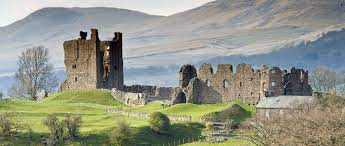
Lady Anne Clifford's castles today:-
Brougham castle, on the river Eamont, near Penrith

Appleby castle: the only one still in private hands

Brough castle: situated on the A66 road several miles south-east from Penrith
The Countess's Pillar: a short distance from Brougham on the road to Appleby. She erected it in memory of her mother, and arranged for charity to distributed from this site every April to the poor of the parish.

The coat of arms of Sir George Clifford, Earl of Cumberland: Lady Anne Clifford's father

Enemies of Boris Johnson routinely used social media to accuse him of being a "fascist": a word nowadays employed so loosely as to be practically devoid of any meaning except dislike. Nevertheless, I consider that there are interesting parallels between him and Mussolini, the leader of the Fascist Party in Italy and the inspiration for copycat movements throught the interwar period.
Mussolini, like Johnson, was by instinct a tabloid journalist, and his principal aim was to dominate the next day's headlines. As a rising politician, he produced no specific policies, and was never really in control of the dark forces of street violence that he had unleased and encouraged. He delivered speeches full of rousing phrases but devoid of any ideological content. His really solid achivements were few: he was a lazy administrator and allowed vast levels of corruption to flourish under his government. When the great recession came after 1929, he had no more clue of how to deal with the economic problems facing his country than did any other western European leaders.
Boris Johnson as Prime Minister was noted for his rousing speeches and for his publicity stunts: dressing up as a soldier, a doctor or whatever, for the benefit of the T.V. cameras. He too was lazy and famously could never be bothered to master the details of policies.
In the 1920s Mussolini was accepted as a serious statesman by the other leaders of Europe, and his Fascism was widely imitated, not least by Hitler in Germany. When the two dictators first met, Mussolini was profoundly unimpressed, and commented that Hitler was "wrong in the head". But Germany is a far stronger power than Italy, and in the end Mussolini could not bear Hitler grabbing all the headlines and felt he would have to lash out internationally himself, with disastrous consequences for Italy and for himself. The only parallel here, though not a very exact one, is with Boris Johnson and Donald Trump.
Postscript: Boris Johnson has reverted to his old job and is now writing articles for the "Daily Mail

It is a sobering thought that he can earn far more for churning out this kind of rubbish than he did as Prime Minister; but personally I do not begrudge him a single penny. I would far rather he was harmlessly enployed producing what Orwell called "prolefeed" than pretending to run the country.
Early in Plato's book, "The Republic", Socrates asks the question "What is justice?". Thrasymachus answers scornfully that justice is merely the will of the strongest imposed on everyone else, and all other talk is nonsense. Socrates rejects this, though he does not really refute it, and also rejects a later suggestion that justice is determined by a consensus agreement. Instead, Socrates defines justice as "everything in the right place". Later, Aristotle defined justice as "Treating equals equally". It can be seen that both these require further investigation!
The mediaeval writers, particularly Thomas Aquinas, depicted an underlying code of right and wrong which we all know in our hearts, and which to some extent can be discovered by reason alone. There is no moral obligation to obey the laws enacted by government ("Positive law") which go against natural law: abstract justice should always have priority over human laws. (The concept of natural law was revived at the Nuremberg trials).
Hobbes rejected any concept of natural law and reached a Thrasymachus position: the state's positive law defines what is just and unjust, and therefore no law can be unjust. (However, because there is no effective international sovereignty, there can be no right or wrong in dealings between states).
Locke revived the concept of natural law under the category of natural rights (to life, liberty, property) and any state which infringes these is acting unjustly and may legitimately be resisted.
From the 17th century, rationalist philosophers attempted to construct codes of absolute justice based on reason rather than divine command. The bottom line of these usually a concept of equality and fairness; and laws which discriminate or are applied in an inequitable fashion may be condemned as unjust.
Supporters of absolute standards of justice, whether derived from religious doctrine or from reason, would argue that unjust laws should be resisted; implying that individual conscipriority over any obligation to obey positive law. Hobbes argued that giving priority to individual conscience is effecively allowing anyone to do whatever they want. A counter-argument would be that individual happiness, or even the happiness of society as a whole, is not the same as "goodness", and that we always have a duty to promote the latter, regardless of all other considerations. How far therefore should my individual conscience take precedence over the "general good" (e.g. conscientious objection in wartime)? Should my individual judgement of right and wrong be guided by a superior authority (the church or the government)?
Positive law. To be just, it should be widely known and accepted, easy to understand, promote a clear and obvious social good, and not discriminate unfairly for or against any groups in society. The administration of justice should be unbiased and open to all. Punishments should be proportionate and should ideally be aimed at reforming the offender. These are all utilitarian arguments. But what if some law or regulation appears irrational or cruel, but is nonetheless accepted by the mass of society: e.g. the monarchy (Edmund Burke's argument)?
Political justice. Nowadays it is believed that "one person, one vote" is the only just form of political structure. But why? Is it because this is the form most likely to achieve the general good (utilitarianism)? and if so, has that always been the case, or is it only applicable to modern society? Surely it is only a means to an end (better government), not a universal entitlement? What about minority groups and the danger of "tyranny of the majority" (Mill). What rights do I have to oppose a policy supported by the majority but which I believe to be disastrous?
Social Justice. The rights and wrongs underlying the social order. Discussion often turns on the conflict between commutative and distributive justice:-
Commutative justice = "Merit should be rewarded" (e.g. skill, hard work, academic attainment: more difficult to assess if "value to society is a criterion); not to do so would be unjust.
Distributive justice = "Rewards should be distributed according to needs" (e.g. number of children to be supported). This may involve compulsory redistribution of property; presumably by the state.
Commutative justice is preferred by economic liberals and by conservatives on the grounds of ecomonic efficiency, and flat-rate equality ("levelling") attacked as in itself unjust. On the other hand, religious teaching often seems to favour distributive justice.
Some modern arguments:
The utilitarian tradition: "The greatest happiness of the greatest number" is still the most common approach to evaluating justice. But utilitarianism has nothing to say about abolute standards of right and wrong (Bentham and Mill were both rationalists and non-believers). Also, why should I, as an individual, care about the wellbeing of society as a whole?
John Rawls ("A Theory of Justice"): There is always an individual claim to justice in the pursuit of "social primary goods" (liberty, wealth, opportunities, self-respect, etc); and fairness dictates that all should be distributed equally unless there is a valid reason why not (e.g. some people may work harder or more usefully, and therefore deserve greater wealth). Slavery for a minority might be of advantage to the majority of the population, but is surely unjust?
Robert Nozick ("Anarchy, State, and Utopia"): Revives claims to natural rights, especially against an obtrusive state. In utilitarian theory, individual rights must be sacrificed to a higher goal of "the general good". A democratically elected government has no more right to seize your property than does a dictator!
Marxists argue that the interests of the different classes are so contrary that no "general good" is possible: every action must benefit one class and disadvantage another. Utilitarianism is therefore fraudulent until the communist revolution: up to that point; good = what furthers the revolution: bad = what hinders it.
Marx's famous summary of justice in a communist society was, "From each according to his abilities, to each according to his needs". But in Stalin's Russia this was changed to "to each according to his work": a change from distributive to commutative justice!
Oteley gardens, Ellesmere, open to the public for one day earlier this month under the National Gardens Scheme: rhododendrons, ancient trees and a fine view over the mere.


Cast in order of appearance:


