Wednesday, 31 January 2018

The Tsar's titles

The full title of the last Tsar, Nicholas II, reflects the vast multi-racial empire which he ruled. It ran (with a few minor omissions) as follows:-

"Emperor and Autocrat of all the Russias: Tsar of Moscow, of Kiev, of Vladimir, of Novgorod; Tsar of Kazan, Tsar of Astrakhan, Tsar of Poland, Tsar of Siberia, Tsar of Georgia; Lord of Pskov; Grand Duke of Smolensk, of Lithuania, of Volhynia, of Podolia and of Finland; Prince of Estonia, Livonia, Courland, Bialystok, Karelia, Tver, Perm, Viatka, Bulgaria and other countries; Lord and Grand Duke of Lower Novgorod, of Tchernigov, Riazan, Polotsk, Yaroslav, Vitebsk, Mtislav and all the region of the North; Lord and Sovereign of the countries of Iveria, Cartalinia, Kabardinia and the provinces of Armenia; Sovereign of the Circassian Princes and the Mountain Princes; Lord of Turkestan."

This reflects how the Russian Empire was built up over the centuries; in contiguous territories, similar to the trans-continental expansion of the U.S.A., rather than scattered worldwide like the British Empire. Kazan and Astrakhan, on the Volga, were conquered by Ivan the Terrible in the 16th century; and this was followed by an expansion all the way across Siberia to the Pacific, overcoming and incorporating the Stone Age tribes encountered on the way, in much the same way as the United States defeated the Red Indian tribes.  The drive into the Baltic territories was begun under Peter the Great in the early 18th century. The ancient Kingdom of Poland was carved up between Russia, Prussia and Austria at the end of the century, and Finland was acquired from Sweden at the end of the Napoleonic Wars. At the same time as this, Russia took over the Trans-Caucasian kingdoms of Georgia and Armenia; but the mountain tribes of the Caucasus mountains: the Chechens and others, proved formidable foes; and it took half a century of bitter fighting before they finally submitted to Tsarist rule. Finally the Moslem emirates of Central Asia, present-day Kazkhstan, Uzbekistan and the others, here called "Turkestan", were conquered with enormous slaughter in the 19th century, leaving only the buffer-territory of Afghanistan between the Russian Empire and British India.

Image result for Russian-Empire

What is truly remarkable is that after the chaos of the Russian Revolution and civil war, Leninand the Bolsheviks managed to hang on to almost all this vast empire. Only the western fringes in the Baltic and Poland were lost, and even this loss proved temporary. Stalin was able to regain most of them in 1945, and even protected his neo-Tsarist empire with a string of Communist-ruled buffer-states. It was only under Gorbachev that the empire was lost as the Soviet Union broke up.
   Unlike the British, who are taught to be ashamed of their empire, the Russians are very proud of theirs. They do not forgive Gorbachev for losing it, and support Putin's attempts to regain control over it.


Wednesday, 17 January 2018

Quiz: Poetry

These are the opening phrases or lines of poems by well-known poets. Who are the authors? The poems are in roughly chronological order.

1. When icicles hang by the wall
2. Drink to me only with thine eyes
3. I struck the board and cry'd, No more./ I will abroad  
4. Let Sporus tremble!
5. 'Twas on a lofty vase's side/ Where China's gayest art had dyed
6. John Gilpin was a citizen/ Of credit and renown
7. I am, yet what I am none cares or knows 
8. She walks in beauty, like the night
9. Milton, thou shouldst be living at this hour
10. No coward soul is mine
11. My heart aches, and a drowsy numbness pains
12. Felix Randal the farrier; oh is he dead then?
13. Is my team ploughing/ That I used to drive?
14. Just now the lilac is in bloom
15. Bent double, like old beggars under sacks
16. We are the hollow men
17. Turning and turning in the widening gyre
18. Do not go gentle into that good night
19. Walking around in the park/ Should feel better than work
20.Looking up at the stars, I know quite well/ That for all they care,  I can go to hell.


Friday, 5 January 2018

Garibaldi in Sicily, 1860

(The failure of the revolutions of 1848-9 had left the Austrians still in charge of Milan and Venice and the rule of Pope Pius IX in Rome backed by a French army. But then in 1859 the Piedmontese Prime Minister, Count Cavour, had persuaded the Emperor Napoleon III of France to intervene in Italy and drive the Austrian from Milan. Garibaldi supported the Piedmontese cause, despite his republican beliefs and his disgust that his home town of Nice was being handed over to the French as part of the deal. Peace had been signed with the Austrian, but what would happen now?)


The people of Sicily had always resented the rule of the Bourbon dynasty in Naples, and in spring 1860 news came of yet another revolt there. Garibaldi was determined to intervene; his supporters obtained two small ships, and on May 5th he secretly set sail.
The great question must be: how much did Cavour and King Victor Emmanuel know of Garibaldi’s activities? The King was said to be sympathetic: Cavour actually ordered Garibaldi’s arrest, though this may have been no more than a gesture. But of the famous “Thousand” men who sailed with Garibaldi, hardly any were regular Piedmontese soldiers; the great majority being idealistic young middle-class volunteers. Cavour had furthermore prevented Garibaldi from arming his men from the “Million rifles fund”, or from the store of arms held in Milan, leaving the expedition with little more than antiquated single-shot muskets. The expedition set sail with insufficient food, fuel or ammunition, and furthermore the uprising it was intended to support had already been suppressed before they landed, so the chances of success did not look great.

So what exactly was Cavour’s game? When G. M. Trevelyan wrote his great history of Garibaldi and Italian unification back in 1909, he simply gave up on this question. “I do not pretend to have fathomed his motives”, Trevelyan wrote, and then suggested, “Cavour was, at least in some degree, an opportunist waiting on circumstance, and unwilling to commit himself or his country until the last possible moment”.  Later historians tend to believe that Cavour neither wanted nor expected Garibaldi to succeed: he just wanted him out of the way. Cavour was now waiting while the little states of northern Italy; Tuscany, Parma and the rest, fell without fighting under his control, but he did not share the idealistic vision of Italian unity held by the likes of Garibaldi and Mazzini. Although he knew Paris and London well, he had never ventured south of Rome, and, even if he had visited Sicily, he would probably have been unable to understand the dialect spoken there. Furthermore he was deeply concerned about the diplomatic situation. Austria, although defeated in 1859, remained very much stronger than Piedmont, and would be supported by Russia and Prussia; and French support for Piedmont was extremely flaky. Everyone knew that Garibaldi’s ultimate ambition was to take Rome as the capital of a unified Italian state, but the Pope still held Rome with the support of a French army. Any threat to Rome could lead to war against France, and what would happen then? But, as it happened, a new factor now appeared on the international scene. In Britain the Tory government had been replaced by a Whig-Liberal one, with Palmerston as Prime Minister and Lord John Russell as Foreign Secretary. Russell was open in his support of Italian unity, and even the “Times” newspaper now backed Garibaldi. The British navy dominated the western Mediterranean, and their attitude was to prove crucial, as we shall see. Another factor benefiting Garibaldi was that King Ferdinand II of the Two Sicilies (nicknamed "King Bomba" for his bombardment of Palermo back in 1848) had recently died, and been replaced by his less brutal but less effective son, Francis II.
   Knowing that his expedition was seriously under-equipped, Garibaldi interrupted his voyage to land at the little port of Talamone, where the commandant of the fort of Orbetello was persuaded, in the name of King Victor Emmanuel, a quantity of rifles and ammunition, as well as three antiquated cannon dating back to the Napoleonic era. As the ships sailed on, they found the northern coast of Sicily well-guarded, and diverted to Marsala at the western extremity of the island. Here the Neapolitan general, Letizia, had driven away some rebels and disarmed the population, but then, astonishingly, retired to Palermo.
   Marsala had a substantial British presence, with merchants engaged in exporting the wine which bears the town’s name; and because of this two British warships had anchored just offshore (one bearing the well-known children’s author, Captain Marryat). They were surprised on May 11th to see Garibaldi’s ships, flying the Italian tricolour with the Cross of Savoy; but it was their presence which deterred a nearby Neapolitan warship from opening fire while the Redshirts came ashore and occupied the town. There was no resistance, but the locals were mostly too timid to give the expedition any assistance.
   Despite the absence of any good maps of the island, Garibaldi advanced inland, and on the 15th encountered General Landi’s troops in a strong position at Calatafimi. Despite being outnumbered, the Redshirts attacked uphill, protected only by a few farming terraces. “Here we make Italy or die”, Garibaldi told them; and by sheer enthusiasm they gained the summit and the Neapolitan fled.
   It was a decisive victory, because now all the centuries-long resentment of the Sicilian peasantry against their foreign oppressors and landlords came to the fore and, crucially, most of the village priests now came out in support of Garibaldi. Soon, much of Sicily was in a state of anarchy. Telegraph cables were cut, and Landi’s men had to endure constant guerrilla sniping on their retreat to Palermo. Locals who came out to fight alongside Garibaldi’s men proved of little use in actual battles (their tendency when meeting professional troops being to fire their weapons into the air and then run away), but they provided him with intelligence on enemy movements, the villagers gave his men much-needed food and shelter, and when counterattacked at Monreale, guided them out of danger along mountain paths. As a result, on May 26th Garibaldi reached Palermo from the south-eastern side, where the defences were weakest.
   Garibaldi’s thousand Redshirts were by now reduced to 750 actives, with the uncertain assistance of about 3,000 locals; mostly poorly-armed peasants. Defending the city were up to 20,000 regular troops: riflemen, cavalry and artillery; and there were Neapolitan warships in the harbour. But there were a great many potential rebels in the city, and also present was Admiral Mundy with a British naval contingent. British and American naval officers, together with the correspondent for the “Times” newspaper, met Garibaldi, spoke sympathetically with him and promised to deliver his post. In fact, the person who seemed least informed about Garibaldi’s plans was the Neapolitan commander, General Lanza.

Garibaldi’s men attacked before dawn at the Porta Termini, where they had to demolish a barricade whilst under ill-directed artillery fire, and charged through into the heart of the city, where they were joined by large though disorganised groups of supporters. The Neapolitan troops showed no enthusiasm to engage in street-fighting, but instead relied on shelling rebel-held districts, while the city’s government retreated to the old royal palace. This method of fighting disgusted Admiral Mundy, who after three days of fighting persuaded Lanza to agree to an armistice on May 30th, and a meeting aboard his ship. This was fortunate for Garibaldi, whose men were virtually out of ammunition. On June 6th the Neapolitan government ordered the evacuation of all its troops, and ten days later a Piedmontese army arrived to take control. Cavour had been careful to dissociate himself from Garibaldi’s adventure, but then moved rapidly to exploit the situation.


G. M. Trevelyan ends the second part of his splendid three-volume life of Garibaldi with the fall of Palermo. The third volume describes how Messina was taken and the expedition crossed the straits to the toe of Italy and marched up through Calabria to take Naples without a shot being fired. (Again, this could not have happened without at least the passive support of the British fleet in the Mediterranean).  Meanwhile Cavour, moving fast, defeated the feeble Papal army and advanced to meet Garibaldi at Teano in October. No-one was able to predict Garibaldi’s response, but in fact he hailed King Victor Emmanuel as King of a united Italy. Meanwhile back in Sicily, Garibaldi’s lieutenants sternly repressed peasant anarchy and a referendum was held, which duly produced an improbably huge majority for union with the rest of Italy.
   Venice remained under Austrian control, and the Pope in Rome was still guarded by French troops. Pius IX not only refused to recognise the new state, but forbade Catholics to hold office in it or even to vote in elections. But the fundamental union of Italy had been achieved, and at astonishing speed, thanks to Garibaldi and his thousand Redshirts.
   The peasants of Sicily, however, gained little or nothing from all this. They continued to live in grinding poverty, and from their point of view they were still living under foreign occupation. Vast numbers of them took the opportunity to emigrate to America. Many historians date the rise of the Mafia to the Unification.

...............................................................

The story of Garibaldi’s campaign and what followed is told in that brilliant novel, “The Leopard”, by Giuseppi di Lampedusa, and in the stories of another Sicilian writer, Leonardo Sciascia.   

Tuesday, 26 December 2017

Nativity

After listening to the usual selection of Christmas carols and readings, I thought it would be interesting to investigate how much of all these was based upon the actual Gospel accounts, and how much was tradition accumulated since.
  St. Mark's Gospel, which is generally reckoned to be the earliest, does not mention the Nativity at all, but instead opens with Jesus meeting John the Baptist. St. John's Gospel, which is quite unlike the others in general character, equally ignores the Nativity. Instead John opens with the mighty passage (traditionally read at the conclusion of the service by the senior man present), starting "In the beginning was the Word", which seems to me to resonate more of Neoplatonism or Gnosticism than of simple Christianity. This leaves us with just Matthew and Luke to describe the Nativity; and they tell completely different stories. Their stories have been combined in Christmas readings, but certain parts are simply omitted. It is often pointed out, of course, that neither Matthew nor Luke give us any reason to think that the Nativity took place in late December. But the winter solstice is an obvious time of year for the God-King to be born. 

   Luke's acount of the nativity is best known. He was a gifted story-teller, and it is from Luke that we have the appearance of the Angel Gabriel to Mary, the jorney to Bethlehem for the census, the birth in a manger, "Because there was no room at the inn", and the shepherds summoned by an angel to worship the baby Jesus. But Luke's full account is actually much more complex, with other, less familiar, details.
   Luke begins with the appearance of the angel Gabriel to Zecheriah, a priest. He and his wife Elizabeth, described as an elderly couple, have no children, but Gabriel announces that Elizabeth will soon bear a child: the future John the Baptist. Only after this, "in the sixth month", does Gabriel appear to Mary in the well-known scene where the future birth of Jesus Christ is announced. Mary then goes to meet Elizabeth, who is her cousin, and together they sing praises to God. The chapter end with the birth of John, which inspires a prophecy from Zecheriah.
   It is in Book 2 that we have the "decree from Caesar Augustus that all the world should be taxed", Jospeh and Mary's journey from Nazareth to Bethlehem, the baby in the manger, and the coming of the shepherds. Luke then tells us that eight days later the infant Jesus was circumcised, and then presented in the Temple, with an appropriate sacrifice (a pair of turtle doves or young pigeons was usual, we are told); and the appearance of the baby inspires two pious old folks, Simeon and Anna, to utter prophesies. In Book three we pass to the work of John the Baptist and the bginning of Christ's ministry. Later in the chapter we have a genealogy of Jesus: son to father, through David, Abraham and Noah, all the way to Adam.     

St. Matthew opens with a genealogy, father to son, from Abraham to Joseph, which is completely different from Luke's. There is not even an agreement on the name of Joseph's father! (In any case, we might wonder what the point of these genealogies is, since Luke and Matthew both insist that Joseph was not the biological father of Jesus. *See footnote). Matthew's story of the nativity involves the wicked King Herod, the wise men with their gifts, and the flight into Egypt to escape the slaughter of the children. But Matthew begins with Joseph, whilst betrothed to Mary, realising that she is pregnant, and deciding to end the marriage contract. He is deterred from this when an angel (not named) appears to him in a dream, and tells him that the child has been conceived by the Holy Spirit, in accordance with a prophecy.
   Chapter two begins with the birth of Jesus in Bethlehem (with no mention of a manger, or reason for the family being there), and the appearance of the wise men (the Magi) to King Herod. They seek the newborn King of the Jews, for they have "seen his star in the East". Herod calls his scholars, who tell him that, according to a prophecy, the Christ child will be born in Bethlehem. The wise men go there, and the star stops over the place of birth. They present their famous and symbolic gifts; but are then warned in a dream not to return to Herod, and make their way home. Next, Joseph is warned, once again in a dream, to flee with the Holy Family to Egypt, thus escaping Herod's enraged massacre of all the babies in Bethlehem. It is only after Herod's death that Joseph is told (yet another dream) that it is now safe to return, and he goes to live, not in Judea, but in Nazareth; despite to suggestion that he had previously lived there.        In chapter three we pass to John the Baptist and the start of Christ's ministry. It is a little odd that Luke, who is believed to be a Greek, mentions Jesus's circumcision and presentation in the Temple; whereas Matthew, who is supposed to be a Jew, does not. Or perhaps to a Jew they were too obvious to be worth mentioning? 
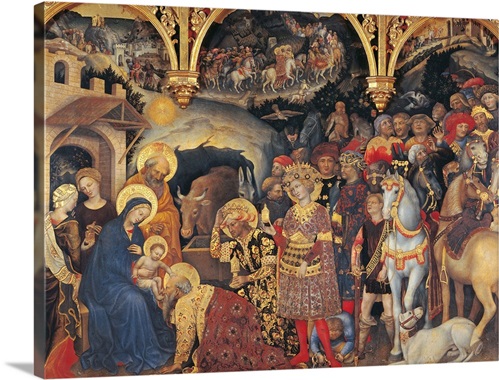
It can be seen that these two accounts have practically nothing in common save for two points: firstly that Jesus was born in Bethlehem, and secondly, that he grew up in Nazareth, in Galilee, which is a long distance away to the north. (One way of accounting for the obvious discrepancies is the tradition that the Magi only arrived in Bethlehem several days after the birth, hence "the twelve days of Christmas")  Also, the gospel accounts, especially Matthew's, have been much embroidered by later additions. He does not even tell us how many wise men there were: the tradition that they were is only a deduction from the fact that they presented three gifts. At no point are they called Kings: the New English Bible calls the astrologers! In the Middle Ages they were provided with names, and sometimes they were depicted as, respectively, a European, an Arab and a Negro, to symbolise the three continents of Europe, Asia and Africa cknowledging Christ. And since Matthew nowhere mentions a stable or a manger, paintings showing magnificently-dressed monarchs with vast trains of attendants kneeling before the infant Jesus in a rickety old stable, although gorgeous and dramatic, lack any Biblical basis. 
Image result for The-magi Nor, for that matter, is there any basis for the charming pictures of an ox and an ass looking down on the baby Jesus: these animals are nowhere mentioned.
   We are told practically nothing about Joseph, except that he is descended from King David (by two incompatible genealogies). The tradition that he was much older than Mary is no more than a tradition; nor is there any reference in the nativity stories to him being a carpenter. But there is no reason why Jesus should not himself have been a carpenter before embarking on his ministry: it was quite common in the Jewish world for rabbis to come from humble origins and support themselves by everyday trades.

Both Matthew and Luke make an attempt to place a date on the nativity. King Herod plays an important part in Matthew's story, and Luke also places the story of Zechariah in the reign of Herod; though he confuses the picture by putting the census "when Quirinius was governor of Syria", which suggests a date as late as AD 6. He then says Jesus began his ministry "in the fifteenth year of the Emperor Tiberius": that is, AD 28 or 29. But this presents another problem, because in the Roman dating Herod died in 4 BC! This difficulty came to be realised in later centuries, which is why Bishop Ussher famously dated the creation of the world in 4004 BC rather than simply 4000; in other words, four thousand years before the birth of Christ. 

When examining these different accounts, we should bear in mind the lack of any surviving independent evidence. Very few documents survive from the Ancient World, and states then were not run bureaucratically: they did not compile information just for its own sake. Historians in Greek and Roman times did not approach their work with the degree of rigorous research and evaluation that would be expected of a modern PhD thesis. The great Greek historian Thucydides tells us that he did not attempt accurate reporting of speeches, but instead tried "to have speakers say what, im my opinion, was called for by each situation".  As R. G. Collingwood put it, "We start from the wrong premise by assuming that Greeks and Romans looked upon the study and writing of history essentially as we do". The same assessment can be made of the gospel writers.         


Footnote: 
A Jewish friend once told me that, for an orthodox Jew, it was a horribly blasphemous thought that God should come down to earth and beget a child on a human woman. The Greek and Roman gods, of course, were doing this all the time. 
   I remember a radio discussion about the Nativity between A. N. Wilson and a bishop. Wilson asked, "Look here, bishop: do you believe these things actually happened?" The bishop started talking about allegory and metaphor, but Wilson cut him short, saying, "Then you don't!" To my mind, Wilson had easily won this exchange, yet the studio audience gave much greater applause to the bishop! 

Wednesday, 20 December 2017

A Happy Christmas to all!


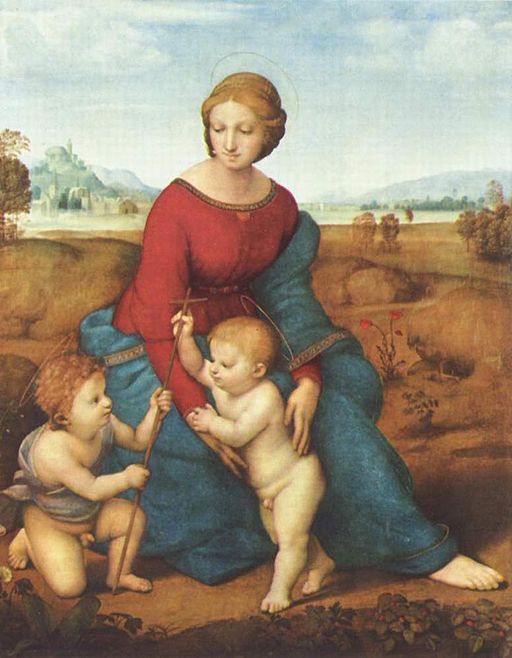
Mary with the infant Jesus and John the Baptist, by Raphael. The iconography on pictures like this is always standard. Mary, as ever, wears a red dress and a bue cloak. John the Baptist always carries a cross with a very long shaft and short cross-piece. As an adult, he would have dishevelled hair and beard, and would wear a tunic of animal-skin. If Jesus is on the picture, John will point at him; otherwise he will point heavenwards.

Monday, 11 December 2017

Grinshill under snow

We've had hardly any snow here in north Shropshire for many years, but this changed dramatically at the weekend. We climbed to the top of Grinshill and were rewarded with these views, looking towards the Wrekin, Shrewsbury and the road to Wales.


Sunday, 3 December 2017

Tolkien's Last Story

When  "The Lord of the Rings" was finally published in 1955, J.R.R. Tolkien was already sixty-three years old. With the help of enthusiastic endorsements from the likes of C.S. Lewis and W.H. Auden, the enormous work was an immediate success, and really took off when Ace Books put out an unauthorised paperback edition in the U.S.A. in 1965. Tolkien, who had always been worried about money, unexpectedly found himself a rich man, and was able to retire from his Oxford professorship in 1959.
    His publishers, Allen and Unwin, were naturally eager for more books from him; partcularly the "Simarillion", which recounted the earlier history of Middle Earth, which Tolkien had been working on spasmodically ever since the First World War; but this was to prove elusive. Tolkien had always been a productive but disorganised writer: he would begin a story or a long poem only to become dissatisfied with it and start again, perhaps several times. His papers therefore included many different drafts of the same story, often with the names of the characters changed. Two of the central stories in the "Silmarillion" cycle, "The Lay of the Children of Hurin" and "The Lay of Leithian" (about Beren and Luthien) were even recast as poems; the first in Saxon-style alliterative verse, the second as rhymed couplets, and neither had been completed! One suspects that "The Lord of the Rings" would have fared no better without the encouragement of C. S. Lewis and the other Inklings: certainly early drafts of the book are very different from what eventually emerged. 
   Reducing the mass of "Silmarillion" drafts into a single coherent story would clearly take a great deal of work, and for the moment his publishers had to be content with two minor works: "The Adventures of Tom Bombadil" (1962), an anthology of poems, and "Tree and Leaf" (1964), a combination of the text of a lecture on fairy stories, and a short story, "Leaf by Niggle". Most of the material in these had originally been written much earlier.
   Meanwhile Tolkien was subject to all manner of distractions. He began to receive enormous quantities of letters from fans, and for a while tried to reply to them all, often at considerable length. He worked on his translation of the great mediaeval poem, "Sir Gawain and the Green Knight", which was only published after his death. He was badly shaken by the death of C. S. Lewis in 1963, and increasingly worried by the deteriorating health of his wife, Edith. They celebrated their Golden Wedding in 1966, in an occasion made memorable by the performance of "The Road Goes Ever On", a setting to music of Tolkien's poems, with the composer Donald Swann at the piano. Then in 1968 they left Oxford and retired to Bournemouth, where Tolkien felt increasingly lonely and cut off from his intellectual roots. He commented, "Find it impossible to work - beginning to feel old and the fire dying down". Edith died in 1971.

Unexpectedly in early 1965 he was asked by an American publisher to write a preface to a reissue of a story by the late-Victorian fantasy writer George MacDonald. Tolkien did not share Lewis's enthusiasm for MacDonald's writings, but he took up the offer, and began by explaining the notion of Fairy; not as a twee little lady with wings and a diaphonous dress, but as something strange and powerful, which may perhaps be glimpsed in a tale. To illustrate the point, he would tell the following story.... The story grew until it became "Smith of Wootton Major", the last story he ever wrote, which was published in 1967. The preface to George MacDonald's book was never completed.

"Smith of Wootton Major" is a very short book. Even with the full-page illustrations it runs to just over 60 pages. The setting, as with Tolkien's earlier work, "Farmer Giles of Ham", is a vaguely-defined mediaeval England. The gist of the story is how the central figure, who is never given any name other than Smith, was as a boy given a token, a star, which enables him to visit the land of Faery (Tolkien's preferred spelling). He travels there many times, and sees a variety of strange, wonderful and sometimes terrifying things, most of which he fails to understand. Eventually after almost fifty years he is obliged to give up the star so it can be passed on, and has to settle down to a mundane life as the village blacksmith.
   Tolkien always maintained that he disliked allegory in stories, but he acknowledged an allegorical element here, with religious obsevation in Wootton Major being reduced to just regular feasting. It is also clearly an autobiographical tale, by an old man who knows his creative powers are waning (Smith can no longer visit Faery once he has given back the star). It also illustrates Tolkien's fundamentally pessimistic attitude towards the modern world: the only other significant character in the story is Noakes, the village cook, who is vain, greedy, ignorant and refuses to believe in Faery at all.

After Edith's death, Tolkien retuned to Oxford, but was unable to make much progress in sorting out the "Silmarillion". He died in 1973, and it was left to his son, Christopher, to publish his own selection of the "Silmarillion" stories in 1977. 


.