This mid-19th century window, in the church of St. Mary the Virgin in Shrewsbury, is a copy of a painting by the Spanish artist Murillo, depicting the adoration of the Kings.

This mid-19th century window, in the church of St. Mary the Virgin in Shrewsbury, is a copy of a painting by the Spanish artist Murillo, depicting the adoration of the Kings.
Margaret Dumont: "I believe Donald Trump was sent by God."
Groucho Marx: "Why? Had he run out of locusts?"

(Some thoughts evoked by recent events in Irael and Gaza)
Terrorism/
terrorist is a “hiss-word”: intended less to convey information than to provoke
an audience reaction. A terrorist is, by definition, a bad guy. Conversely, no
good guy can be a terrorist, even though his actions might be considered to be
similar.
What is the difference between a terrorist and a
freedom-fighter? The cynical answer is that “it depends where you’re standing”:
one man’s terrorist being another man’s freedom fighter. Nevertheless, it
should be possible to draw some distinction.
Terrorism always has some underlying political
motive. Thus, ordinary gangland killings and bombings are not considered
terroristic, but could be if there was some underlying ethnic or religious
conflict
One might have thought that there is always a natural right to defend your home against a foreign invader, but in military law this is not the case. It is a longstanding principle of war that, whereas
enemy uniformed soldiers are entitled to be treated justly, partisans,
guerrilla fighters and civilians in arms can simply be killed out of hand. They
are, in fact, always treated as terrorists.
It is straightforward to designate certain actions
as terrorism (for instance, “9-11” in New York in 2001), but more difficult to
define terrorism as such. Are all political assassinations necessarily terroristic? Most of us would agree that the killing of the Nazi leader Heydrich in Prague in 1942 was justifiable and not terroristic: but should it be viewed differently if numbers of civilian bystanders were killed in the operation?
Can governments be guilty of terrorism. such as the
mass bombing of cities? Possible examples might be Dresden or Hiroshima in 1945, or indeed Gaza?
What should be the best response by a government
whose citizens have suffered a terrorist attack? Might it only serve to make
things worse? In the instances of 9-11 and October’s events in Israel, the
governments concerned understandably felt they had to do SOMETHING: hence the
Afghan war and current events in Gaza. The campaigns in Afghanistan and then Iraq were militarily successful in the short term, but not at all useful in the eventual results. By contrast, Mrs Thatcher’s government did NOT
react violently to the I.R.A.’s Brighton bomb in 1984, which almost succeeded in killing the entire Cabinet. Why did
she behave with such caution? Was that in fact the best response, leading eventually to the Northern Ireland peace process?
The most spectacular example of an understandable
reaction going horribly wrong is, of course, the response of the Austrian
government to the assassination of Archduke Franz Ferdinand by Serbian-backed
terrorists (freedom fighters?) at Sarajevo in 1914!
Postscript: “Situationism”is a term stemming from events in France and elsewhere around 1968. This involves taking actions so violent that the state responds with extreme violence of its own, which falls mostly upon the local population rather than the perpetrators. This has the effect of discrediting the moderates, forcing everyone to take sides, and turning opinion against the government. Should the Hamas gunmen of October be regarded as situationists?
My online historical novel has finally been finished, after 37 weekly chapters! It can be read in its entirety at
pgvshil.blogspot.com
or by following the link on the right, through "View my complete profile" to "The shadow of the past: the memoirs of Charles Huntingdon, M.P."
Any comments would be welcome!
Merton Russell-Cotes (1835-1921) was a rich and successful hotelier. In 1876 he and his wife Annie moved to Bournemouth, the seaside resort on the Dorset coast, and developed the Royal Bath Hotel as the most luxurious hotel in the town. As well as their business work and their charitable and political activities (he served as Mayor of Bournemouth in 1894-5, and was knighted in 1909), the couple were indefaticable travellers, voyaging all over the world, collecting wherever they went; being particularly keen on Oriental and Islamic art and artifacts.
In 1896 Russell-Cotes commissioned a local architect, John Frederick Fogarty, to design them a new house, to be named East Cliff Hall, in a position high above the beach with a garden in front and large windows and balconies opening to a beautiful view westwards to Poole Bay. Special fireplaces, stained glass and light fittings were ordered, but the house was also to have the most up-to-date electricity, plumbing and central heating, plus a telephone. The house was completed in 1901, but in 1916-19 new galleries were added to house the family's burgeoning art collection.
They had always intended to open their house to public view, and after their deaths it was established in 1922 as the Russell-Cotes Art Gallery and Museum.
This is the house and its view today.


This can hardly be bettered, but the contents of the house, while undoubtedly splendidly opulent, verge on the surreal, for they embody everything that the next generation of artists and designers were in revolt against. Walls are heavily panelled, every surface and niche is full of objects or pictures,
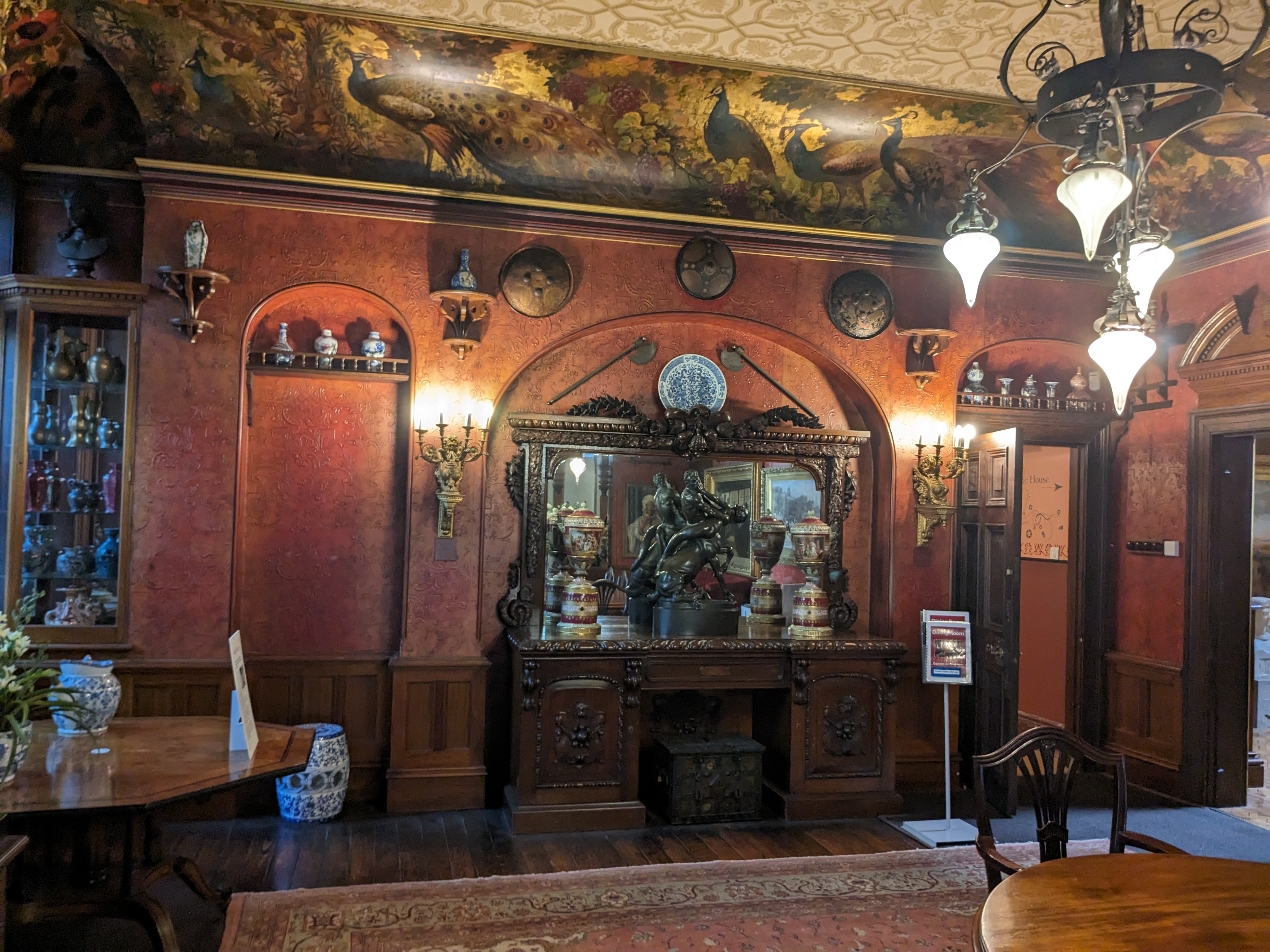

and what is one to make of the pictures, such as this enormous late-Victorian potrayal of nudes entirely devoid of any erotic appeal,

or of religious scenes, such as this one by Edwin Longsden Lang of the Holy Family arriving in Egypt (approximately 18 feet by 6, in a style that, fifty years later and in another country, would be termed "Socialist realism"?

If you are ever in Bournemouth, you must go and see it!
In these violent times, my thoughts have turned to a scene in Shakespeare's early play, "Henry VI, part 3", set in the blodstained turmoil of the Wars of the Roses. The teenage son of the Duke of York has been captured by Lord Clifford: the boy pleads for his life, but Clifford is implacable. "Thy father killed mine, therefore die!" he tells him.
I find these words truly terrifying. An endless cycle of revenge can so easily continue for generation after generation, and differences of religion, ideology or race count for little by comparison.

Bryan Humphreys and his wife Ann Wigley left the village of Carno, near Newtown in Powyss, to seek a new life in America, eventually settling in Chicago. But they did not find properity, for Bryan was a feckless character, too fond of drink and gambling, and the family was reduced to poverty when in 1906 he lost his job through drunkenness. Their son, born in 1899 and christened Llewellyn Morris Humphreys, had to leave school to work as a newsboy. The youth, like many others in his position, became involved in petty crime, and was arrested on many occasions for theft, but was spared any long prison sentence.
With the coming of Prohibition after the First World War, unbounded new horizons opened up for criminals in the smuggling of bootleg alcohol. In 1922 Humphreys, who by this time had given himself the name of Murray, attempted to muscle in on the racket by hijacking a liquor truck belonging to Al Capone. He was soon caught and brought before the great man himself, but Capone was impressed by his impudent courage, and instead of shooting Humphreys, recruited him for his organisation!
Murray Humphreys was soon reognised as one of the superior brains of the gang, and his rise up the hierarchy was rapid. He may have had a hand in organising the famous St Valentine's Day massacre of 1929, but he never acquired the reputation of being a man of violence: instead his role was mostly financial. No major gang could hope to survive without paying a substantial proportion of its takings to local police, politicians and officials, and Humphreys seems to played had a key part in this chain of corruption. He became a specialist in the laundering of "dirty money", working with a fellow-Welshman; an accountant called Fred Evans. He also gained the unusual nickname of "The Camel", presumably through the obvious link of "Murray the Hump".

After Capone was convicted of tax evasion and sentenced to eleven years' imprisonment in Alcatraz, his organisation continued more or less intact. Humphreys himself was officially branded as "Public Enemy No. 1" after his boss's fall, but all that happened to him was that he was sentenced to 18 months' imprisonment in 1933 after pleading guilty to income tax evasion, and was released after just 13 months. It was the longest term of imprisonment he would ever suffer. Instead he continued his activities of bribery and corruption, infiltrating trades unions and laundering the profits of crime.
New possibilities opened in California, where the gangsters found they could extort money from Hollywood by infiltrating the Scenery Erectors' Union and paralyse the movie industry by threatening to call strikes. Humphreys was involved in this, and also in the bribery of state officials in Nevada to permit the building of the first casinos in Las Vegas. It has been suggested that the character of Tom Hagen in the "Godfather" films is based on Humphreys.
Like many other senior gangsters, Humphreys experienced difficulties when summoned to testify before the Kefauver Committee on organised crime in the early 1950s. Many of the gangsters, advised by their clever lawyers, attempted to "plead the Fifth Amendment", to avoid answering questions, on the grounds that, in the immortal words of Capone's old business manager, the splendidly-nicknamed Jake "Greasy Thumb" Guzik, "I might discriminate myself". Nevertheless, they were all made to look extremely uncomfortable before the nation's television cameras.
Humphreys now faced further investigation of his tax affairs but avoided arrest by dying of a heart attack in 1965 while vacuuming his apartment. He was one of the last survivors of the riotous days of the criminal 1920s. This was perhaps the only way the career of a gangster could be held to have ended successfully: to perish of natural causes, never having served a lengthy term in prison.


