Saturday, 15 December 2012

Nativity


Christmas is fast approaching. We are all familiar with the traditional Christmas story, but often do not realise how contradictory are the scriptural accounts of the birth of Jesus, and how much of the story is based on tradition alone.

The gospels of Mark and John make no mention of the nativity at all, and Luke and Matthew tell wholly different stories. Neither puts a date on the year of Jesus's birth, presumably because they did not consider this to be very important. Indeed, Matthew confuses things by bringing King Herod into his story, since by Roman chronology Herod died in 4 BC! Luke tells us that John the Baptist began his preaching "in the 15th year of the Emperor Tiberius" (AD 28-29), and that Jesus met him "when he was about 30 years old". The only point of agreement about the nativity is the Jesus was born in Bethlehem; which is in itself a little puzzling, since Jesus clearly began his ministry in Nazareth, by the Sea of Galilee, a long way to the north of Bethlehem. Matthew and Luke give completely incompatible genealogies for Jesus. They cannot even agree about the name of Joseph's father (Matthew gives it as Jacob; Luke as Heli) - which in any case seems a bit pointless, since both stress that Jesus was not Joseph's son anyway. Neither of them says at what time of the year the nativity took place: it is only a tradition that it was at the end of December; though it seems fitting that the God-child should be born just after the shortest day of the year: a time of renewed hope.


It is Luke's account which is the best-known. He begins his story with the miraculous birth of John the Baptist to Mary's elderly "kinswoman", Elizabeth. Then we have the Archangel Gabriel appearing to Mary; "the decree from Caesar Augustus that all the world should be taxed", "when Quirinius was governor of Syria" (which appears to refer to a census taken in 6 AD) causing Joseph and Mary to travel to Bethlehem; the lodging in the stable, and the adoration of the shepherds after they have seen the angel. After the nativity we have the circumcision of the baby Jesus in the Temple in Jerusalem, accompanied by various prophesies, and the return to Nazareth.

Matthew's story is quite different. There we have an angel appearing to Joseph, and there is no mention of a stable for the birth in Bethlehem. The most famous part of Matthew's story is the appearance of the "wise men" or "magi" before King Herod, enquiring about the Christ-child, since they "have seen his star in the east". Matthew nowhere calls them kings, nor does he even tell us how many they were: the notion that there must have been three of them is only a deduction from the fact that they presented the baby Jesus with the three symbolic gifts. There seems to be some confusion about the whole story of the star. Around 6 BC there was a major conjuction of the planets, which astrologers would have interpreted as predicting an event of major importance. (Some scholars have speculated that it might refer to the appearance of Halley's Comet in 12 BC). The New English Bible translates "magi" as "astrologers", which is appropriate. Herod, angry and alarmed, orders the slaughter of all children in Bethlehem (an action which, though lacking support from any other historical source, would have been quite in accordance with what is known of Herod's character!), but Joseph and Mary are forewarned in a dream and escape into Egypt. They do not return till Herod is dead, when they decide to settle in Nazareth, because it is safer. This appears to contradict Luke's story that they came from Nazareth in the first place, and does not tally with Luke's account of the circumcision in the Temple, which Matthew does not mention at all. (Neither, incidentally, makes any reference to the Holy Family travelling on a donkey, which forms such a touching scene on so many Christmas cards)


It is clear that we have here two completely different accounts of the nativity, which cannot be reconciled.
I have been told that, for a Jew, the notion that God could descend from the heavens to beget a child on a human mother would be horribly blasphemous. The Greek and Roman gods, by contrast, did this sort of thing all the time; which perhaps helps to explain why the early Christian missionaries met with great hostility from Jews, but were more successful in converting gentiles.

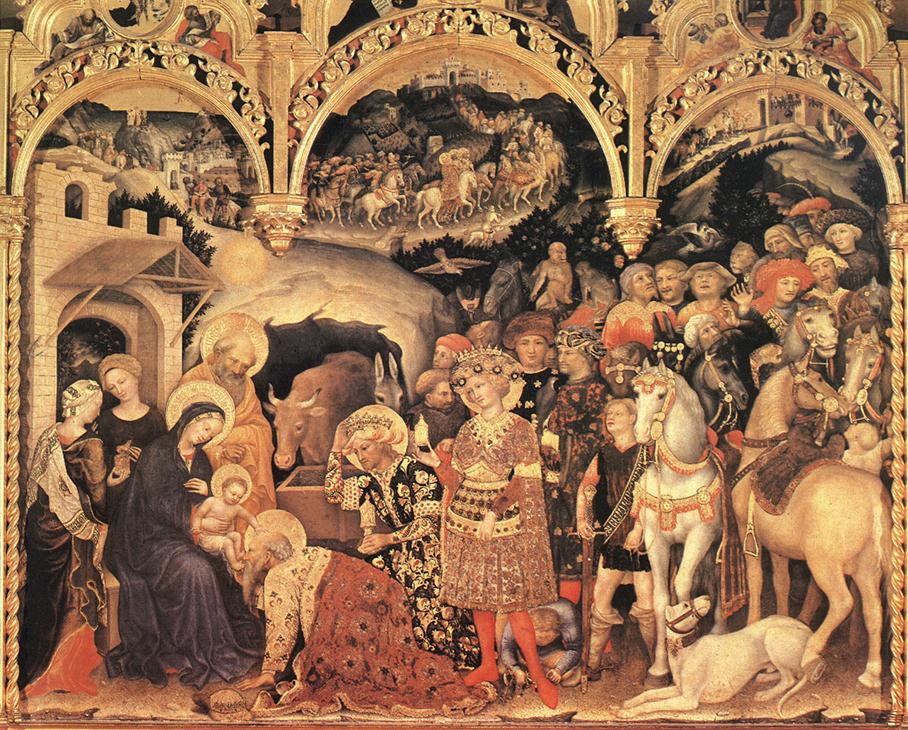
The Nativity has inspired great art over the centuries. The first picture here is by Piero della Francesca (c.1420-92), the second by Sandro Botticelli (1444-1510), the third by Andrea Mantegna (1431-1506), and the fourth by Gentile da Fabriano (1370-1407). All have certain features in common, quite apart from the rustic setting. The Virgin Mary wears her traditional colours; a blue cloak over a red dress; and Joseph is an old man; often rather detached from the scene. The baby Jesus, oddly enough, always appears to be several months old; certainly not a newly-born infant!

At a very much lower artistic level, illuminated Santa Claus figures are going up all over buildings even as I write, but I have yet to see any portrayal of the Christian Nativity at all. Perhaps this is as it should be: we are celebrating a consumerist festival called "Xmas", and for this Santa Claus is a suitable multi-faith symbol: perhaps the only supernatural figure that all children are encouraged to believe in. Every year around this time there are reports of teachers being officially censured for telling their little charges that he doesn't really exist! So Santa's red and white (the Coca-cola colours!) have rightly replaced the Virgin Mary's red and blue as the colours of the festive season.

Friday, 7 December 2012

Henry VII: a disturbed childhood

Henry Tudor, the future King Henry VII, had the misfortune to be born in 1457, and thus grew up in the most turbulent period of the Wars of the Roses between the rival families of Lancaster and York. His formative years were haunted by violent death.

His mother, Margaret Beaufort, through whom he inherited his distinctly sketchy dynastic claim to the throne, belonged to the family of the Dukes of Somerset: firm Lancastrians. Her father had committed suicide following dubious conduct in the wars against France when she was one year old, leaving her a great heiress. In consequence at the age of ten her marriage was arranged to Edmund Tudor, half-brother to King Henry VI. She was still only thirteen when Henry, who was to be her only child, was born.    

Henry was never to see his father, who was captured in battle and imprisoned in Carmarthen castle, where he died of the plague two months before Henry's birth. Margaret  then married Henry Stafford, the son of the Duke of Buckingham.
     In 1461 Henry's paternal grandfather, Owen Tudor, found himself on the losing side at the battle of Mortimer's Cross and was beheaded. The new Yorkist King, Edward IV, granted his supporter William, Lord Herbert, guardianship of young Henry. In May 1464 Margaret's cousin, the Duke of Somerset, was also defeated in battle and executed.
     Henry seems to have got on well with his guardian, but disaster struck again in July 1469, when Lord Herbert's forces were defeated at Edgecote, near Banbury. He was beheaded the next day. Henry, aged twelve, witnessed the battle, and not surprisingly was terrified. In autumn 1471 the Lancastrian forces were defeated at Tewkesbury and the deposed King Henry VI was murdered in the Tower, leaving Henry Tudor, now Duke of Richmond, the only remaining Lancastrian claimant to the throne. He managed to flee to Britanny, where he stayed for the next thirteen years, constantly fearing kidnap by English agents. His mother did not see him at all during this time: meanwhile her second husband, Henry Stafford, died of wounds received at the battle of Barnet; and she again remarried; this time to Lord Stanley.
     Margaret proved to be a great survivor. Despite her strong Lancastrian links, she managed to stay on friendly terms with the Yorkist regime, and was even given the honour of being a train-bearer for Queen Anne Neville at the coronation of Richard III in 1483. But soon after this she became involved in plotting. In 1485 her son Henry, with the backing of the King of France, landed in south Wales and mustered supporters. His victory over Richard at Bosworth was largely due to the fact that the forces of his stepfather Lord Stanley changed sides in the middle of the battle. Richard was killed and Henry was crowned King, essentially by right of conquest.

Henry once told the chronicler Philippe de Commynes that most of his life had been spent as a captive or fugitive, as a result of which he had become extremely (we might nowadays say pathologically) suspicious. No modern psychologist would be in the least surprised at this: the wonder is that he didn't turn out far worse!

Friday, 30 November 2012

Relations with Islam: how things have changed!


This is a propaganda poster which I saw on a visit to the Soviet Union back in 1984. In those days the western powers were arming Islamic fighters in the war to drive the Communists and their Soviet mentors out of Afghanistan: so here we have Mujahadeen warriors, all of whom look very like Ousama bin Laden, charging beneath their banner, which is, of couse, the dollar! (My Russian isn't up to translating all the caption: can anybody help?).
The anti-communist campaign was successful. After heavy losses, Gorbachev withdrew the Red Army and in 1991 the Soviet Union disintegrated; the Afghan disaster having played no small part in the collapse. In Afghanistan itself the Communist government was overthrown, and soon afterwards the Taleban came to power, with results that are familiar to us all.
How different things are now! I cannot help but ponder that if our aims in Afghanistan were to stop the heroin trade and curb militant Islamic fundamentalism, we should have left the Communists in control. They would have dealt very effectively with opium growers and people who wanted to stop little girls from going to school: they'd have shot them! But our priorities were very different back in the 1980s!

Thursday, 22 November 2012

Dickens and Disraeli on discontent

I recently read “Hard Times” (1854), Charles Dickens’s only attempt at a novel about the industrial north of England, set in a cotton-manufacturing city he calls “Coketown”. Opinions of the novel have differed widely: in George Orwell’s long essay on Dickens we are told that the great Victorian historian Lord Macaulay refused to review the book because of what he saw as its “sullen socialism”, whereas Lenin was revolted by Dickens’s “bourgeois sentimentality”. In my opinion, Lenin was much closer to the mark than Macaulay. I found it a deeply irritating book, with a ramshackle plot, ridiculous characters, and a complete absence of any ideas for remedying the faults and abuses Dickens portrayed. As a corrective I reread a contemporary novel covering similar ground: “Sybil” (1845) by Benjamin Disraeli. I would like here to compare and contrast the two books.

Dickens always excels at memorable descriptions of scenes and characters. His weaknesses, apart from the improbable plots, are that the characters tend to be one-dimensional caricatures, that he has neither knowledge nor interest in how things actually work, and that the only remedy he can find for abuses is that everyone should be nicer to each other. All this is apparent in “Hard Times”. The “bad guys”, Gradgrind and Bounderby, especially the latter, are simply comic clowns, far too ridiculous to be taken seriously. Bounderby is a bully, but also rabbits on endlessly about how he dragged himself up from the gutter by his own efforts. It transpires that this is totally untrue, but his motive for doing it remains a mystery. Louisa, the daughter of Gradgrind and unwilling wife of Bounderby, is, like many Victorian heroines, too wet to be interesting. The central working-class figure, Stephen Blackpool, who is “sent to Coventry” for refusing to join a Trades Union and then unjustly accused of being involved in a bank robbery, merely comes across as pathetic, making little effort to defend himself. Then there is the Trades Union and Chartist leader, Slackbridge, who is portrayed mercilessly; ludicrous name, ludicrous appearance, ludicrous speeches; yet with the workers of Coketown eating out of his hand. When Blackpool is unjustly accused of the robbery, Slackbridge actually believes Bounderby rather than Blackpool, and urges the workers to catch him and hand him over! (Lenin and Stalin, I feel sure, would have marked out a working-class bank robber as a man of spirit and a good recruit for the revolutionary cause!) Dickens plainly has no sympathy for Trades Unionism.

I thought there were faults of construction. The local dialect of Blackpool and the lisp of Sleary the circus-owner are given phonetically throughout, which I found a very irritating distraction, forcing us to decipher every word. Gradgrind changes in character very abruptly when Louisa runs away from her husband, and has no difficulty in accepting that his son is a bank robber, despite the extreme flimsiness of the evidence against him. James Harthouse, an upper-class idler, is the only character with any sex-drive: I felt sure he must be involved in the robbery, but instead he simply disappears form the story. The pages of “pathos” describing the death of Stephen Blackpool are simply awful; and at the end, his friend Rachel is portrayed as simply working on at the factory until she is too old to continue.

What does Dickens want to happen? He has no plan at all for the relief of industrial abuses he describes. He is contemptuous of reason, and despises Parliament (calling M.P.s “National dustmen”). There is no trace of anything specifically Christian in his writings, which is perhaps not surprising, since he was essentially a pre-Victorian, born in 1812: none of his characters shows any sign of Christian belief - or, indeed, of any other religious faith. Dickens was writing twenty years before the enforcement of compulsory primary schooling, and one generally expects that education will be seen as a hope for a better society in the future. But in the unforgettable school scene which opens the book, the children are crammed with “facts” at Gradgrind’s insistence, and forbidden ever to exercise their imagination. The best that can be said for the teacher, the splendidly-named McChoakemchild, is that he is a more useful person than J. Wackford Squeers in “Nicholas Nickleby”; and yet Dickens had so little in the way of positive ideas about education that he sent his own son to Eton! I think this typifies Dickens’s limitations as a thinker.

Let us turn to Benjamin Disraeli: the only British Prime Minister to have been also the author of several novels. In the 1840s, when he was already a Tory Member of Parliament (at this point representing Shrewsbury, in Shropshire) he produced a trilogy: “Coningsby”, “Sybil” and “Tancred”; the third being the least satisfactory. His motives for writing were mixed. In the first place, he needed the money: for most of his career he was plagued by debts, which at this time amounted to about £20,000 - at least half a million in today’s terms. Secondly, there were political ideas he wished to put forward, and which he does at length in the trilogy. He was associated with a group of youthful aristocrats known as “Young England”. Their theories sound very silly nowadays, but at the time they were considered important enough for Karl Marx to jeer at them in the “Communist Manifesto”. Particularly they were hostile to their Conservative party leader, Sir Robert Peel (Prime Minister 1841-46), whom they accused of betraying old Tory principles. Disraeli, who was neither an aristocrat nor young (he was born in 1804, eight years before Dickens) produced such ringing phrases as “A Conservative government is an organised hypocrisy”, and, in “Coningsby”, “A sound Conservative government - Tory men and Whig measures”. In 1846 Disraeli was to play a leading role in splitting the party and bringing down Peel’s government: an action which left the Conservatives without a Parliamentary majority for the next thirty years.

Most of Disraeli’s novels centre upon an upper-class young man making his way in politics and high society; “Sybil” being the only one where he ventured to set scenes in the industrial north. The hero, Charles Egremont, is indeed a young aristocrat, but is saved from the vapid existence led by many of his class by his love for Sybil, the daughter of the radical Chartist leader, Walter Gerard. The full title of the book is “Sybil, or The Two Nations”; the latter phrase being explained by a scene in Chapter 5 where Gerard tells Egremont that Queen Victoria rules over “Two nations; between whom there is no intercourse and no sympathy; who are as ignorant of each other’s habits, thoughts and feelings as if they were dwellers in different zones, or inhabitants of different planets; who are formed by a different breeding, are fed by a different food, are ordered by different manners, and are not governed by the same laws. ……. THE RICH AND THE POOR.” (it is printed thus, in block capitals, to ensure we get the message).
Part of the plot is romantic and improbable, but it is firmly anchored into a clear chronology of historical events: the accession of Queen Victoria in 1837, the formation of Peel’s government in 1841 and, as a climax, the “Plug Plot” riots of 1842.

Disraeli outdoes Dickens by describing four different communities, each with its own problems and grievances: a decaying rural town, a factory town called Mowbray, a coalmining village, and, most memorably, the settlement he calls “Wodgate” (believed to be Willenhall, near Birmingham), where there is no constituted authority at all and the people are totally illiterate (which makes one realise that the children at Gradgrind’s school were actually quite privileged!). Disraeli had not visited such places, but he got his information from the “Blue Books” of government statistics, which were also extensively used by Marx and Engels, but which Dickens ridicules. Disraeli knew, for instance, that a principal grievance in the mining communities was the system of “tommy-shops”: the miners were not paid in cash, but in tokens which could only be used in certain shops, where they were given low-quality goods at inflated prices. One of Disraeli’s best scenes depicts Master Thomas, who runs the tommy-shop, bullying and humiliating the miners’ wives.

Disraeli’s characters, though not as memorably depicted as Dickens’s, are much more believable as people. The selfish reactionary nobleman, Lord Marney, comes across as a genuinely sinister and dangerous person, as does his friend, Lord de Mowbray, unlike the ridiculous Bounderby. It is interesting that the Chartist leaders, Gerard and Stephen Morley, are given far more sympathetic treatment than Dickens gives to the ludicrous Slackbridge; and Disraeli’s young working-class figures, Dandy Mick and Devilsdust, are infinitely more positive characters than the pathetic and passive Stephen Blackpool: indeed, all these men play important heroic roles in the plot. Devilsdust, incidentally, has genuinely risen from the gutter, as Bounderby pretends to have done, but has learnt to read and write and has absorbed a good deal of left-wing class-conscious ideology, concerning capitalists and workers, several years before the writing of the “Communist Manifesto”. Rather surprisingly, there is more overt Christianity in Disraeli’s novel than in Dickens’s: Disraeli portrays Walter Gerard and his daughter as dedicated Catholics, and among his minor characters there is a strong-minded vicar who is prepared to stand up to the upper-class bullies.

As an experienced politician, Disraeli knew how things actually worked, whereas Dickens never bothered to find out, but simply took refuge in satire. Dickens is contemptuous of Parliament and dismisses M.P.s as “national dustmen”; though many today would see the time as a golden age of political giants: Palmerston and the young Gladstone, as well as Peel and Disraeli himself. Dickens is thus incapable of matching the lethal scene where Disraeli portrays Peel (called simply “the gentleman in Downing Street”) instructing his factotum, who is given the thoroughly Dickensian name of Hoaxem, to give two completely contradictory messages to two different visiting delegations, and particularly to be “ “Frank and explicit”: that is the right line to take when you wish to conceal your own mind and to confuse the minds of others.” This is far more damaging than Dickens’s crude abuse! (Incidentally, many historians view Sir Robert Peel as one of the greatest of all British Prime Ministers)

Unlike Dickens, Disraeli brings his novel to a dramatic climax in the “Plug Plot” riots, in which the bad characters duly get their comeuppance: Master Joseph perishes as his tommy-shop is destroyed by the striking miners, Lord Marney is stoned to death by a furious crowd, and Lord de Mowbray’s bogus-mediaeval castle is plundered and burnt to the ground by the “hell-cats” of Wodgate. The plot necessitates that Gerard and Morley should both be killed by the militia, though both of them die heroically. Finally, Charles Egremont rescues Sybil from the chaos and they live happily ever after, with Disraeli assuring us that times are now getting better for everyone. Although no-one could pretend that Disraeli could ever be Dickens’s equal as a novelist, I thought this book to be a far better portrayal of the times they lived in.
 I think "Sybil" would make an excellent film! I'm surprised no-one has attempted it.

Footnotes:-
1. Benjamin Disraeli served as Chancellor of the Exchequer in 1852, 1858-9 and 1866-8, and as Prime Minister in 1868. On none of these brief spells in government did the Conservatives hold a Parliamentary majority. It was only in 1874-80 that he was Prime Minister in a majority government. He was created Earl of Beaconsfield in 1876 and died in 1881.
2. 1845, the year when "Sybil" was published, also saw the publication of "The Condition of the Working Class in England" by the young Friedrich Engels (born 1820, living in England since 1842). Engels used the same official statistics as Disraeli, but it is unlikely that Disraeli knew anything of Engels's book, since it was initially published in Germany and did not appear in English for several decades.

Thursday, 15 November 2012

Inherit the Truth, by Anita Lasker-Wallfisch

This is the autobiography of a German-Jewish lady who survived the Holocaust thanks to her skill as a cellist. Anita Lasker, as she was then, was born in Breslau in Germany in 1925, one of three daughters of a prosperous, musical middle-class Jewish family. She showed great early promise as a cellist, but her childhood and youth witnessed increasing anti-semitic discrimination and persecution. One of her sisters, Marianne, managed to escape to England, but in April 1942 her parents were deported to Poland and never seen again; and that autumn Anita and her other sister, Renate, were arrested for trying to flee to France. They were imprisoned, which paradoxically could well have saved their lives, because it meant they were not deported to Auschwitz-Birkenau until autumn 1943.
      On arrival there she was saved from "selection" for the gas chambers by letting slip that she was a cellist. Although she was still only 18, and had not been able to practise since her arrest, she was immediately recruited into the Auschwitz orchestra: a bizarre organisation of internees which gave concerts for the guards and played marching tunes for the slave labourers as they were driven out to their work. Again, her life was saved.
     Auschwitz was run down in late 1944 as the Red Army came near. In October of that year, Anita and Renate, together with countless others, were taken westwards to Belsen. Here there were no mass gassings, but instead gross overcrowding, starvation and typhus epidemics as Nazi Germany collapsed. Why the guards did not simply throw away their uniforms and lose their identity in the turmoil of refugees remains a mystery: instead they kept the camp going, with an ever-mounting death rate, until British troops arrived in April 1945. Nothing could have prepared the soldiers, battle-hardened though they were, for the appalling sights that met them: the heaps of emaciated copses, and even the survivors little more than walking skeletons. Anita and Renate remained on the scene to give evidence at the trials of the Belsen guards, which resulted in the hanging of eight men and three women.
      After some bureaucratic delays, Anita managed to move to England, where she married and began her career as a cellist.


I was fortunate enough to meet Anita Lasker-Wallfisch when she gave a very moving lecture about her experiences. I asked her to comment on what I had read; that the most brutal guards in the concentration camps were often not Germans, but people drawn from minority groups in Eastern Europe, such as Lithuanians and Ukrainians. She agreed with this: her view was that for most Germans, antisemitism was essentially intellectual or academic; whereas for many of these other peoples it was much more visceral: they simply hated all Jews.

Tuesday, 6 November 2012

Wordsworth's Daffodils


The opening verse of this poem must be one
 of the best known in the English language:-

"I wandered, lonely as a cloud
That floats on high o'er vales and hills,
When all at once I saw a crowd,
A host, of golden daffodils;
Beside the lake, beneath the trees,
Fluttering and dancing in the breeze.

Continuous as the stars that shine
And twinkle in the milky way,
They stretched in never-ending line
Along the margin of a bay;
Ten thousand saw I at a glance
Tossing their heads in sprightly dance.

The waves beside them danced; but they
Outdid the sparkling waves in glee:
A poet could not but be gay
In such a jocund company:
I gazed - and gazed - but little thought
What wealth the show to me had brought:

For oft, when on my couch I lie
In vacant or in pensive mood'
They flash upon the inward eye
Which is the bliss of solitude;
And then my heart with pleasure fills,
And dances with the daffodils."

The first line of the poem is not strictly accurate, because when Wordsworth saw the daffodils, he was not in fact alone, but walking with his sister, Dorothy. She recorded the incident in detail in her journal. The date was Thursday April 15th, 1802; a wet and windy day; and the two of them were walking along the north-western shore of Lake Ullswater, through Watermillock and under Gowbarrow Fell, when they saw the daffodils:-

"Under the boughs of the trees, wesaw that there was a long belt of them along the shore, about the breadth of a country turnpike road. I never saw daffodils so beautiful. They grew among the mossy stones about and about them; some rested their heads upon these stones as on a pillow for weariness; an dthe rest tossed and reeled and danced, and it seemed as if they verily laughed with the wind that blew over them and over the lake."

William and Dorothy Worsworth are clearly writing about the same incident, but Dorothy is giving an immediate description, whereas William, writing some time afterwards, is more directly concerned with the effect the memory of the daffodils have had on him.

The daffodils still flower on the same spot beside Ullswater every spring, as is shown in these photographs, taken by my father. They are wild daffodils, with much shorter stalks than the garden variety. These are prevented from growing near them for fear of cross-pollination, so that the Wordsworth legacy may be preserved.


Thursday, 1 November 2012

Lambert Simnel

A quiz question: who was the only person ever to be crowned King of England in Dublin?

Answer: Lambert Simnel, said to have been the son of a carpenter from Oxford, who in 1487 was crowned as "King Edward VI" in Christ Church cathedral in Dublin - not, obviously with a crown, but with a golden chaplet taken from a statue of the Virgin Mary. He had the support of Ireland's premier nobleman, Gerald Fitzgerald, Earl of Kildare, of the Archbishop of Dublin and of the Irish Parliament. How did this come about?

According to the story, Lambert Simnel was born around 1475. His strong physical resemblance to the Yorkist royal family, whose dynasty had been brought to an end when Henry Tudor defeated and killed Richard III at the battle of Bosworth in 1485, was spotted by a local priest named Richard Symonds. Symonds took the boy under his wing and taught him how to behave like a royal prince, and then took him to Ireland. There he was proclaimed to be the young Earl of Warwick, the son of that Duke of Clarence who, according to legend, had been "drowned in a butt of Malmsey wine" in the Tower of London. The boy was therefore the nephew of Edward IV and Richard III and the last direct male descendant of the Plantagenet line of kings. The real Earl of Warwick was the same age as Simnel, and was currently held in the Tower by Henry VII. Simnel's claim received powerful support in Ireland, and also from John, Earl of Lincoln in England,  and from Margaret, Dowager Duchess of Burgundy. From her base in the Netherlands, where she was acting as regent for her stepdaughter, Margaret sent a fleet to support Simnel's cause, with a regiment of mercenary soldiers under a war-hardened veteran, Martin Schwarz. A force of some 8,000 men was assembled for the invasion of England. Meanwhile the real Earl of Warwick was brought out from the Tower and paraded round London so that everyone could see that Simnel's claim was fraudulent.

It will immediately occur to us that there must be more to this than meets the eye. How would a mere country priest recognise a boy as resembling a royal prince, or train him to behave like one? How could such a vast and ludicrous imposture ever fool such people as Lords Kildare and Lincoln and Duchess Margaret? It seems likely that they were not fooled. Ireland had always been strongly Yorkist in the Wars of the Roses, and as long as the Tudor hold there was weak, the Earl of Kildare and his clan (known as the Geraldines) remained in effective control. The Earl of Lincoln was the cousin of the Yorkist Kings, Edward IV and Richard III; he was Richard's nominated heir, and his dynastic claim to the throne  was far superior to Henry Tudor's. It has always been suspected that, had the revolt succeeded, young Lambert Simnel might have soon vanished from the scene, leaving Lincoln to take the crown. As for Duchess Margaret; she was the sister of Kings Edward and Richard; she doubtless regarded Henry Tudor as a mere usurper,and would support any attempt to get rid of him.

The rebel forces landed in the northwest of England.They made first for York, picking up support as they went, but were unable to take the city, and then headed south through the east midlands. By the time they encountered Henry's army at Stoke, near Newark, they probably numbered about 8,000 men. The battle which followed was much bigger than Bosworth, two years earlier, when Richard III was killed, and marks the real end of the Wars of the Roses. After a hard-fought contest, the untrained Irish levies broke and fled, Lincoln was killed and the mercenaries fought on to the last man. Total deaths were perhaps 6,000, compared with about 1,200 at Bosworth. The priest Richard Symonds disappeared into the Tudor gulag, but Henry showed commendable good sense as well as mercy in dealing with Lambert Simnel: he was forgiven and employed in the royal kitchens. Because of the perilous situation in Ireland, Henry had little option but to pardon Kildare for his manifest treason, and the power of the Geraldines in Ireland was only broken under Queen Elizabeth a century later.

The person who suffered most from the episode was the entirely innocent young Earl of Warwick. He was returned to the Tower, but when a decade later there was another rebellion by another pretender, Perkin Warbeck (who claimed to be Richard, Duke of York, the younger of the "Princes in the Tower"), Henry decided Warwick was too dangerous to be allowed to live. The young man was accordingly convicted of treason and executed. He was 24 years old and had been held in the Tower since the age of ten. So perished the last descendant of the Plantagenets in the direct male line.
    Warwick's sister, Margaret, Countess of Salisbury, was more fortunate, at least in the short term. She was permitted to live until the age of 68 before Henry VIII decided it was high time she had her head hacked off, and accordingly arranged it. One of her sons had preceded her to the scaffold; another was condemned to death but reprieved after agreeing to plead guilty and give evidence against his family. During the reigns of the first two Tudor Kings no fewer than seven nobles who had the misfortune to bear Plantagenet blood were convicted of treason and executed. It is surprising that so much debate has always raged about the supposed murder of the "Princes in the Tower" by Richard III (which at this late time is unlikely to be resolved either way), but this series of flagrant judicial murders by the two Tudors is ignored.