From 1880 the Irish Nationalist party regularly won around 80 seats in the British Parliament, taking virtually every seat outside Ulster. The party's domination of southern Ireland was such that eventually the majority of their M.P.s were returned unopposed, with no other party bothering to put up candidates against them. The Irish Nationalists could wield considerable power after a close election. The aim of the party was to achieve Home Rule for Ireland; that is, not complete independence, but a type of devolution similar to that held by Scotland nowadays. The party was officially peaceful in its tactics, but there was always an extremist republican element in Ireland, making its presence felt with occasional terrorist outrages and murders. The republicans were known under the general name of "Fenians".
In 1886 and 1893 the Liberal Prime Minister Gladstone put forward two Home Rule Bills. They were strongly opposed by the Conservatives, and also awakened hostility in Protestant Ulster, where the Orange Order revived, with the slogan, "Home Rule means Rome Rule": a self-governing Ireland would be dominated by the Catholic Church. Liberals opposed to Home Rule left the party and merged with the Conservatives, under the name of the Unionist Party.
The two general elections of 1910 left the Liberals and Conservatives equally balanced in Parliament, and the Irish Nationalists, led by John Redmond, agreed to support Asquith's Liberal government in return for a new Home Rule Bill. The Ulstermen under Sir Edward Carson vowed to start an armed revolt in Home Rule was forced upon them, and their campaign was irresponsibly supported by the Conservatives. Redmond dared not make concessions on Ulster, since he was being outflanked by a number of republican groups, such as Sin Fein and the Irish Republican Brotherhood. The Irish Volunteer Force formed in the south. Both sides started to import arms, particularly from Germany. The House of Lords held up the Home Rule Bill until the summer of 1914, when, as fate would have it, its passing exactly coincided with the outbreak of the First World War. Home Rule then passed into law, but its implementation was suspended until peace should return. The whole question of Ulster was left unresolved.
When the war came, the Orangemen flocked to the colours in such numbers that they formed their own division, the 36th (Ulster), nicknamed "Carson's Army". They were held in readiness for the great offensive planned in 1916. The IVF were allowed to be a sort of militia, to protect Ireland against German invasion. Military conscription, begun in 1915, was never imposed in Ireland. Redmond's party gave full support to the British war effort, but elsewhere in Ireland various groups looked to an armed rebellion, to be supported by Germany. The prospective rebels, contrary to popular belief, did not include Sinn Fein, led by Arthur Griffith: the main activists being the Irish Republican Brotherhood, under the somewhat cloudy intellectual Patrick Pearse, and the "Citizens' Army" of the trades union leader James Connolly. Militants infiltrated the IVF, and the movement split. Meanwhile Sir Roger Casement, a former diplomat, negotiated with the German government for the supply of arms to the rebels, and toured prisoner of war camps in Germany, trying to recruit Irishmen to fight against Britain, though without any notable success. Near the end of 1915, Pearce and Connolly fixed the date of Easter 1916 for an armed rising.
The rising was marked by considerable confusion and incompetence on both sides. British military intelligence had learnt of the plans through intercepted transatlantic cables, but had neglected to inform Birrell, the Irish Secretary. The Prime Minister, Asquith, continued in his traditional Irish policy, which was, in the words of one historian, "to postpone the evil day when something would have to be done". Casement,disillusioned with the lack of German interest, was now determined to call off the rising. The Germans did send arms, but on an aged steamer, the "Ald", which astonishingly had no radio. Having failed to make contact with rebel forces off Tralee on Thursday April 20th, the "Ald" was intercepted by a British warship and scuttled two days later. Casement was landed in Kerry from a German submarine, but was quickly captured and taken to London. Eoin MacNeill, an academic historian who was the commander of the IVF but had possibly been kept in the dark about Pierse's plans, now published an order calling off the rising, thus spreading further confusion.
Nevertheless, on Easter Monday, April 24th, about 1200 men from the Volunteers and the Citizens' Army paraded through Dublin and occupied the Post Office and other buildings. At 12.45 a manifesto was issued proclaiming an Irish Republic and the formation of a provisional government. With the planned offensive on the Somme a little more than a month away, it is not surprising that there were very few front-line troops or commanders in Ireland. In fact, the Beggar's Bush barracks was almost empty, and Dublin Castle, the seat of government, was so weakly garrisoned that the rebels could have seized it quite easily had they made the attempt. In fact the rebels made no serious attempt to spread the rising throughout the city, and there was only small and scattered action in the rest of Ireland.
Fighting continued for a week. The gunboat "Helga" on the river Liffey fired shells that destroyed the Post Office and surrounding buildings. The rebels in the Post Office surrendered on April 29th, followed by the various other isolated groups. Total deaths have been estimated as 64 rebels, 132 government forces and about 230 civilians. The survivors attracted no support as they were led away into captivity: most Dubliners blamed them for the devastation caused by shellfire and for the fact that the occupants of the slums had taken advantage of the confusion by pillaging the shops. Compared with the Bolshevik seizure of St. Petersburg, successfully organized by Trotsky just eighteen months later, the whole rising looks distinctly amateurish.
Pearse and his friends must soon have realised that their cause was doomed to failure, but saw themselves as heroic martyrs in the cause of Irish independence; and the British government, in an extraordinary misreading of the situation, now proceeded to give them the opportunity for martyrdom. It was quite understandable, under the circumstances of the First World War, that men who started an armed rebellion with the expectation of German help should be charged with treason: and it could even be argued that the government reaction was quite moderate. 77 rebels were sentenced to death by court-martial, but in the end only 16 were executed. Eamon de Valera was reprieved because he was an American citizen by birth; and another reprieved (to her intense disgust) was the only woman sentenced to death: Countess Markiewicz, formerly Constance Gore-Booth of Lissadel house, whose beauty had been admired by the poet W. B. Yeats. One name for the future, Michael Collins, was not considered important enough to be executed.
John Redmond, the leader of the Irish Nationalist party, had been entirely opposed to the rising, but, fearing the consequences for Irish public opinion, he now begged the Prime Minister not to allow the executions to take place. Undoubtedly Asquith could have done this, if only to order a postponement, but he refused to take any action, and must take much of the blame for what followed. The executions went ahead. Their impact on public opinion was made much worse by the fact that the sixteen condemned men were not shot on a single day, but in twos and threes, spread out over more than a week. As a grotesque finale, James Connolly, who had been wounded in the leg and was unable to walk, was dosed with morphine and tied in a chair to be shot on May 12th.
Yeats was in England at the time, but was deeply moved by these events, and composed one of his most famous poems, "Easter 1916", with the refrain, "All changed, changed utterly: A terrible beauty is born". Of course Yeats was right, and so was Redmond. One man who was "changed utterly" was Arthur Griffith, the founder of Sinn Fein, who, despite his non-involvement in the rising, was now interned alongside other suspects. He now heard that "men whom he knew and loved" had been "murdered in cold blood by the English law" and "longed for vengeance on the murderers". The shift in Irish public opinion was soon to become evident. In the meantime, there was more death. Sir Roger Casement was charged with high treason. His trial, bizarrely, turned on an arcane legal argument on the precise wording of the Treason Act of 1351, which was of course written in Norman French. He was convicted and, after an appeal had been rejected, was hanged in Pentonville prison on August 3rd. During the course of all this, the "Black books", Casement's alleged diaries, found their way into the press, revealing him to be a homosexual. It has been disputed ever since whether these were genuine, and whether it was a dirty trick perpetrated by the British government. (In the present day, Casement would have been branded a paedophile and universally reviled)
By that time, however, the most far-reaching slaughter had already occurred, for the first day of the great Somme offensive had come on July 1st. The 36th (Ulster) division (many of them,it was said, wearing the sashes of the Orange Order) stormed into attack north of Thiepval, seizing the Schwaben redoubt and pressing onwards before being cut off by German counterattacks. They won two Victoria Crosses that day, but suffered grievous losses. Three of their battalions, the County Down Volunteers, the Donegal and Fermanagh Volunteers, and the Armagh, Monaghan and Cavan Volunteers, each lost over 500 men and ceased to exist as viable units, as did in other parts of the Somme battlefield two battalions of the Tyneside Irish and the Royal Inniskilling Fusiliers from the regular army. One can imagine the sentiments in Protestant Ulster, finding their boys slaughtered fighting the Germans whilst in the south, rebels were trying to import German arms. The polarisation of Irish feeling was getting ever wider.
Postscript: A quotation from Patrick Pearse: “We may make
mistakes in the beginning and shoot the wrong people, but bloodshed is a
cleansing and a sanctifying thing, and the nation which regards it as the final
horror has lost its manhood”. This would not seem out of place coming from
Hitler or Mussolini!
(To be continued)
Friday, 25 March 2016


Sunday, 6 March 2016
Catherine the Great
(This is a continuation of my earlier piece on Russian empresses)
Peter III was proclaimed Tsar of Russia immediately on the sudden death of his aunt, the Empress Elizabeth, at Christmas 1762. He inherited a country at the peak of its power: the war against Frederick the Great of Prussia was successful, with Russian troops occupying Berlin There was no opposition to Peter's succession, but there must have been severe doubts among those who knew him. Peter was half German in ancestry, and entirely German in upbringing and outlook. He had been brought to Russia at the age of 13, to be Elizabeth's heir, but had never bothered to conceal his dislike for everything about his new country: its religion, its language, its military system. Furthermore, although he was now 32, he seemed remarkably childish, even feeble-minded, in his behaviour. This was in stark contrast with his very strong-minded wife. She was Sophia; another German, from the insignificant little principality of Anhalt-Zerbst, who had been personally recommended by Frederick the Great, of all people. Sophia was brought to Russia aged 14, where she was converted to Orthodoxy and renamed Catherine; and in 1744 she and Peter were duly married.
They did not get on. Peter preferred playing with his toy soldiers, while Catherine concentrated on
making friends and allies at court; and, according to gossip, taking lovers.
In 1754 a son was born, named Paul. The child's parentage was always in doubt. The Empress Elizabeth
took the matter very calmly, saying, on hearing stories of the child’s alleged
bastardy, “If he is, he’s not the first in my family!” But when Paul grew up he
also acted very strangely, so maybe he really was Peter’s son!
Things got more uncertain for
Catherine in 1757, when Elizabeth suffered a stroke, bringing the question of
the succession to the fore. Catherine gave birth that year to a girl, and Peter openly expressed doubts on the child’s paternity.
The Chancellor Bestuzhev, who was close to Catherine, was arrested and
exiled; but now Catherine began to take up with a young army officer, Gregory
Orlov, one of five brothers, without much education but strong and courageous, who had
distinguished himself by his heroism at the battle of Zondorf against the Prussians. When Catherine was
again pregnant in 1761, few doubted that Orlov was the father. Then on
Christmas Day 1761, Elizabeth died, leaving personal debts of 675,000 roubles, but with her army holding Berlin. Her weird nephew duly succeeded.
Peter was duly as bad as
predicted. Some of his measures, like the decree releasing nobles from lifelong
service to the state, but allowing them to retire to their estates whenever
desired would have been popular; and another which abolished the Secret Chancellery (a forerunner of the secret
political police) might seem admirable nowadays. His ending of the persecution of the Old Believers sect stemmed not from enlightened toleration, but from contempt for the Orthodox Church. More seriously, he was effectively the international president of the Frederick
the Great Fan Club. He immediately pulled Russia out of the war with Prussia and renounced all conquests, just when a final and complete victory seemed just a matter of time. He even reversed Russian foreign policy to ally with Prussia against Elizabeth's ally, Austria! (see footnote for an odd echo of this in the 20th century!). He further infuriated Russia’s victorious
army by remodelling drill and uniforms on Prussian lines. He was now openly
hostile to Catherine, and was said to be intending to confine her to a convent and disinherit her son Paul. Catherine’s supporters even spread rumours he
intended to murder her. Soon plots were forming against him.
He lasted just six months. The Orlov brothers laid plans well. At dawn one day in June 1762, Catherine,
staying at the Peterhof palace, was roused by Alexei Orlov, Gregory's thuggish brother, and driven to St Petersburg, where, like Elizabeth twenty years earlier, she immediately won the support of the Guards regiments. She appeared on the balcony of the Winter Palace with her young son, and made a speech criticizing Peter’s friendship with Prussia and hostility
to the Church (though without naming him personally), and was proclaimed Empress by
vast crowd. There was no suggestion of her merely being regent for her son! A few of Peter’s
supporters were arrested, but there was no serious resistance.
While all this was going
on, Peter was at Oranienburg, along the coast. He did not attempt to rally his friends, but tried to flee to the Kronstadt naval base, where the sailors did not allow him to land. He returned to Oranienburg, was arrested,
signed a document of abdication and was confined to fortress. A week later it was announced that he had died. He was presumably strangled by Alexei Orlov, but the announcement said had died of haemorrhoids! (The French philosopher, D’Alembert, commented, “Haemorrhoids are clearly
very dangerous in Russia!” and rejected an invitation to visit the country because he suffered from them himself).
Yet again, the Guards had determined the Russian succession. Once again, they had placed a woman on the Imperial throne, but this time one without any dynastic claim and without a single drop of Russian blood. What would she make of it?
Yet again, the Guards had determined the Russian succession. Once again, they had placed a woman on the Imperial throne, but this time one without any dynastic claim and without a single drop of Russian blood. What would she make of it?
Catherine II was one of the most important of all the Tsars. She is usually called Catherine the Great; though when I was visiting Russia back in the Communist days, I was interested to learn that she was not given the epithet there. She appears in the history books as one of the trio known as the "Enlightened Despots", alongside Frederick the Great of Prussia and Joseph II of Austria: rulers who used their autocratic powers to reform and modernize their countries.
Catherine massively expanded the Russian empire. Together with Frederick and Joseph, she took advantage of the weakness of Poland to divide up the country between them in three partitions. In 1795 Poland disappeared from the map until after the First World War. This also had the effect of bringing vast numbers of Jews within the Russian empire. In 1791 Catherine issued a decree banning Jews from Moscow and St. Petersburg, which later developed into the "Pale of Settlement"; an area of western Russia outside of which Jews were not permitted to live. Poles were to be irreconcilable enemies of Russia, and pogroms against Jews, often with official encouragement, were to be one of the most disgraceful features of nineteenth century Russia.The other large state on Russia's border was the Ottoman (Turkish) empire. The Ukraine had always been an uncertain border region, contested between Russia and Poland, with Cossack forces of uncertain loyalty and periodic raids by Turkish and Tatar forces from the Crimea. But now the Ottomans were beginning their long decline, and the Don Cossacks were tamed and many were resettled in the Kuban and along the Terek, guarding Russia's new frontier on the northern slopes of the Caucasus. General Suvurov defeated the Turks in 1768, and Potemkin, Catherine's lover, general, organizer and right-hand man was able to establish permanent bases and the Black Sea and to conquer the Crimea for Russia. He founded the city of Odessa. The Ottomans also began to look vulnerable in what is now Moldova and Romania, though Russian forces invading there would be likely to provoke a crisis with the Austrians.
And not just the Austrians. I have seen a cartoon in which the Devil offers a delighted Catherine two cities: Warsaw and Constantinople. Her obvious ambitions in the Black Sea area and towards the Bosporus straits (she even had two of her grandsons given the names of Alexander and Constantine; names not known in Russia before this) led to a serious diplomatic crisis with Britain. This was the start of one of the great themes of 19th century foreign policy; the so-called "Eastern question": how Britain might protect Turkey against Russian penetration. Catherine had already angered Britain by her hostile attitude during the war of American independence, where she turned down a rather desperate British attempt to buy her support by offering her the island of Minorca!

Catherine was fascinated by the philosophical movement known as the "enlightenment". She corresponded with Voltaire and persuaded the French philosophe Denis Diderot to come to Russia, talking with him on a daily basis. She established schools for girls, encouraged inoculation against smallpox. She reformed local government structures, and in 1766 summoned a "Great Commission" to discuss all aspects of laws and government, but, typically, did not permit any real power to pass from her own hands. She continued to employ great architects, mostly Italian, but including a Scotsman: Charles Cameron. She also bought the magnificent collection of paintings accumulated by the British prime Minister, Sir Robert Walpole, when his feckless grandson was forced to sell them. (I remember on my first visit to the Hermitage being suddenly confronted by a portrait of Archbishop Laud by Sir Anthony Van Dyck, and thinking for a moment that I was back in England!)
None of this did anything to improve the lot of the Russian peasant serfs, who made up 90% of the population. In 1774 she faced a major revolt in the Volga and Urals region of peasants, disaffected Cossacks and racial minorities like the Bashkirs and Kalmyks, led by the Cossack Pugachev, who improbably claimed to be the murdered Peter III. There was enormous slaughter on both sides before the rising was crushed and the leaders publicly quartered.
A pretender of a different kind was a mysterious young lady who turned up in Italy, claiming to be the daughter of the Empress Elizabeth. Alexei Orlov was dispatched to deal with her. After chatting her up he persuaded her to come aboard a Russian ship, where she was promptly arrested and taken back to Russia and imprisonment. In 1775 she died of tuberculosis, alone in her cell, maintaining till the end that she was Elizabeth's daughter. Her true identity remains a mystery. The most tragic case was that of the former baby Tsar, Ivan VI, who had been held in prison ever since his deposition by Elizabeth. The instructions were that he was to be killed if there was any plot to free him. In 1764 an eccentric young nobleman called Mirovich did attempt this; but the gaolers had time to stab Ivan to death before he could be rescued. Mirovich was executed and his co-conspirators savagely flogged.
Catherine continued to have numerous lovers as the years advanced; often very young men,who had enormous wealth lavished upon them. Not surprisingly, wildly scandalous accounts of her supposedly voracious and perverse sexual appetites circulated amongst Russia's enemies. She lived to witness the French Revolution, which predictably horrified her. It is said that she purged her gallery of "worthies", destroying the effigies of Voltaire, whose writings were said to have inspired the revolution, and the English Whig leader Charles James Fox, who spoke in support of it.
She died in 1796, and was succeeded by her son Paul; the first direct parent-to-son succession in the whole 18th century. Catherine had never thought much of him, and would not have been surprised that within five years he had met the same fate as his father; being deposed and strangled. So Russian traditions of succession by coup were continued.
.................................................................................
Note: The salvation of Prussia when Elizabeth died and Peter succeeded had an odd reprise in the 20th century. In the spring of 1945, with Hitler trapped in the bunker in Berlin by the attacking Soviet forces, Goebbels tried to cheer up the Fuhrer by reading him an account from the British historian Thomas Carlyle of how Frederick the Great was saved by the death of Elizabeth and the accession of Peter III. Soon afterwards the news came through the President Roosevelt had died. For just a day or so, Hitler believed that the luck of Germany had held again; and the news that America would continue in the war was one of the factors which led him to abandon hope and commit suicide.
Sunday, 28 February 2016
Recent Reads: Catullus and others
The cold weather has enabled me the time to read several recently-published books:-
The first I would recommend is "Catullus's Bedspread", by Daisy Dunn, about the great Roman poet who was a contemporary of Caesar and Cicero. When I was doing school Latin, nobody told me that Roman poetry could be so remarkably rude and obscene: far beyond anything that would be acceptable nowadays!
Secondly: Simon Sebag Montefiore's "The Romanovs", Montefiore concentrates on personal details rather than politics, and there are plenty of sordid details to tell about this seriously weird dynasty. My only criticism would be that he gives far too much attention to the killing of Nicholas II and his family. Of course it was a tragedy, but the man was extremely stupid and also violently antisemitic (he believed every word of the "Protocols of the Elders of Zion", which his own secret police had put out); and an immense number of Jews were slaughtered in pogroms during his reign.
On this topic, we have David Cesarani's "Final Solution": an enormous book on the Holocaust. Cesarani stresses throughout how improvised, incoherent and generally chaotic the Nazi campaign of mass murder was. Cesarani, whom I met once, sadly died prematurely last year, and this book will have to serve as his posthumous achievement.
Another large book is "The Story of Alice", by Robert Douglas-Fairhurst. I wouldn't have thought it was possible to write a dull book about Lewis Carroll and Alice, but I found this tough going. There was simply too much detail, particularly on things that might have influenced Carroll, and the result was frequently indigestible.
The first I would recommend is "Catullus's Bedspread", by Daisy Dunn, about the great Roman poet who was a contemporary of Caesar and Cicero. When I was doing school Latin, nobody told me that Roman poetry could be so remarkably rude and obscene: far beyond anything that would be acceptable nowadays!
Secondly: Simon Sebag Montefiore's "The Romanovs", Montefiore concentrates on personal details rather than politics, and there are plenty of sordid details to tell about this seriously weird dynasty. My only criticism would be that he gives far too much attention to the killing of Nicholas II and his family. Of course it was a tragedy, but the man was extremely stupid and also violently antisemitic (he believed every word of the "Protocols of the Elders of Zion", which his own secret police had put out); and an immense number of Jews were slaughtered in pogroms during his reign.
On this topic, we have David Cesarani's "Final Solution": an enormous book on the Holocaust. Cesarani stresses throughout how improvised, incoherent and generally chaotic the Nazi campaign of mass murder was. Cesarani, whom I met once, sadly died prematurely last year, and this book will have to serve as his posthumous achievement.
Another large book is "The Story of Alice", by Robert Douglas-Fairhurst. I wouldn't have thought it was possible to write a dull book about Lewis Carroll and Alice, but I found this tough going. There was simply too much detail, particularly on things that might have influenced Carroll, and the result was frequently indigestible.
Saturday, 13 February 2016
Russian Empresses

Peter The Great was undoubtedly the most important Tsar in all Russian history. He forced Russia to become a modern state, imitating the western European powers. He formed an army and navy, and defeated the Swedish invaders, though his wars against the Turks were less successful, and founded new industries to provide the armaments. He built a new capital, St Petersburg, on the Baltic coast at the mouth of the Neva, employing Italian architects.

He forced the nobles into a lifetime of service to the state, compelling them to cut off their beards, wear western dress, and speak French. He abolished the office of Patriach of the Orthodox church, and brought it under the control of the state. (The Patriachate was restored by Stalin, of all people!). As with most revolutions, this was largely paid for by the peasants, who made up 90% of the population, and were reduced to ever-more oppressive serfdom.
Like many great men, Peter was disappointed with his son, Alexis, who showed neither the desire nor the capacity to rule, and associated with the most reactionary elements, opposed to Peter's reforms. In 1716 he fled abroad. In 1718 he was persuaded to return, only to be arrested and accused of treason; and in November of that year he died, presumably of the savage floggings he had received. His friends and followers were tortured and executed in a variety of prolonged and ingenious ways. He left a son and daughter, in neither of whom did Peter take much interest. This left the Russian throne without an adult male heir. In 1721 Peter issued a decree that the Tsar had the right to name his successor, but then in January 1725 he died, without naming anyone!
For the rest of the 18th century, Russia was ruled almost entirely by women. Not until 1796 did the Russian throne pass from monarch to son; instead there were coups, dramatic rises and falls of courtiers (resulting in the exile and sometimes the execution of the losers), and occasional murders. It all depended on who had the confidence of the elite Guards regiments and the powerful ministers and courtiers.
Peter's only direct descendants were all too young to rule personally. They were Peter, the son of the unfortunate Alexis, and two daughters, Anna and Elizabeth, of his second wife, Catherine. This woman, whose real name was Martha, was a 19-year-old Lithuanian peasant girl and camp-follower who had first attracted Peter's attention in 1703, and had borne him several children before they were officially married and her name changed to a Russian one. Now, immediately on Peter's death, his right-hand man Prince Menshikov rallied his supporters, won the support of the commander of the Guards, and had Catherine proclaimed Empress.

Catherine had no lust for power. Her principal activity seems to have been enjoying marathon drinking bouts with her friends. During her brief reign her country almost became involved in a war with Britain, which was becoming increasingly alarmed at Russian penetration of the Baltic. Then in May 1727 she died.
Menshikov had already made his plans, and Peter the Great's young grandson was promptly proclaimed Tsar as Peter II. But in his attempt to control the boy-ruler, Menshikov soon overreached himself. He had risen from humble origins to immense power and fantastic wealth (he was one of the first of the nobles to build himself a palace in St. Petersburg)

but his limitless ambition and extreme greed had made him many enemies. They now moved against him, and he was stripped of all his offices and exiled to Siberia, where he and his wife soon died. But, as often happened in Russia, the pendulum eventually swung back,and his descendants returned to royal favour and power under Nicholas I.
Whether Peter would have become an effective Tsar, we shall never know. The fact that he moved the capital back to Moscow suggests that he may have tried to reverse some of his grandfather's reforms. But then in January 1730, on the day originally set aside for his wedding, at the age of only 14, and he died of smallpox.
Anna was the daughter of Peter the Great's invalid half-brother, Ivan, who had ruled as joint Tsar with Peter for a few years. She had been married to the ethnic German Duke of Courland (more or less modern Latvia), but he had died of drink soon after the wedding. She was now 37 years old,and was living a tedious provincial life when she was astonished to be approached by a group of prominent courtiers, who offered to make her Empress, provided she signed a contract which effectively left all power in their hands. Anna was quick to accept, and made her way to Moscow, where she cultivated the support of the Guards and then publicly tore up the contract she had signed! Thenceforth she would rule on her own terms.

Anna is described as a large, coarse woman, with cheeks "as big as a Westphalian ham". She had a lover, Biron, who had begun life as a groom, but whom she now raised to the position of Grand Chamberlain and great wealth. She returned the government to St. Petersburg, where she employed the Italian architect Carlo Rastrelli to rebuild the Winter Palace. Under her rule, Russia became involved in the War of the Polish Succession from 1733, but without any notable success.
Anna was childless, and was determined that the succession should not pass to the beautiful young Elizabeth, the daughter of Peter the Great and Catherine. Instead she nominated her own niece, another Anna, the teenage daughter of her sister and the German Duke of Mecklenburg. Accordingly in 1739 it was arranged that Anna should marry Prince Anton of Brunswick. The wedding duly went ahead, despite the bride's obvious reluctance, and a male heir, Ivan, was born in August 1740.
This came none too soon, for the Empress was seriously ill that autumn. In October she was able to present the baby to her courtiers as Russia's future ruler, but then a week later she died.
The baby-emperor was now proclaimed as Ivan VI, with his mother as regent. Unfortunately, Anna soon showed herself inadequate for the position, and became widely unpopular. The time was right for another coup.
In the middle of the night in late November 1741, Elizabeth, the only surviving child of Peter the Great, 32 years old. donned a military breastplate and was driven through the snow to the barracks of the Preobrazhensky Guards. The sight of this blonde Amazon invoking the memory of her mighty father was too much for the soldiers. They proclaimed her as Empress and sent squads throughout St. Petersburg to arrest Anna and her supporters, who were shortly afterwards imprisoned in Arctic fortresses. There was no resistance. The baby ex-Tsar Ivan was taken from his parents and imprisoned separately, with strict instructions that his true identity must never be revealed to him. We shall deal with his tragic end later. A number of prominent people were exiled. Later, two ladies of the court who were accused of plotting with Anna were flogged and had their tongues ripped out, and the men involved were executed.

Elizabeth was childless. It was never certain whether she had legally married her lover Razumovsky, a Cossack villager who had first attracted notice as a choirboy with a beautiful voice, and was now nicknamed the "Night Emperor". Her elder sister Anna had married the Duke of Holstein in Germany, and died there at the age of just twenty, leaving a son, Peter, who was now thirteen years old. This youth was summoned to Russia, to be instructed in the Orthodox Church and officially recognized as Elizabeth's heir. He arrived in time for Elizabeth's coronation in Moscow in April 1742.
Elizabeth had a lively and easy-going disposition. The expenses of her court were enormous (it was said that she possessed fifteen thousand dresses!), but contained seeds of long-term benefits for Russia. She continued to employ the Italian architect Rastrelli, who now built his masterpiece for her: the great palace at Tsarskoye Selo.

One of her lovers helped found Moscow University and patronised Russia's first native-born polymath scientist: the former serf Mikhail Lomonosov. Elizabeth eased the duty of service to the state that her father had imposed on the nobility, but she intensified their power over their serfs, who could now be bought and sold as mere chattels. She lavished rewards on those of her father's supporters who still survived. The most interesting of these was an Ethiopian former slave known as Hannibal, who had risen to be Peter's friend and trusted commander. He was now promoted to major-general and granted a massive landed estate. Hannibal was to become the grandfather of the poet Pushkin.
Elizabeth's accession coincided with a major crisis in central Europe. The Emperor Charles VI; Archduke of Austria, King of Hungary, Holy Roman Emperor and head of the great family of Habsburg; had died in 1740, leaving no sons but only a daughter, Maria Teresa. The Imperial crown was granted by election by the German princes, and for years Charles had canvassed the European powers to support the eventual election of his son-in-law, Francis, as Emperor. But now King Louis XV of France decided to stir up trouble against France's traditional enemy, and sponsored Charles Albert of Bavaria as Emperor. Meanwhile Prussia (eastern Germany) had a new King, Frederick II, to be known to history as Frederick the Great. He had been atrociously bullied by his father, who despised him as an intellectual pouff, and he was anxious to prove himself. He now took his first steps towards greatness by taking advantage of the confusion by seizing the Austrian province of Silesia and invading Bohemia. Thus began the War of the Austrian Succession, with Britain supporting Austria and Frederick changing sides whenever it was to his advantage.
Russian was not directly involved, and indeed it was Frederick who recommended a suitable bride for young Peter. His choice was a promising fourteen-year-old German princess: Sophie of Anhalt-Zerbst, who was brought to Moscow in early 1744, to be taught Russian and instructed in the Orthodox faith prior to her marriage. All of this was to have momentous consequences, not just for Russia but for the whole of Europe. She was renamed Catherine.
The war ended in what was effectively a draw, but, as in football, everyone knew there would be a replay. British diplomacy was focused on building a coalition against France, and to this end large financial subsidies were promised to both Russia and Prussia; but these transparent manoeuvres were countered when Austria and France signed an alliance, with the aim of crushing Frederick and regaining Silesia. At the same time, Frederick gained the implacable hatred of Elizabeth by insulting her in the most obscenely sexual terms as a power-mad nymphomaniac: "the Messalina of the north". Russia now ignored British blandishments and joined the Franco-Austrian coalition. Some romantic writers have portrayed Frederick as the German hero enmeshed by the machinations of the three wicked women: Elizabeth, Maria Teresa and Madame de Pompadour, mistress of Louis XV of France. In 1756 Frederick, finding himself surrounded by enemies, struck first; and the Seven Years' War had begun
Frederick was the most brilliant general of the age, but he was massively outnumbered. His only significant ally was Britain; but Britain was now fully involved in a war with France, and the only help she could give Frederick was financial subsidies (amounting to several million pounds) to pay for his troops. But in battles against the Russians, such as Zondorf and Kunersdorf, Frederick's losses were unsustainable. The Russian war machine ground remorselessly westwards; a preview of what would happen in the 19th century under Alexander I, and in the 20th under Stalin.
By late 1761 Russian troops had reached Berlin, and skirmishing Russian cavalry, Cossacks and Bashkirs, terrorized the Prussian countryside. Frederick had retreated into Saxony and was contemplating suicide. Then, on Christmas Day, at the moment of her greatest triumph, Elizabeth died of a stroke. She was fifty years old. Her nephew duly succeeded her as Tsar Peter III.
What would happen now?
(To be continued!)
..............................................................................................
Footnote: Since writing this, I have read Simon Sebag Montefiore's new book: "The Romanovs", where you can find the full story.
Sunday, 7 February 2016
The Baths of Caracalla in Rome
The Severan family dominated the Roman Empire for half a century. Septimius Severus, a general who was born in Libya, seized the imperial power in a brutal civil war, and reigned from 193 to 211.
 Here we see Septimius Severus and his wife, Julia Donma, who was from Syria, and below, their son, known by his nickname of Caracalla. When Septimius died at York (and was the only emperor in a period of over 50 years to die of natural causes!), Caracalla succeeded him (after disposing of his brother and joint-heir, Geta) and reigned until he was murdered in 217.
However, the dynasty continued, though oddly enough it was through the female line. Below we see Julia Donma's sister, Julia Maesa, and Maesa's daughter, Julia Soaemias, who was the mother of the Emperor Elagabalus (a particularly disastrous emperor: reigned 218-22), and also the Emperor Alexander Severus (reigned 222-35), who was the son of Maesa's other daughter, Julia Mamaea. I am still searching for coins of Elagabalus and Julia Mamaea!

The main surviving relics of the Severans in Rome are the triumphal arch of Septimius Severus at the end of the forum -

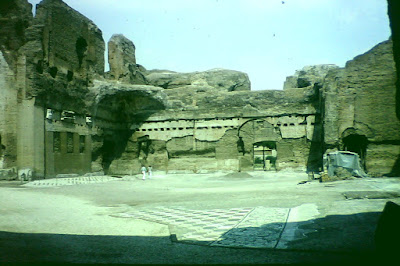
- and the gigantic Baths of Caracalla; which were actually started by Septimius Severus in 206, officially opened by Caracalla in 216 and further decorated by Alexander Severus. This is a reconstruction of how they might have looked; being part of a model of late Imperial Rome.

The baths were in one of the poorer districts in the south-east of Rome, and were clearly meant to cater for the mass of the population who could not afford their own private baths. To enhance the overall appearance, Caracalla built an impressive approach-road: a tree-lined boulevard now known as the Via Nova, which contrasted with the notoriously narrow and twisted alleyways that ran through most of the city.
The new baths are supposed to have catered for up to 1,600 bathers, making them by far the largest yet seen in the city, and they featured all the characteristics of a Roman baths, but on a suitably massive scale. There was underfloor heating by a hypocaust beneath the magnificent mosaic floors, a warm room (tepidarium) a hot steam room (calidarium) and an enormous swimming-pool. Slaves could provide massage, and because the Romans never invented soap, the tradition was to have your skin oiled and then scraped with a bronze sickle-shaped knife called a strigil.
The Emperor Augustus had banned mixed bathing, and it is presumed that there would have been times when use of the baths was reserved for women.
Outside the baths themselves was an enclosed leisure area, with gardens, fountains, statues, libraries, religious shrines and gymnasiums. (The Romans had always disliked the Greek fondness for naked or semi-naked athletics, but clearly thought that exercise in the gymnasium was OK!) The overall effect must have been truly magnificent.
When the baths ceased to be used is not known, but they could hardly have continued when the city aqueducts were cut in the 6th century, in the wars between Belisarius and the Goths. Then they began to be plundered, especially in the Renaissance, with stone taken to build the new churches, and the marvellous statues carted off for private collections. Many are still in museums; for instance the "Farnese bull", now in Florence:

All we can do nowadays is contemplate the enormous ruins and the surviving mosaics, and imagine them as they once were.



In the 1960 Rome Olympics, the Baths of Caracalla were used to stage the gymnastics events, which seems entirely appropriate.

However, the dynasty continued, though oddly enough it was through the female line. Below we see Julia Donma's sister, Julia Maesa, and Maesa's daughter, Julia Soaemias, who was the mother of the Emperor Elagabalus (a particularly disastrous emperor: reigned 218-22), and also the Emperor Alexander Severus (reigned 222-35), who was the son of Maesa's other daughter, Julia Mamaea. I am still searching for coins of Elagabalus and Julia Mamaea!

The main surviving relics of the Severans in Rome are the triumphal arch of Septimius Severus at the end of the forum -

- and the gigantic Baths of Caracalla; which were actually started by Septimius Severus in 206, officially opened by Caracalla in 216 and further decorated by Alexander Severus. This is a reconstruction of how they might have looked; being part of a model of late Imperial Rome.

The baths were in one of the poorer districts in the south-east of Rome, and were clearly meant to cater for the mass of the population who could not afford their own private baths. To enhance the overall appearance, Caracalla built an impressive approach-road: a tree-lined boulevard now known as the Via Nova, which contrasted with the notoriously narrow and twisted alleyways that ran through most of the city.
The new baths are supposed to have catered for up to 1,600 bathers, making them by far the largest yet seen in the city, and they featured all the characteristics of a Roman baths, but on a suitably massive scale. There was underfloor heating by a hypocaust beneath the magnificent mosaic floors, a warm room (tepidarium) a hot steam room (calidarium) and an enormous swimming-pool. Slaves could provide massage, and because the Romans never invented soap, the tradition was to have your skin oiled and then scraped with a bronze sickle-shaped knife called a strigil.
The Emperor Augustus had banned mixed bathing, and it is presumed that there would have been times when use of the baths was reserved for women.
Outside the baths themselves was an enclosed leisure area, with gardens, fountains, statues, libraries, religious shrines and gymnasiums. (The Romans had always disliked the Greek fondness for naked or semi-naked athletics, but clearly thought that exercise in the gymnasium was OK!) The overall effect must have been truly magnificent.
When the baths ceased to be used is not known, but they could hardly have continued when the city aqueducts were cut in the 6th century, in the wars between Belisarius and the Goths. Then they began to be plundered, especially in the Renaissance, with stone taken to build the new churches, and the marvellous statues carted off for private collections. Many are still in museums; for instance the "Farnese bull", now in Florence:

All we can do nowadays is contemplate the enormous ruins and the surviving mosaics, and imagine them as they once were.


In the 1960 Rome Olympics, the Baths of Caracalla were used to stage the gymnastics events, which seems entirely appropriate.
Thursday, 28 January 2016
Mount Elbruz
A splendid dramatic picture of Mount Elbruz, the highest peak in the Caucasus mountain range, taken by Alexander Trashin.

It used to be believed that it was here that the Aryan races of Europe originated; hence the word "Caucasian" for the body of an unidentified white man in American crime dramas. Heinrich Himmler believed this story of Aryan origins, and in the Second World War, as Nazi forces approached the Caucasus, he sent an S.S. mountaineering team to scale Mount Elbruz and plant a banner on the summit, to show that the Aryan race had returned to its homeland.
In fact, when I was down in Georgia, south of the Caucasus, thirty years ago, it was noticeable that none of the locals bore any resemblance to the Aryan racial ideal of blond hair, fair skin and blue eyes. In fact they all looked very like that most famous of Georgians, Joseph Stalin; especially the women!
Nowadays the story of the all-conquering Aryans sweeping through Europe in the Bronze Age is generally dismissed as a myth. Instead the less emotive term "Indo-European" is used to describe not a race, but a group of languages which have a common root. This group includes Persian (the words "Iran" and "Aryan" being much the same), Hindustani, the ancient Hittite language and most of the languages of Europe, with a few exceptions such as Finnish, Hungarian and Basque. However, I don't anticipate the word "Caucasian" disappearing from our TV screens in the foreseeable future.

It used to be believed that it was here that the Aryan races of Europe originated; hence the word "Caucasian" for the body of an unidentified white man in American crime dramas. Heinrich Himmler believed this story of Aryan origins, and in the Second World War, as Nazi forces approached the Caucasus, he sent an S.S. mountaineering team to scale Mount Elbruz and plant a banner on the summit, to show that the Aryan race had returned to its homeland.
In fact, when I was down in Georgia, south of the Caucasus, thirty years ago, it was noticeable that none of the locals bore any resemblance to the Aryan racial ideal of blond hair, fair skin and blue eyes. In fact they all looked very like that most famous of Georgians, Joseph Stalin; especially the women!
Nowadays the story of the all-conquering Aryans sweeping through Europe in the Bronze Age is generally dismissed as a myth. Instead the less emotive term "Indo-European" is used to describe not a race, but a group of languages which have a common root. This group includes Persian (the words "Iran" and "Aryan" being much the same), Hindustani, the ancient Hittite language and most of the languages of Europe, with a few exceptions such as Finnish, Hungarian and Basque. However, I don't anticipate the word "Caucasian" disappearing from our TV screens in the foreseeable future.
Sunday, 10 January 2016
England: Moreton Corbet
Moreton Corbet is a village a few miles north of Shrewsbury in Shropshire; taking its name from the Corbet family. The first of the Corbets, with two of his sons, came to England with William the Conqueror, and settled in Shropshire, where they were granted land by Earl Roger de Montgomery, one of William's most trusted lieutenants. This region was to remain the "wild west" for many generations, until Wales was finally brought fully under English rule. There were frequent raids and skirmishes, as well as occasional full-scale battles; and because of this the great Earls of the borderlands, the "Marcher lords" were given quasi-regal powers, greater than anywhere else in England.
The Corbet coat of arms is easy to recognize. There are several versions, but they always involve one, two or more ravens on a gold shield (in heraldic parlance, "Or, two corbeaux sable"). This is an example of a "canting" coat of arms, which makes a pun on its owner's name: French, "corbeau", old Scots "corbie"; a raven or crow. A single raven was sometimes a "corbyn".
St. Bartholomew's church in Moreton Corbet contains the magnificent Tudor tombs of the Corbet family: Sir Robert Corbet (died 1513) and his wife:-

and Sir Richard Corbet (died 1567) and his wife:-

The Corbet coat of arms is clearly visible in the first quarter of the shield. I suspect some of the heraldry may be imaginary, as was quite common in the Elizabethan age!
The revolution in artistic taste which took place in the following century is well shown in the monument to Richard Corbet (died 1691).
 The church itself has features dating back to the Norman period. Nearby are the remains of a mediaeval castle,

but the most spectacular feature is an enormous ruined Elizabethan mansion, built by Sir Andrew Corbet in 1579.


In its time, it would have been as grand as any contemporary building in England. It also shows how Renaissance architectural features were appearing here, even though the local builders did not yet really understand them.
It was destroyed by Parliamentary forces in the Civil War..
The Corbet coat of arms is easy to recognize. There are several versions, but they always involve one, two or more ravens on a gold shield (in heraldic parlance, "Or, two corbeaux sable"). This is an example of a "canting" coat of arms, which makes a pun on its owner's name: French, "corbeau", old Scots "corbie"; a raven or crow. A single raven was sometimes a "corbyn".
St. Bartholomew's church in Moreton Corbet contains the magnificent Tudor tombs of the Corbet family: Sir Robert Corbet (died 1513) and his wife:-

and Sir Richard Corbet (died 1567) and his wife:-
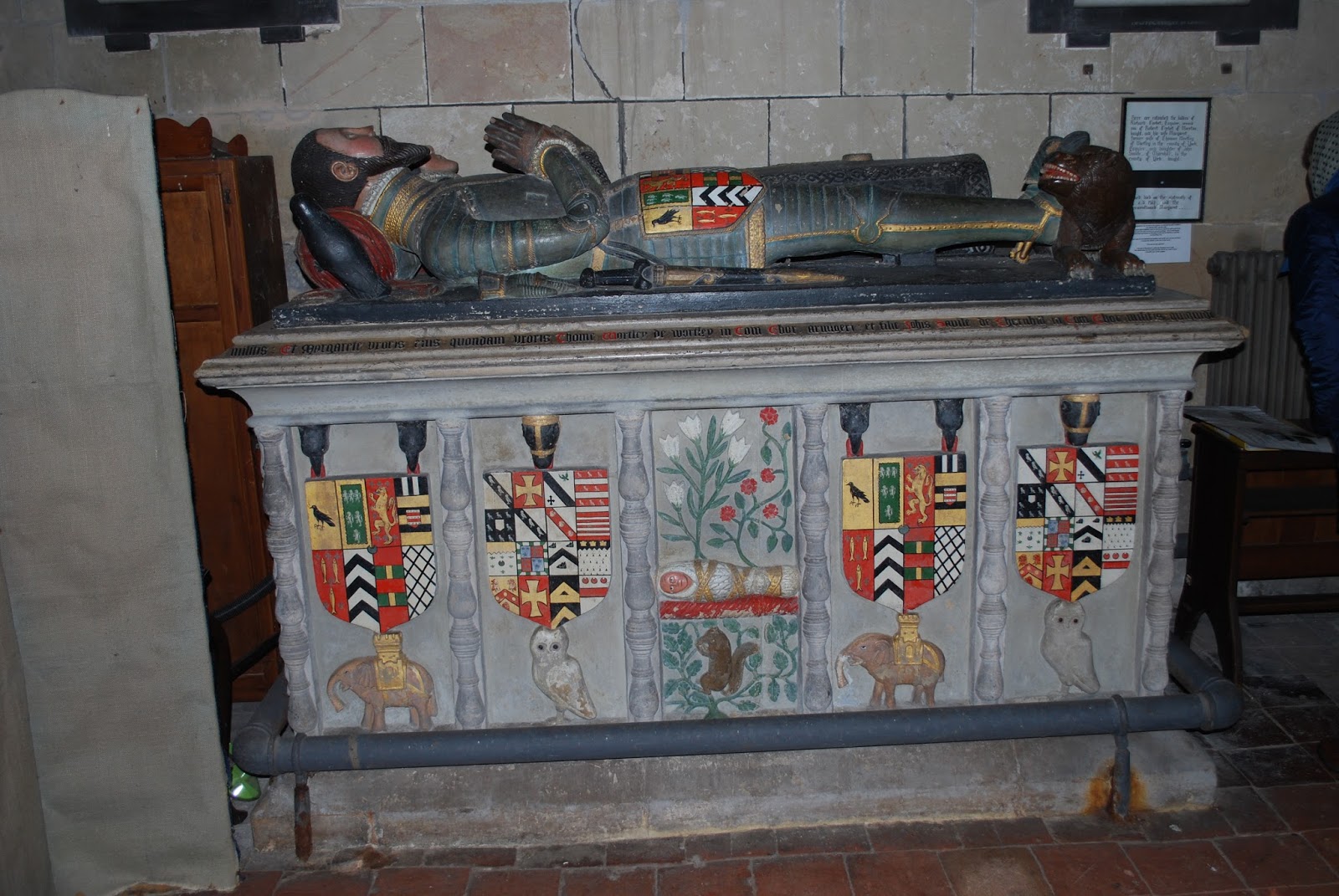
The Corbet coat of arms is clearly visible in the first quarter of the shield. I suspect some of the heraldry may be imaginary, as was quite common in the Elizabethan age!
The revolution in artistic taste which took place in the following century is well shown in the monument to Richard Corbet (died 1691).


but the most spectacular feature is an enormous ruined Elizabethan mansion, built by Sir Andrew Corbet in 1579.


In its time, it would have been as grand as any contemporary building in England. It also shows how Renaissance architectural features were appearing here, even though the local builders did not yet really understand them.
It was destroyed by Parliamentary forces in the Civil War..
Subscribe to:
Posts (Atom)
