Wednesday, 12 August 2015

The Foundation of the Middle Ages: Popes and Emperors


The Roman Empire was permanently divided between East and West from 395. The eastern empire, based in Constantinople, flourished, but gradually changed in character so that historians know it as the Byzantine Empire. In the west, the emperors abandoned Rome itself, first for Milan and then for Ravenna; western Europe and western north Africa were overrun by Germanic tribes, Rome itself fell to the Goths in 410, and in 476 the western empire disappeared entirely. The attempt by Justinian in the 6th century to reconquer Italy from the Goths caused only massive and widespread destruction. Rome itself was ruined, the great aqueducts had been cut, and the population had collapsed. In the east, the Christian church was firmly under the control of the Byzantine state; but in the west the church, and specifically the Popes, were able to step into the gap left by the disintegration of state power.
      The early Christian church was based on the towns (not for nothing was the word for the peasants, the country people, “pagani”!). Every large town with a Christian population had a bishop, and from the time of Constantine these were given a major role in local government; but it was generally accepted that primacy should go to the bishops of the great centres: Rome, Constantinople, Antioch, Jerusalem and Alexandria (It will be noticed that that all but one of these were in the lands of by the Byzantine Empire). It was not clear whether, for religious purposes, Rome was superior to Constantinople, or vice versa; nor how much authority the Emperor at Constantinople had over the whole church.
     The church in west was greatly boosted by St Benedict, (c.480-543), the father of western monasticism. Early monks had lived in the deserts of the east, often practicing extreme asceticism (e.g. St. Simeon Stylites, who lived on top of a pillar for 33 years!). Benedict drew up rules for monks to live communal lives, working and praying together. Around 529, he founded the great monastery of Monte Cassino. The movement spread rapidly.
      Many of the earliest Popes are little known, perhaps even mythical; but the papacy grew in importance once Emperors ceased to live in Rome. It was Leo I who persuaded Attila the Hun to turn back, and then got Genseric the Vandal chieftain to promise not to kill anyone when his forces plundered Rome. The method of choosing a Pope was often chaotic; he was unofficially elected by Roman people, and then needed confirmation by the Emperor in Constantinople. The most important of the early Popes was Gregory the Great (590-608), who came from a noble background, had served as Prefect of Rome 573, and had had to deal with the threat caused by the Lombard invasion of Italy. He became a Benedictine monk, and was sent as an envoy to Constantinople in 579, to beg help from the Emperor Maurice (who had his own problems and could do nothing). He was elected Pope by the Roman people in 590, and strove to reform the church, especially enforcing clerical celibacy and obedience to Rome. Most famously, he sent Augustine to convert England, ensuring the Roman church’s control there from the start. Less happily, Gregory rejoiced when the Emperor Maurice and all his family were killed by an illiterate soldier, Phocas, and set up a column in Phocas’s honour in the Roman forum. It is still there. (Phocas proved to be perhaps the most brutal, murderous and incompetent of all the Byzantine Emperors)
     Events in the east meant that the Byzantine Emperors, whilst retaining footholds in Italy, were unable to do much there. From 606 to 628 there was a long and immensely destructive war with the Persian Empire. The Persians seized control of Palestine, Syria and Egypt (the Christian communities in these places never really recovering), and for two years Constantinople itself was besieged, by the Persians on Asian side and on the European side by the Avars: an Asiatic people who had emigrated into Hungary and the Balkans. The Emperor Heraclius (610-641) saved the city and smashed the Persians in brilliant campaigns, recovering his lost territories. But both empires were now completely exhausted; as was to be seen in what followed.
     A few years after the defeat of the Persians, Heraclitus would have received a strange letter from someone he had never heard of, living in a city from outside his empire, commanding him to embrace the new religion. The writer was, of course, Mohammed. It is not known whether Heraclitus read it.

Mohammed died in 632, and the early Caliphs, his successors set out to conquer the world for Islam: with astonishing success. By 640, Syria and Lebanon were overrun, Iraq fell in 642, Iran followed in 650, and the ancient Persian Empire disappeared. Simultaneously Egypt was overrun in 642, followed by North Africa, with Carthage taken in 695. In 711 an army commanded by Tariq’s invasion invaded Spain (he landed by an impressive geological feature which he named after himself: “Jebel Tariq”, the Rock of Tariq, or as we would say, “Gibraltar”). The Visigothic kingdom, which had existed since the fall of the Roman Empire, quickly collapsed. Christianity almost disappeared in the Middle East and North Africa, with Jerusalem and two other great church centres: Antioch and Alexandria, now in Moslem hands.
      The first Arab attack on Constantinople came in 674; then in 717-718 came a much greater attack, with Arab troops crossing the Hellespont to besiege the city from the European side, in alliance with Bulgar tribes emigrating from the Ukraine.  The city was saved by new emperor, Leo III (717-741), a Syrian peasant by birth. He retained control of sea with a new secret weapon, “Greek fire” (spontaneously-combusting substance, whose exact chemical composition remain a mystery); annihilated the Arab fleet and persuaded the Bulgars to attack the Arabs on the European side. Constantinople would not be attacked again for almost 500 years. (This must count as a decisive battle in world history; for if Constantinople had fallen, who could have stopped the Arabs from flooding into Europe from the east, as the Turks did in the 15th and 16th centuries?) But after this, the Byzantine Empire was confined to modern Turkey, and its Balkan territories were increasingly penetrated by the Bulgars and later by the Serbs.

But no sooner had Leo defeated the Arabs than there began a new religious conflict: iconoclasm! Leo ordered the destruction of all religious images, beginning in the great cathedral of Santa Sophia. His campaign was denounced by the papacy, so there was now a serious breach between Rome and Constantinople. Leo’s son, Constantine V (741-775) was even more hostile to icons, violently persecuting monks who kept them. He neglected his bases in Italy. The next Emperor, Leo IV, died young in 780, leaving only a 10-year-old son, Constantine VI. The dowager Empress, Irene, an Athenian girl of obscure origin, became regent for next ten years. She was pro-icon, and “veneration” of icons was once again permitted by the Council of Nicaea in 787. The Pope would approve, and so would most subjects of the empire; but no Pope could ever approve of what followed. When Constantine VI took personal control, he soon proved a cruel and incompetent ruler, and in 797 Irene struck back. She took her son prisoner and had him blinded (he died soon afterwards) and then ruled as empress in own right! Meanwhile, Ravenna, the main Byzantine base in northern Italy, fell to the Lombards, and Sicily broke away from Byzantine control, only to be invaded and overrun by Moslem invaders soon afterwards.
     So, from the point of view of the Popes, there were several heretical Emperors, followed by a usurping Empress who blinded her own son! Why should Constantinople be obeyed any longer? Had the Empire not clearly forfeited its right to lead the Christian world?

     One significant Pope of this period was Honorius II (625-638) who organized the supply of food and water to Rome; showing how the papacy could take on government functions, in the absence of anyone else to do it. Another was Gregory II (715-731), who denounced Iconoclasm; yet another was Zacharius (741-752), the first pope to be appointed without seeking approval from Constantinople. But other Popes of time were flagrantly corrupt, deeply insignificant, or mere puppets in the hands of Roman aristocratic families. Many Popes were terrorized by Roman mobs, and the city was frequently under threat from the Lombards. Popes might have moral authority, but had no means of enforcing order even in Rome. Who could help?

North of the Alps were the Franks. Unlike the Germanic tribes, they were pagans when they entered Roman territory after 406, but around 500 their king, Clovis, was baptized a Christian; and, what was more, a proper Catholic, unlike the Goths, who were Arian heretics! Clovis conquered modern France, from the Pyrenees to the Rhine – his southern territory being still heavily Romanized, with villa life continuing but slowly declining. Clovis’s descendants were known as the Merovingians (as featured in the “Da Vinci code” and other works of dubious historical merit). They were without question one of the most appalling dynasties in European history; their unedifying story being recorded in the “History of the Franks”, written by Gregory, Bishop of Tours, around 590. 
    There were primitive survivals from pagan times; notably that the kings never cut their hair, as a sign of their sacred nature. There was no capital; and when a king died, the kingdom was divided among all his sons, resulting in savage civil wars, betrayals and murders. Local control was in the hands of bishops (such as the famous St Martin of Tours) and the “comites”, who were in charge of local troops (which gives us the title of “count”. By about 700, the Merovingian kings had declined to mere figureheads, with real power in the hands of the “Mayor of the Palace” (Major Domo): a sort of hereditary Prime Minister.

In 732 Moslem forces, having overrun Spain, invaded France; but were defeated at the battle of Tours by the Mayor of Palace, Charles Martel. (This battle equals in importance the siege of Constantinople a few years earlier. Edward Gibbon speculated how far Moslem conquests might have extended had the victory gone the other way!) Charles Martel’s son, Pepin the Short, deposed the last Merovingian, Childeric III, who had his sacred long hair cut and was banished to a monastery. The Frankish nobles hailed Pepin as King: Pope Zacharius recognized his title, and he was anointed with holy oil by St Boniface, an English missionary, in a ceremony deliberate copying the anointing of David by Samuel in Bible. (Anointing is still the central ritual of British coronations)
     In 753 Pope Stephen II fled from the Lombards to seek help from Pepin. His Franks then invaded Italy and defeated the Lombards but did not take Rome itself. Pepin succeeded in 768 by son, Charles, who became better known as Charlemagne (though at first he had to divide the kingdom with his brothers). During his long reign, Charlemagne destroyed the power of the Avars and forcibly spread Christianity eastwards among the pagan Saxons.
     Pope Adrian I again needed help against the Lombards in 773. Charlemagne invaded Italy, destroyed the Lombard kingdom and crowned himself with Iron Crown of Lombardy: but did not enter Rome. At some unknown time shortly before this, there appeared the “Donation of Constantine”; a document in which the great Emperor acknowledged the supremacy of the Pope and gave him sovereignty over Rome. Charlemagne accepted the validity of the Donation, which was exposed by Renaissance scholars as a blatant forgery.

In 799 the next pope, Leo III, lost control of Rome. After being attacked in street by mobs and beaten unconscious, he fled to Charlemagne. This time Charlemagne did enter the city, and in St Peter’s on Christmas Day 800 was crowned as Emperor by Pope Leo. He was thus the first in Emperor in the west for over 300 years; and there were now two Emperors in the Christian world. The significance of this, in the minds of Charlemagne and the Pope, has been debated by historians ever since; but it was certainly a direct challenge to Constantinople, and a repudiation of the Byzantine Emperors’ claim to universal rule. We should remember what had been in Constantinople: several heretical iconoclastic Emperors followed by the frightful woman Irene, who blinded own son. Leaders in the west could ask: was there really a legitimate Emperor there at all? (Ironically, Charlemagne rather admired Irene, and even wrote to her proposing marriage!) 

Charlemagne died in 814, and his empire ceased to exist as a single entity after the death of his son Louis in 840. But the concept survived as an ideal: a universal church and a universal empire, each under a single head, working together. But whether the Emperor was subordinate to the Pope or vice versa, was not clear and would cause much trouble in later centuries.

(This story is continued in my next post)

Monday, 3 August 2015

Cicero

I have been reading the letters of Marcus Tullius Cicero, the great Roman advocate and orator. In his introduction to this edition, the editor, L. P. Wilkinson, told the following delightful anecdote:-

     A student looked up "Cicero" in the Encyclopaedia Britannica and found by accident the following entry:
   "Cicero: a town in Cook County, Illinois, bounded on the north, east and south by Chicago".

     Wilkinson thought this was a splendid metaphor for the career of the Roman Cicero. On three sides he faced politicians who were really just gangsters: Catiline and Clodius at the start of his career; Mark Antony at the end (Sulla, Pompey and Caesar were hardly any better, though on a much larger scale); and on the fourth side he found snobbish aristocrats who never fully accepted him because he was a "novus homo": literally a "new man": someone from an obscure provincial background without any famous ancestors. (He was also encumbered with a silly name: "Cicero" meaning "chickpea"!)

    In view of Cicero's political vacillations, his extreme vanity, and his tendency to irritate his contemporaries by forever bragging about his achievements, he was perhaps fortunate to survive as long as he did in this world of street violence, military coups-d'etat, bloody purges and civil war. Julius Caesar pardoned his support for Pompey; but eventually his luck ran out, and in the year 43 BC, at the age of 63, he was murdered on the orders of Mark Antony. His head and hands were cut off and nailed up in the forum, the scene of his greatest triumphs. Over a hundred other prominent Roman citizens were killed at the same time, without the least semblance of judicial process. Cicero fondly believed that he had a friend in the 19-year-old Octavian, Caesar's heir, and soon to be better known as the Emperor Augustus, but Octavian made no attempt to save him.

    The Roman historian Plutarch, in his life of Cicero, tells us that his last unsuccessful attempt to flee was betrayed by a young slave called Philologus. Later, Mark Antony, feeling pangs of remorse, compensated by handing over Philologus to Cicero's sister-in-law, who then tortured him to death with hideous cruelty. Plutarch considers that by this action, "Antony did show one sign of decent feeling". It cannot be stressed too much how deeply Roman standards of ethics differed from ours!


Footnote: The town of Cicero was notorious in the late 1920s as the headquarters of Al Capone's gang. I have sought to find in this a metaphor for the career of the Roman Cicero; but without success.

Tuesday, 21 July 2015

Rhodes

I visited Rhodes with a school party several years ago. This is a report.

Originally there were three ancient Greek cities on Rhodes: Kamiros, Ialyssos and Lindos (the third being the only one we visited, and the only one with significant archaeological remains from the classical period), but in 408 BC the three came together and built the new city of Rhodes on the northern tip of the island. It soon became a great trading centre, with a population much bigger than today.
Everyone knows about the Colossus of Rhodes; a gigantic statue of the sun-god Helios; one of the “Seven wonders of the world”, though no-one knows what it looked like, or even exactly where it stood, though imaginative Renaissance drawings of it straddling the harbour are highly improbable. It was erected to commemorate Rhodes’s survival in a siege by Demetrios in 304 B.C. in the wars that followed the death of Alexander the Great. It was said to be 35 metres tall, made all of bronze, the work of the sculptor Chares of Lindos, but it survived no more than 70 years before collapsing in an earthquake in 227 B.C. To the Romans, and indeed to most Greeks, it would be known only as the monstrous ruins which lay untouched on the site for more than eight hundred years.
Rhodes attempted to remain neutral in the wars between the Hellenistic states and the rising power of Rome, but in 164 B.C. became a “permanent ally” of Rome, and its independence was effectively at an end. It was for centuries a centre of learning, famous for its schools of philosophy, rhetoric and science: Cicero studied there, and Tiberius, the future Roman Emperor, spent several years studying on the island. But the artistic glory of Rhodes never recovered from when in 44 B.C. it was pillaged by Cassius (famous as one of the assassins of Julius Caesar) who stole most of its treasures and slaughtered many of the inhabitants.
For centuries Rhodes was contested between the Byzantine Empire and the Arabs. It was in the seventh century A.D., during a period of Moslem occupation, that the remains of the Colossus were finally removed by the Arabs and sold to a Jewish scrap-metal dealer. It is said that 125 tons of bronze were taken away, loaded onto 900 camels. Today no trace remains.
Rhodes town today bears little remembrance of classical times. It is far more redolent of the Middle Ages, because for 200 years it was the centre of the Knights of the Hospital of St. John of Jerusalem, an order of fighting monks left over from the Crusades. The Grand Master of the Hospitallers, Foulkes de Villaret, bought the island in 1309 and turned it into a base against Islamic forces.  The Old Town of Rhodes is still encircled by vast ramparts and a triple moat built by the Hospitallers, 

enclosed within which is a real rabbit-warren of tiny alleyways and heavy stone buildings. Some of the main streets have arches over them. 

Only a few parts have been taken over by tourist shops; the rest can scarcely have been changed for centuries. The most famous street is the Hippoton, where the Knights lived, 

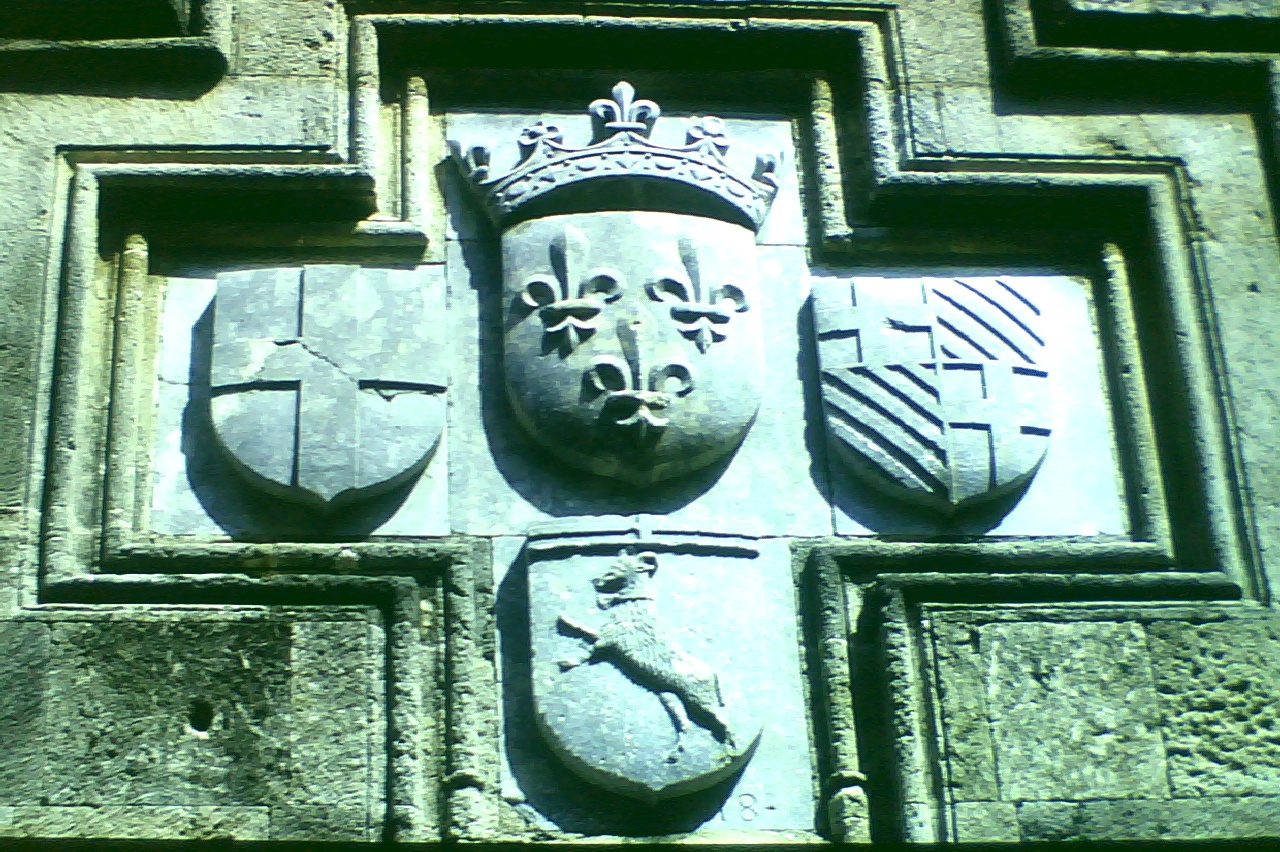
with each “tongue”, or nationality, of the Order having its own “inn”, marked by distinctive coats of arms.

In 1522 the forces of Suleiman the Magnificent, the greatest of the Ottoman Sultans, launched an attack on Rhodes. A stout defence reduced the Hospitallers to just 180 knights, at which stage they surrendered and were allowed to withdraw to their new base of Malta, though many of the native Rhodians were slaughtered. The Turks then ruled Rhodes for the next four centuries, and their era is marked by the occasional mosque and derelict burial ground.

The population of Rhodes was mostly Greek, but it was not joined with the newly-created Greek state in the 19th century. Instead in 1912 Rhodes was seized by the Italians in a war with the disintegrating Turkish Empire (as was Libya at the same time). Much of old district, particularly the Palace of the Grand Masters, was aggressively restored by Mussolini during the period of Italian occupation.

 I found a plaque commemorating restoration work done “in the 13th year of the Fascist Era”. According to our guide, the locals still hate the Italians even more than they do the Turks, which must be something of a record for Greeks anywhere.
There used to be a large Jewish colony in Rhodes, dating back to the earliest years of the Christian era, and Mussolini ignored them as long as he ruled. But when the Germans took over in 1943 after Mussolini’s overthrow, all the Rhodian Jews were rounded up and sent to Auschwitz. The train journeys across the Balkans took so long that most of them were dead of starvation before they arrived.
In 1947 Rhodes was at long last reunited with Greece.

We stayed at Faliriki, a popular resort on the east coast. Our hotel was mostly occupied by middle-aged Germans, who insisted on wearing the most unsuitably brief bathing costumes. Most of the island looked typical of rural Greece: very rugged and barren (though with lots of wild flowers in spring), some primitive little villages and towns with brightly painted walls, and the ubiquitous reinforced concrete skeletons of partially built hotels and apartments. As well as visiting Rhodes town, we had a day in Lindos, now a little seaside town with steep cobbled streets nestling beneath a towering acropolis. This was converted into an impregnable fortress by the Hospitaller Knights,

 but still contains parts of a classical temple to Athene and propylaea. These were swathed in scaffolding for our visit, but there was a fine view from the top.

Our trip coincided with the Greek Easter, and on the Saturday evening we went into the cathedral in Rhodes town for the service. This proved very strange. There was an incomprehensible and interminable litany chanted amidst deep gloom, during which more and more people pushed their way in with little sign of reverence. At 11.45 pm the archbishop and other priests suddenly emerged from behind the iconostasis, presumably to proclaim the Risen Christ, because the chandeliers suddenly blazed, lights were transmitted from candle to candle, and everyone processed out to the square, where the service resumed under a canopy. Precisely at midnight rocket flares were launched, fireworks were set off, the police band struck up, and all the ships in the harbour sounded their hooters. I believe the service continued, though of course nobody could now hear a word.
On the last night we staged a fancy dress party. The Germans in the hotel had annoyed us by complaining about the noise, and one of the boys decided to disguise himself as Hitler. With a false moustache and carefully combed hair he managed a remarkable resemblance: so much so that he lost his nerve at the last moment and had to cross the foyer pretending to read a newspaper close to his face. This was the only disappointing moment on our holiday.


Tuesday, 14 July 2015

England vs. Australia: Ten Great Ashes Tests

I have selected ten matches in which there were very close finishes, dramatic changes of fortune, or new records set


1. The Oval, August 1882. Australia won by 7 runs

Australia 63 (Barlow 5-19) and 122 (Massie 55, Peate 4-40)
England 101 (Spofforth 7-46) and 77 (Spofforth 7-44)

This was the match which gave birth to the term "the Ashes", though it was in fact the ninth between the two countries. It was an exceptionally low-scoring game, resulting from the wet weather and a pitch which would probably nowadays be deemed unplayable. (It should be remembered that until the 1950s pitches were left uncovered during a match, and in consequence some surfaces made batting extremely difficult). Massie, opening Australia's second innings, was the only batsman to reach 50. England, needing only 85 to win, were destroyed by Frederick Spofforth, the original "demon bowler". The great W. G. Grace scored 32, but only two other Englishmen reached double figures.

   
2. Sydney, December 1894. England won by 10 runs

Australia 586 (Gregory 201, Giffen 161, Richardson 5-181) and 166 (Darling 53, Peel 6-67)
England 325 (Ward 75, Giffen 4-75) and 437 (Ward 117, Giffen 4-164)

This is the first of only two occasions when a team following-on has won a test match (for the other one, see later). Australia opened the match with a huge total, and England set them only a modest target to win; but then it rained overnight, producing a classic "sticky wicket", on which the Australians found Bobby Peel's left-arm spin almost unplayable. Giffen's immense all-round performance went unrewarded.  


3. In summer 1902 there were two great matches within a few weeks! At Old Trafford in July, Victor Trumper scored a century before lunch on the first day, and England's last man in, the unlucky Fred Tate in his only test match, was bowled second ball to enable Australia to snatch victory by 3 runs. Then next month, this happened:-

The Oval, August 1902. England won by 1 wicket

Australia 324 (Trumble 64, Hirst 5-77) and 121 (Lockwood 5-45)
England 183 (Trumble 8-65) and 263-9 (Jessop 104)

England, set a moderate total to win the match, collapsed to 48 for 5. Gilbert Jessop then smashed his way to what is still the fastest century in Ashes tests, but when the 9th wicket fell, England were still 15 short of their target, and it was left to the Yorkshire pair of Hirst and Rhodes to see them home.


4. The Oval, August 1926. England won by 289 runs

England 280 (Sutcliffe 76, Mailey 6-138) and 436 (Hobbs 100, Sutcliffe 161)
Australia 302 (Gregory 73) and 125 (Rhodes 4-44)

This match could have been influenced by the weather, but wasn't. The England second innings had to begin on a very dangerous drying wicket, but Jack Hobbs and Herbert Sutcliffe defied the conditions with an opening partnership of 172, and eventually England won easily. Wilfred Rhodes had been recalled to the team at the age of 48, and responded with six wickets in the match. This victory gave England their first series win against Australia since before the First World War.


5. Lord's, 1930. Australia won by 7 wickets

England 425 (Duleepsinhji 173) and 375 (Chapman 121, Grimmett 6-167)
Australia 729-6 declared (Bradman 254, Woodfull 155) and 72-3

England witnessed the awesome run-scoring power of Don Bradman for the first time. Despite scoring 400 on the first day, with a brilliant century from the young Indian prince Duleepsinhji, England were overwhelmed as Bradman then reached 250 in less than six hours. In the second innings Grimmett chipped away at the England batting with his leg-spin, while Percy Chapman, England's captain, threw caution to the winds with a hard-hit century. Sir Neville Cardus, looking back on it many years later, described it as "the ideal cricket match". It was certainly action-packed: 1600 runs being scored off almost 500 overs in less than four days of cricket!


6. Adelaide, January 1933. England won by 338 runs

England 341 (Leyland 83, Wall 5-72) and 412 (Hammond 85, O'Reilly 4-79)
Australia 222 (Ponsford 85, Allen 4-71) and 193 (Woodfull 73, Bradman 66, Allen 4-50, Larwood 4-71)

This is immortalized as "the bodyline test". To counter the menace of Bradman, Harold Larwood, England's fastest bowler, was instructed to pitch short and aim at the batsman's body, with no fewer than six short-leg fieldsmen clustered round for a catch. (We should remember that batsmen in those days had no helmets and no body-armour). The Australian captain, Bill Woodfull, was struck several times, to the disgust of the crowd, and the wicket-keeper Bert Oldfield suffered a fractured skull when he top-edged a pull shot onto his forehead. Bradman was too quick on his feet to be struck, but it reduced his run-scoring to merely mortal levels. (Oddly enough, England's most successful fast bowler in the match, Gubby Allen, did not bowl bodyline). The whole episode led to an angry exchange of telegrams between Australia and England.


7. Leeds. July 1948. Australia won by 7 wickets

England 496 (Washbrook 143, Edrich 111) and 365-8 declared
Australia 458 (Harvey 112, Loxton 93) and 404-3 (Morris 182, Bradman 173 not out)

England thought they had a chance of defeating Bradman's all-conquering team when they set a target of over 400 on the last day, but in vain. This was Bradman's last great innings, in his penultimate test match. What is remarkable by today's standards is that England bowled well over 100 overs on that final day, making no attempt to waste some time as Bradman and Morris destroyed the attack, adding nearly 200 runs between lunch and tea. It couldn't happen nowadays! (In Bradman's final innings, at the Oval a month later, he was bowled by Eric Hollies for 0, thus reducing his career average to less than 100!)


8. Manchester, July 1956. England won by an innings and 170 runs

England 459 (Richardson 104, Sheppard 113)
Australia 84 (Laker 9-37) and 205 (McDonald 89, Laker 10-53)

This match was one-sided from start to finish, but is remembered for Jim Laker setting a record unlikely ever to be beaten, with 19 wickets. The Australians were wholly unable to cope with his off-spinners on a helpful surface.


9. Leeds, July 1981. England won by 18 runs

Australia 401 (Dyson 102, Botham 6-95) and 111 (Willis 8-43)
England 174 (Lillee 4-49) and 356 (Botham 149 not out, Alderman 6-135)

This is only the second occasion in which a team following-on has won the match. After losing the first test badly and drawing the second, England recalled Mike Brearley as captain. The position appeared hopeless as England were reduced to 135 for 7 in their second innings, but then Ian Botham and the tail added more than 200 with some vigorous hitting, enabling Bob Willis then to blow away the Australian batting. This is always remembered as "Botham's match", but Willis's role at the end was just as important.


10. Birmingham, August 2005. England won by 2 runs

England 407 (Trescothick 90, Warne 4-116) and 182 (Flintoff 73, Warne 6-46)
Australia 308 (Langer 82) and 279 (Flintoff 4-79)

The 2005 series is generally reckoned to be the best of recent years. Australia won the first match, and almost won this, the second. England were well ahead for the first four days, and the fifth looked to be of short duration, with Australia on 175 for 8: over 100 behind. But then Warne, Lee and Kasprowicz brought them within three runs of victory, before finally Kasprowicz gloved a ball from Harmison down the leg side and was caught behind. (To add to the interest, later video analysis suggested he shouldn't have been given out!). Andrew Flintoff was adjudged "man of the match", but if the result had gone the other way the award would surely have gone to Shane Warne.

Saturday, 4 July 2015

Auschwitz-Birkenau

The city of Cracow in southern Poland is a popular tourist destination, and rightly so, since it is one of the very few cities in eastern Europe to have survived the war without being devastated. It was the capital of mediaeval Poland; it has a well-preserved centre with several fine churches and an old university. The future Pope John Paul II lived here. On Wawel hill you can see the magnificent tombs of the old kings of Poland in the cathedral of St. Stanislaus. There is also a Jewish quarter, called Kazimierz, where you can identify some of the settings used in the shooting of the film “Schindler’s List”, though little trace now remains of Schindler’s factory. In the war, Cracow was the administrative centre of the German-occupied "General Government" of Poland, headed by Hans Frank, who was an extremely nasty character even by Nazi standards. If you sign up for a package holiday in Cracow, you will find one day is devoted to an outing to Auschwitz; but this will always be billed as “optional” - understandably so, since many people would find the experience too upsetting.

Historians remain divided on when the decision was made to exterminate the European Jews (or, indeed, whether there was ever one single decision, as distinct from a general spasmodic intensification: see notes at the end). Of course, it is possible that Hitler always intended extermination, though there is no documentary evidence for this (indeed, there is not a single reliable document to show that Hitler even knew of the existence of Auschwitz). The suspicion is that a decision was made either in the spring of 1941, before the invasion of the Soviet Union in “Operation Barbarossa”, when the mass killing really started, or that autumn, when the Einstazgruppen (hit-squads) in Russia began to shoot large numbers of Jewish women and children as well as men. The Wannsee Conference in January 1942, where the aim of extermination throughout Europe was announced, only explained a policy already decided upon, for the gassings in the camps had already started.
There were six death-camps with facilities for gassing, as distinct from simple concentration camps. All six were in Poland. Four of them, Chelmno, Belzec, Sobibor and Treblinka, were built in 1941-42 for the purpose of killing the Jewish population of occupied Poland. These were extermination centres pure and simple, and comparatively little is known about them, for there were hardly any survivors and the Nazis demolished them thoroughly in their retreat before the advancing Red Army later in the war. The two remaining camps were Majdanek, near Lublin, and the most famous of all, Auschwitz. They had facilities for work as well as gas chambers: for instance, the Italian writer Primo Levi worked in Monowitz, part of the Auschwitz camp complex, where he and other slave labourers manufactured artificial rubber known as “Buna”. He survived, as did various others, such as the cellist Anita Lasker-Wallfisch, who was a member of the Auschwitz orchestra (see notes at the end).

The buiding of the Auschwitz complex began in spring 1940, and its first prisoners were Polish. It was greatly expanded in autumn 1941 to house Russian prisoners-of-war, who were used in the first experiments with cyanide gas (Earlier camps like Chelmno and Belzec had used carbon monoxide from diesel engines). Mass murder of Jews began there in early 1943, and the vast gas chambers built the next year. The complex continued to expand until it was evacuated in early 1945.

Auschwitz is about an hour’s drive from Cracow, across flat, swampy and rather uninteresting countryside with occasional areas of forest, thinly inhabited. I visited three times with school groups. The whole Auschwitz complex eventually came to cover more than 20 square miles, with numerous sub-camps, but only two are open to the public: the original camp which is “Auschwitz I”, and a mile or so away across the railway line, “Auschwitz II” or Birkenau (derived from the Polish word for a birch-wood).

Auschwitz I is actually quite small, and is now maintained as a museum, crowded with parties having guided tours. The barbed wire is intact, with over the gate the famous slogan “Arbeit Macht Frei”: “Work sets you free”, expressing the notion found under many different regimes that labour is somehow morally improving and can save you from falling into wickedness.

 The camp mostly consists of identical barrack-blocks, two stories high with attics, and a parade-ground complete with a gallows. We saw photographs of the camp taken by the Russians when they occupied it in January 1945, and tins which contained the crystals for the Zyklon-B poison gas.

 We saw Block 11, the Gestapo torture centre, with its isolation cells down below, in one of which there is a memorial to a Polish priest who was starved to death there. Others were mere tubes, rather like chimneys, a yard square at the base, in which recalcitrant prisoners would be made to stand all night. Outside this was the “Wall of death” where shootings took place.

 What really shook everyone, however, were the grotesque collections of goods taken from victims that the Russians found stored in a part of Birkenau known as “Canada” (so named because to the inmates, who were mostly from Eastern Europe, Canada was a legendary land of plenty), and which now formed huge displays in one of the blocks. There was a whole wall of human hair (two tons of it, according to the guide), another wall of suitcases, a third of artificial limbs; great dumps of brushes, of shoe-polish of spectacles, and (what was most distressing) baby-clothes. One lady burst into tears at the sight of the baby-clothes, despite the fact that she had visited before and knew what was there. The overall effect of this monstrous exhibition can only be described as surrealist. We were also taken round the only surviving crematorium and gas chamber, which simply looked like a large, gloomy cellar. It survived because later in the war it was used as an air-raid shelter, and the little trucks for transporting corpses to the furnaces actually came from elsewhere.

 In fact, the gassings almost all took place at Birkenau: nobody knows how many, because the victims were mostly taken directly there from the trains without ever being registered or counted. Just outside the wire of the camp stood the house of the commandant, Hoess, who after the war was brought back there to be hanged. On one of my visits I noticed a school party of children who looked no more than 10 years old being taken round. I could not understand the reasoning behind this: either the experience would give them appalling nightmares or it would have no effect at all: neither would serve any useful purpose.
Birkenau is quite different. It is a vast howling wilderness of over 350 acres, surrounded by barbed wire, within which little now survives except a few barrack-blocks in a desolation of rough grass: the other blocks are marked only by their foundations and brick chimneys.

 The four huge gas chambers and crematoria which once stood at the far end were blown up before the Nazis retreated, and are now mere heaps of concrete rubble.

(This has enabled Holocaust-deniers to ask what evidence there is for mass gassings). The entrance to Birkenau, known as the “Gate of Death” is still intact, with a railway line built through it in 1944 to take the huge shipments of Hungarian Jews direct to the gas chambers.

We were able to look round the few surviving barrack-blocks, single-storey here, and built of wood or very crudely mortared brick, each of which would hold up to a thousand people in fantastically overcrowded communal bunks while they waited to be gassed.

 This hut held Ukrainian women; ten to each of the three levels of each tier. One of our girls took just one look, exclaimed “Oh, God!” and fled. In one corner of the camp I found a small wooden hut in which, the sign informed me, the S.S. killed babies born in the camp by lethal injection.

 Even in sunny weather the effect was overwhelmingly depressing, and everyone was very silent as we drove back to Cracow. One of the boys announced that he didn’t want to revisit Berlin after this. I could well understand him - and understand those who would prefer not to visit Auschwitz at all.


Notes: (1) I once had a very intelligent colleague who was one of those who doubted whether there was ever any one single decision to begin extermination. I said to him, “But surely someone, somewhere, must have made a decision?” “I don’t think that follows”, he replied, “I used to work for the B.B.C. No-one there ever made any decisions at all!”

(2) Some years ago I attended a talk by Anita Lasker-Walfisch, who had survived Birkenau because she was a cellist in the camp orchestra. Their jobs included staging concerts for the guards, playing marching tunes to send off the slave-labour squads in the mornings, and performing on the platform to greet each new trainload of victims, who would conclude that the place couldn’t be too bad if there was a band. She finally escaped when the surviving inmates were marched off westwards as the Russians approached in January 1945 (Primo Levi was left behind in the hospital by mistake). I asked her about the comments I had come across, that the most brutal guards at the camp were not actually Germans, but Ukrainians or Lithuanians. She agreed. Her interpretation was that for the Germans, anti-Semitism was always something academic or philosophical rather than visceral, whereas many of the peoples of Eastern Europe simply hated Jews, and relished an opportunity to kill them.

(3) I do not know what the Poles today make of the camps. Outside Reading there used to be a Polish museum, run by a group of exiled Polish monks. The whole tone of the museum was anti-Russian: anti-Tsarist in the earlier sections, anti-Communist in the more recent exhibits. You would not learn from a cursory glance that Germany twice in the 20th century invaded and devastated Poland; still less that there was once a huge and vibrant Jewish community there. I once taught Politics to a Polish student who had come to Britain to do his A-levels, and I asked him, “Back home, what were you taught about the fact that all the Nazi death camps were in Poland?” “Nothing!” he replied firmly

Saturday, 27 June 2015

"A snapper-up of unconsidered trifles" (Shakespeare: "The Winter's Tale")

When we lived in the Lake District we had a friend who was most ingenious at finding uses for things which other people would have discarded. On one particular occasion, however, this landed Chris (as I shall call him) with an awkward dilemma. He was driving home up the M6 motorway at dead of night when he noticed at the roadside a small sack which must have fallen off a lorry, and had split open. He went to investigate. It was too dark to make out the contents, but putting his hand inside the sack he felt something cold and slimy. "Putty!" he thought, "I could use half a hundredweight of putty!" So he loaded the sack into the back of his Land-Rover and drove home.
     In the morning he went to investigate his new find. Imagine his surprise when he discovered the sack contained not putty, but sausage meat! Now Chris and his wife were both rigid vegetarians. What on earth were they to do with a sack of sausage meat? They couldn't give it to anyone, and it would be difficult to put it out for the dustmen to collect. So he decided to spread the meat on his lawn for the birds. Within an hour or so every seagull in the Lake District must have descended on his garden, and the whole lot had been snaffle. We imagined seagulls staggering down the road towards Lake Ullswater, too heavily laden to take off. 
    I don't think this misadventure cured Chris of his habit.

Saturday, 20 June 2015

The Idea of Progress

Definitions:
       “Progress” originally just meant a journey. In the modern sense it means the notion of improvement: that the human race is getting better, not just in terms of economic and technological improvement and rising living standards, but also in terms of greater knowledge, more representative and less oppressive government, and even moral improvement. There is also the expectation that the future will be better than the present, just as the present is better than the past. Some of these ideas are unquestionably true; other have been questioned.
     It is often difficult to realize that this is a purely modern outlook. It was first voiced by Condorcet, a French philosopher at the end of the 18th century, following the time of the Enlightenment, when religious belief came to be questioned and Reason was elevated in its place. (At the same time, Conservatism took on its modern meaning, to describe those who resisted such a change)
   Prior to this, the most widely held view was Degeneration: that people in the past knew more than us, and past civilizations were superior to others; wiser and more moral; even their art and literature being better. This is seen in the writings of conservative intellectuals like Dr Johnson and Edward Gibbon. It is also the core principle of most religious belief: the Garden of Eden lay in the past and we have fallen since then: religious leaders in the past were closer to God than we are now, and so we should accept their teachings as gospel truth. (By contrast, the notion of Progress hopes for the coming of a golden age at some time in the future) 
   The Victorian age was the time when a belief in Progress really took off: when people realized they were living through a time of unprecedented change. It was the central theme in the philosophy of both John Stuart Mill and Karl Marx; the latter drawing on Hegel’s philosophy. Mill based his whole system round “man as a progressive being”, and Marx was certain the golden age was just around the corner, following the revolution.

Types of Progress, and evidence for it
        The most obvious evidence for progress is in the fields of science and technology, including medicine. The mid-Victorians knew that their world had been transformed into something entirely different from what had gone before, and invented the term “Industrial Revolution” for it. The most obvious example was railways. Neither the Romans nor any earlier civilization had built railways, and as a result people were able to travel much faster, and to carry heavy goods far cheaper, than had ever been done before. The population of Britain was massively greater than ever before. Thanks to science, more was known about the world than people in the past had ever known. The nature of disease was beginning to be understood, and thanks to the invention of anaesthetics and antiseptic surgery, lives were being saved, and made less painful. There was also, for the first time in human history, plentiful supplies of clean water, perhaps the biggest advance of all.
          Coupled with this was what is known as the “Whig interpretation of history”. This is the notion that British history especially is the story of steady progress towards individual liberty and democratic, constitutional government: citing such landmarks as Magna Carta, the "Glorious Revolution" of 1688 which spawned the Bill of Rights, the 1832 reform of Parliament, and so forth. Britain, it was felt, was particularly privileged here, and in fact led the world towards these goals. (The “Whig interpretation” has been unfashionable amongst historians for some time now!)
The Victorians could also cite moral progress: the fact that deliberate cruelty was no longer acceptable; that prisons had been reformed and punishments less barbaric; that factory conditions had been improved and child labour banned; education provided by the state, and even the rights of animals protected by law. Even in religion, toleration had become general, and the doctrine of hellfire and eternal damnation downplayed. Once again, Britain seemed to be leading the way.
   Having said this, you can see why Darwinism was so exciting to progressive thinkers. Darwin’s theory of evolution appeared to show how the competition for survival led to progress by eliminating species which were unable to cope and thus leaving room for the more efficient. Darwin did not actually say that mammals were in any sense “better” than dinosaurs, but that is how his ideas were widely interpreted. This “social Darwinism” was seized on by racists and imperialists, and also by free marketeers, who argued that free competition, by eliminating waste and inefficiency, was the only route to economic progress. (Note how the term “dinosaur” is still used in a pejorative sense: “trades union dinosaurs” etc)
    The Victorians had little doubt that all this progress would be continued in the future. Underlying it all was the idea of the ultimate perfectibility of mankind and the hopes for a coming Golden Age in the future. The liberals and Marxists were at one here; they only differed about how the Golden Age would be achieved.

Doubters
     Unquestionably this Victorian optimism suffered severe setbacks in the first half of the 20th century. The two World Wars suggested that technological progress had merely provided more efficient ways of mass killing. Nazism and other violent revolutionary movements showed that men were still capable of savage cruelty on a massive scale. More recently, religious extremists have rejected the entire western outlook of toleration in favour of a return to doctrinal fundamentalism and the persecution of unbelievers.
       Thomas Malthus, writing at the end of the 18th century, famously argued that mankind would inevitably starve, because food production could not keep pace with rising population. Although we can nowadays feed a population more than ten times what it was in his day, we still find outlooks similar to his pessimism amongst those alarmed at the prospect of climate change. 
     Conservatives have, by definition, always doubted the concept of progress, and can be detected by their habit of talking about “so-called progress”. (I don’t mean here the leadership of our conservative party, who are free-market liberals, seeking to achieve economic growth and higher production). Most religions deny reject the notion of human perfectibility, maintaining that man can only be saved from sin by divine grace. By contrast with modern conservatives, J. R. R. Tolkien was a genuinely conservative Roman Catholic, who believed in respect for authority, mourned the disappearance of the English countryside and in his later years did not even possess a car.  His ideas thus had quite an overlap with those of the Green lobby; which in turn can be said to have a definitely conservative tinge.  

Thus brings us to Rousseau, the source of so many green-conservative and anti-progress ideas. He first came to prominence with a prize-winning essay on the subject of “How the arts and sciences have benefitted mankind”. Rousseau’s ringing answer was, “They haven’t! Civilization is all wrong! We were happier when we lived in the trees!” He greatly admired the stone age Red Indian tribes of North America (whom he knew, of course, only from travellers’ tales), saying they were “very well governed”. He believed international trade had disastrous consequences, making people dependent on foreign luxuries. He asked, as many of his followers do today, whether civilization had made people any happier, or any more moral? If not, what was the point? And for improved medicine, if people were more content with a simple lifestyle and didn’t crave unnecessary luxuries like sugar, they wouldn’t become ill! We still come across many such arguments today.

       A conservative philosopher, Anthony O’Hear, once asked in a lecture I attended whether there had been any progress in the arts. Could we possibly argue, for instance, that Rothko was a better painter than Raphael, or that any modern playwrights are superior to Shakespeare? It was only afterwards that I realized that, while this question could not be answered, there could be no doubt that access to the arts had improved vastly. For the first time in our history, anyone can now access good music, art or literature (however we choose to define “good”) at very little cost, and this surely has to be progress.
     By contrast, a great British liberal historian, Jack Plumb, argued strongly that the fact of progress is irrefutable. Medicine has so far advanced that life expectation is far longer than before, infant death is now uncommon, and there is no reason to suffer pain. (The best argument for living in the present time is dentistry!) Literacy is near-universal. We have become much more shocked by violence and cruelty; we no longer practice executions, mutilation or judicial torture, and rightly regard those countries which do as backward and primitive. We expect government to be tolerant of dissident opinion, and not to persecute those who do not conform.
      When David Cameron talks of “British values”, he in fact means those of the 18th century or later. If we believed in the “British values” of Tudor times we would still be torturing suspects, hunting out witches and burning heretics at the stake! This must surely be counted as progress!
   But what if Malthus was right after all? The world population surely cannot keep on increasing indefinitely at the present rate. Fossil fuels will not last forever, and the alternatives to them are expensive. Will progress, in the form of ever-higher living standards, soon have to stop?