Saturday, 16 July 2016

Dante: His Life and Times

Dante Alighieri was born in Florence in 1265, the son of a small-scale financier. He was only nine years old when, according to his own account, he first set eyes on the love of his life. She was Beatrice Portinari, also nine, the daughter of a near neighbour, and she was to dominate his poetical imagination. Of course, there was never any likelihood of them marrying, because such important matters were arranged by parents, and in 1277 Dante was formally betrothed to Gemma Donati. He was not yet twelve, she was about ten. They married, probably in 1286, and had several children.
   Nowhere in his writings does Dante make any reference to his wife. It was Beatrice who continued to fascinate and inspire him, and in 1283, he tells us, she actually deigned to speak to him for the first time. In the meantime he studied the great Roman authors, particularly Virgil and Cicero, under the tutorship of Brunetto Latini, a man whose soul he came to place in Hell. He began his first attempts at writing poetry, particularly about his love for Beatrice. But she had married Simone de Bardi in 1287, had children, and then died prematurely in 1290.
   Dante never forgot her, and many years later he would portray her spotless soul guiding him through Paradise in the final section of his “Divine Comedy”. In the immediate future, her death inspired him to the compilation and publication of his first collection of sonnets about his love for her, together with his commentary upon them: a book generally known as “La Vita Nuova”; the New Life.


Dante’s lifetime saw the start of a new style of painting in Florence, with Cimabue (1250-1302) and Giotto (1266-1337) foreshadowing the Renaissance. He certainly knew Giotto personally. It was also an age of great political turmoil in Italy. The great Emperor Frederick II, “Stupor Mundi”, “The wonder of the world”, who ruled Naples and Sicily as well as Germany, had faced a sentence of excommunication and deposition pronounced against him by Pope Innocent IV, and had finally died defeated in 1250. His illegitimate son Manfred managed to establish himself in southern Italy, only for Pope Clement IV to proclaim a crusade against him. The French warrior, Charles of Anjou, financed and supported by the Pope, defeated and killed Manfred at Benevento in 1266. Two years later Frederick’s 15-year-old grandson Conradin tried his luck with an expedition from Germany, but he too was defeated by Charles and then beheaded in the market-place at Naples, together with his equally young friend and supporter Frederick of Baden. This unprecedented act of violence against youths of the highest aristocracy shocked contemporaries, and fifty years later Dante was still upset by it, but the Pope rejoiced that the last of the “devil’s brood” had been extirpated. Dante, by contrast, rather admired Manfred, and placed his soul in Purgatory rather than Hell.
   This was not the end of disturbances in Sicily, because at Easter 1282 the people of Palermo suddenly rose up and massacred Charles’s French troops in the city, in a carnage that quickly spread throughout the island. (One of the many explanations of the mysterious word “Mafia” is that it is short for “Death to the French!”) King Peter of Aragon then claimed the throne of Sicily by virtue of his marriage to Manfred’s daughter, and the Pope, Martin IV, responded by excommunicating him and proclaiming a crusade against him. Such blatant abuse of spiritual weapons for purely political ends did much to discredit the papacy.

   The troubles of the papacy had, in fact, barely begun. Following the death of Nicholas IV in 1292 there was a hiatus of two years while the cardinals wrangled over the succession. Eventually they settled on a compromise candidate: an 80-year-old Italian hermit called Peter Morrone, who duly became Celestine V. Not surprisingly, this aged unworldly man proved to be a disastrous choice, and after a few months he was persuaded to abdicate, was imprisoned and died soon after. Inevitably, there were rumours that he had been murdered. Dante showed his contempt for Celestine by consigning him to the “Vestibule” just inside the gates of Hell: a region reserved for those who lack the courage to be either virtuous or wicked, and who are endlessly buffeted about by powerful winds and stung by wasps.
   The next Pope was Boniface VIII, the scion of a powerful Roman clan. He had exalted opinions of the authority of the papacy, which soon involved him in a disastrous dispute with King Philip IV of France. The culmination came in 1303 when Philip’s minister, Nogaret, kidnapped the Pope and actually struck him in the face. Boniface was soon rescued by his supporters, but he was a broken man and died not long afterwards.
  After the brief papacy of Benedict XI, a Frenchman was elected Pope, as Clement V. But he took up residence in Avignon and never set foot in Rome. For the next seventy years, all the Popes were French, living at Avignon, and little more than puppets of the Kings of France. This then was the situation for the latter stages of Dante’s life. It is not surprising that he consigned Boniface VIII to one of the lowest circles of Hell, as we shall see.       

    
   All this left Italy, and especially Florence, divided into two rival parties; the Guelphs (supporters of the Pope) and the Ghibellines (supporters of the Emperor), and local feuding was very bitter. The Ghibelline families were driven out of Florence in 1266 and all their properties destroyed, thereby leaving an open space which is now the Piazza della Signoria; it being solemnly decreed that no building should ever be erected on such an accursed spot. It was against this background that Dante began his public life. He joined the Apothecaries’ Guild, fought for his city at the battle of Campaldino against Ghibelline forces in 1289, and began to make a name for himself in Florentine politics. He emerged as a fine orator, and in 1300 was elected one of the three Priors of the city, made a superintendent in charge of the roads and road repairs, and sent on a mission to Rome.
   But Florentine city politics was always riddled with factions, and the Guelph party soon found itself divided into rival groups known as the “Blacks” and the “Whites”; a split which seems to have been more about family rivalries than any ideological disputes. Dante’s sympathies were with the Whites. He was still in Rome in November 1302 when Florence was occupied by the troops of Charles of Valois, brother of Philip IV of France. The Black faction seized power and the Whites were driven out. Early next year Dante was charged in his absence with embezzlement of public funds and sentenced to death by burning at the stake. The death sentence was renewed in 1315, and even extended to include his three sons. Dante never set foot in his home city again.

The rest of his life was spent in a wandering existence round the cities of northern Italy, supported by various powerful families but never staying anywhere for more than a few years. In his work “De Monarchia”, published in 1308, he expressed his longing for a strong leader who could provide unity for Italy and for the whole of Christendom. He had hopes that first Charles Martel, grandson of Charles of Anjou, and then the Holy Roman Emperor Henry of Luxembourg might fulfil this role, but both died young with nothing achieved.
    Around 1308 he began work on his masterpiece, known as the “Divine Comedy”. It is set in Easter 1300, and describes in three books how he, guided by Roman poet Virgil, is taken firstly down through Hell, then up Mount Purgatory on the far side of the earth, and finally through the spheres of the planets and stars in Paradise.
   He takes the opportunity to bring many of his contemporaries into the story, especially in the first book, the “Inferno”, where he descends ever deeper inside the earth. Pope Celestine V, as was mentioned, is amongst other cowardly souls in the Vestibule. The Florentine Ghibelline leader, Farinata degli Uberti, is discovered alongside the Emperor Frederick II in the burning tombs of the heretics. Dante’s old tutor Brunetto Latini is placed among the sodomites; a fact which has puzzled scholars ever since, because Dante was always appreciative of the debt he owed to Brunetto’s teaching. Pope Boniface VIII was, of course, still alive when the story was supposed to be set, but Dante still manages to get a dig at him. In one of the lowest circles of Hell the poets meet the shade of Nicholas III, a notoriously corrupt Pope, who mistakes Dante for one of his successors and asks, “Are you here already, Boniface?” Finally they encounter the gigantic form of Satan himself, at the earth’s centre, like a maggot in the heart of an apple. Satan eternally chews on the bodies of Judas Iscariot, Brutus and Cassius. This last scene always comes as a shock to modern readers, brought up on Shakespeare and accustomed to see Brutus as a heroic, patriotic figure, “the noblest Roman of them all”; but to Dante, who believed universal empire was God’s will for the world, the crime of Brutus and Cassius in killing Julius Caesar was almost as wicked as that of Judas in betraying Christ.
   The poets now pass right through the earth and reach Mount Purgatory on the far side (thus making it clear that Dante, as with all his educated contemporaries, knew that the world was round). Purgatory houses the souls of those who repented of their sins and who, after being purged of evil, will eventually be permitted to enter Paradise. (In later centuries, Luther, Calvin and other Protestant theologians denounced the whole notion of Purgatory) As mentioned above, at the entrance to the mountain he meets King Manfred, who is having to do penance for thirty times his natural life because he delayed repentance until just before his death in battle. Virgil conducts Dante to the summit of the mountain, but as a pagan he can go no further, and it is the shade of Beatrice who then guides the poet through the circles of Paradise, which are marked by the moon, the sun and the five visible planets, meeting saints and choruses of angels, until finally, beyond the stars, Dante is granted a sight of God himself. This vision of the structure of the heavens was ultimately derived from Aristotle.

Dante completed this third section of his great work around 1320, when he was living in Ravenna. The next year, returning to the city from a diplomatic mission to Venice, he caught malaria and died, aged 56.

  His sepulchre can be seen in Ravenna. In the 16th century Michelangelo was keen to build a tomb for him in Florence, but the Franciscan monks of Ravenna refused to release his bones, and even went to the lengths of hiding them to prevent a handover. They were not rediscovered until the nineteenth century.

   Dante is revered as one of the greatest poets of all time, but also as the originator of the modern Italian language.

Wednesday, 6 July 2016

Ravenna


Ravenna is off the main tourist routes, in flat, marshy uninteresting surroundings. If it was not for the mosaics, no-one would visit it. But it was once the capital of the Western Roman Empire, and that is why the mosaics are there.
   The Roman Empire was divided in the 4th century, with Constantinople the new capital in the east. Milan became the capital in the west, but then the Emperor Honorius, considering that Milan was too exposed, retreated to Ravenna on the east coast; protected from attack by the marshes and linked to Constantinople by the fleet. Honorius (reigned 395-413) was one of the most inept of all the emperors: it was during his disastrous reign that German tribes swept across the Rhine in 406 and Rome itself was sacked by Alaric’s Goths in 410. Honorius made no attempt to avert these catastrophes, but at least in Ravenna he was safe.
   Honorius had a sister, Galla Placidia, who after a distinctly chequered career was buried in Ravenna, in a charming little mausoleum decorated with superb mosaics.

Above the entrance is Christ as the Good Shepherd with his flock


and facing him, St. Lawrence, with the gridiron on which he was barbecued alive.

The Roman Empire in the west finally disappeared in 476, and a few years later Theoderic, King of the Ostrogoths, established a powerful kingdom in Italy, with Ravenna as its captal. He was generally on good terms with Constantinople, and made an effort to maintain Roman traditions.

   The Goths were Christians, but to the orthodox they were Arian heretics – that is, they held that Jesus necessarily came later than, and was inferior to, God the Father. Theoderic, however, was a tolerant ruler, and as a result of this Ravenna had two baptisteries: an Arian one
and an Orthodox one, now known as the Neonian baptistery.


It will be noticed that in these early Christian mosaics, Jesus is always shown as a beardless youth. We are so accustomed to seeing an adult bearded Jesus that it comes as a surprise. I’m not sure when the “bearded” tradition begins.
   Arian churches were built, such as S. Apollinare Nuovo, which has magnificent mosaics.
Here on the northern side of the aisle we see the three Magi presenting their gifts to the baby Jesus, attended by a line of holy virgin martyrs; with male martyrs facing them on the southern side. There is also a representation of the fleet that was once based at Ravenna (The sea has now retreated a considerable distance)

   Theoderic died in 526 and was buried in an austere mausoleum on the outskirts of Ravenna.

There followed a disputed succession, and the emperor at Constantinople, the great Justinian, decided to take advantage of this confusion to regain Italy for his empire (now more generally known as the Byzantine Empire), and sent his generals, Belisarius and then Narses, on a campaign of reconquest. This war lasted eighteen years, and was successful in the short term, but left Italy completely devastated. The situation was made worse by the onset of a plague epidemic and by climate change, with temperatures falling. Many historians would argue that it was the 530s, rather than the fall of Rome, which marked the real end of the classical world.
   The Goths retreated from Italy, but this only left room for the invasion of another German tribes, the Lombards, who gave their name to a region of northern Italy.
   Ravenna continued to be the centre from which Justinian and his successors attempted to rule Italy. Arianism was suppressed, and existing churches were reconsecrated in the orthodox faith.

   The finest mosaics of all were created in the church of S. Vitale, after the expulsion of the Goths. The most glorious are in the presbytery
with Christ the saviour in the apse (see the start of this essay) and the Lamb of God with angels on the ceiling.
On either side are saints, prophets and evangelists, such as this illustration of the story of Abraham
all surrounded with decorations of foliage, birds and abstract patterns.
But the most famous of all the mosaics show, on the left hand side, the Emperor Justinian
and facing him, his Empress Theodora, both flanked by their suites.
Theodora began her career as a dancer in the circus; or, according to her enemies, a child prostitute.

(A magnificently scandalous depiction of Justinian and Theodora can be read in “The Secret History” of Procopius: one of the greatest books to survive from Byzantine times)

(A few miles outside the town is the church of S. Apollinare in Classe, with more fine mosaics, but we didn't get there. Not far from S. Vitale a Roman house with extensive floor mosaics has recently been discovered, and given the rather charming name of  "the house with the stone carpet")


Ravenna fell to the Lombards in 751, depriving the Byzantine Empire of its last foothold in Italy, and the town quickly declined in importance. Its most famous later resident was Dante, the great poet and father of the Italian language. Driven from his native Florence after taking the wrong side in a political dispute, and threatened with a gruesome execution if he ever returned, Dante died in Ravenna in 1321, and his tomb is there.
 A lamp in his sepulchre is kept burning with oil from Florence. More recently, the Florentines asked for his body to be returned to them, a request which the people of Ravenna rejected.


Justinian


Wednesday, 29 June 2016

The Accrington Pals

July 1st is the centenary of the start of the Battle of the Somme. On that first day, almost 20,000 British and Empire troops were killed and twice as many wounded. For many of them, this was their first experience of combat.

    This is one of the saddest stories of that day.
This monument is the Valhalla of the "Accrington Pals" (officially the 11th battalion of the East Lancs Regiment) at Serre, near the northern end of the 16-mile front. The battalion was raised in the small Lancashire town as part of Lord Kitchener's appeal for the creation of a "new army" in the autumn of 1914. Every man was a volunteer: there was no conscription yet. They were trained and saved up for the big offensive of summer 1916. About 25 officers and 800 men of the battalion would have gone into attack "over the top" on that first morning, and 21 officers and 564 men were lost. No ground was gained. Back in Accrington the rumour spread that all their men had been killed, and angry crowds besieged the town hall, demanding to be told the truth. 
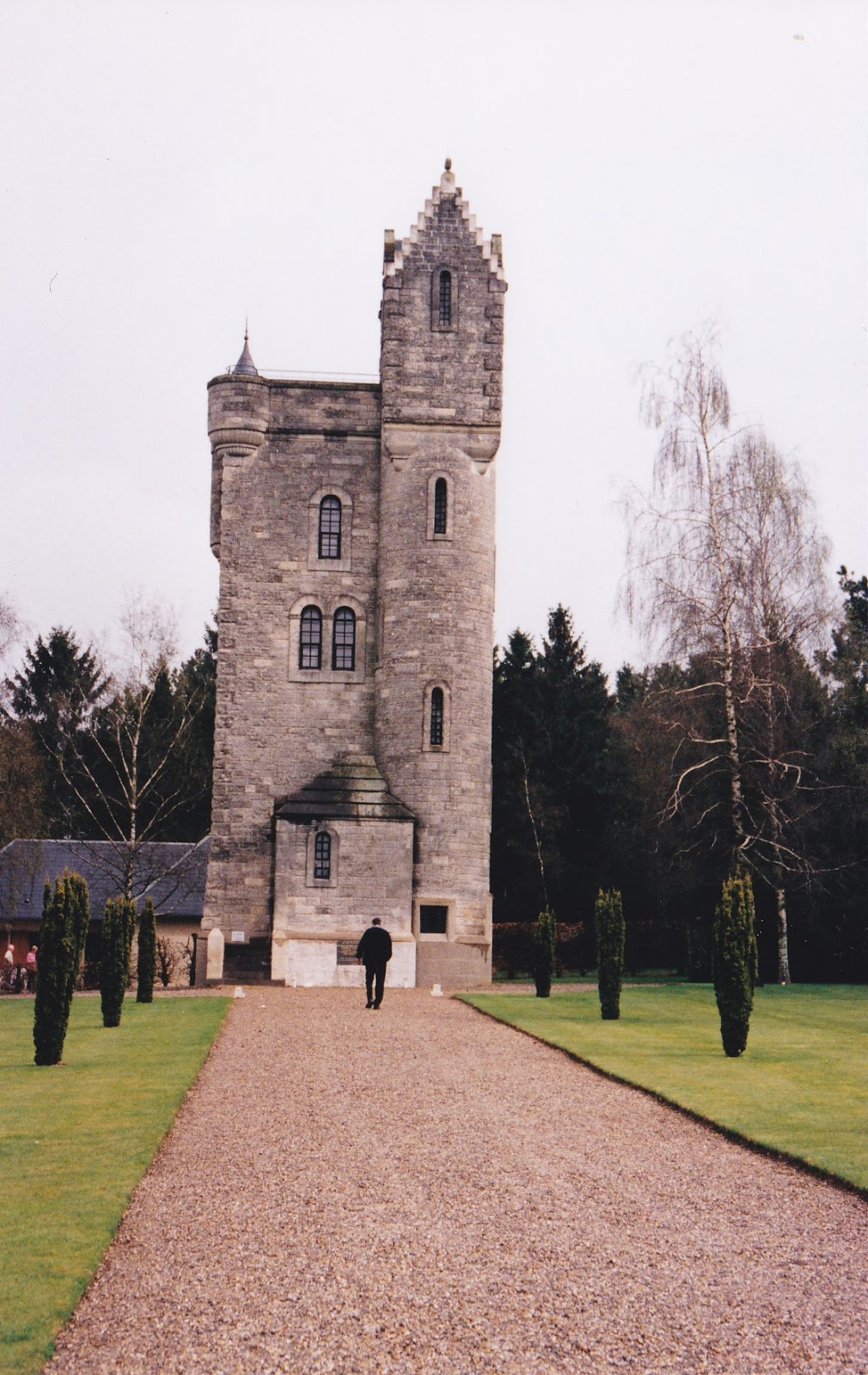
   A few miles to the south, near Thiepval, the 36th (Ulster) division fought an epic battle when some units fought their way through the German front-line trenches only to be cut off and slaughtered by a counterattack. The "Ulster Tower" now stands on the site as a memorial.
This happened just a few weeks after republicans in Dublin staged the Easter Rising in the hope of receiving German weapons and support, and Ulstermen have not forgotten it.
     More than thirty other battalions also suffered more than 500 casualties on July 1st 1916. Popular attitudes towards the war, the military high command and the governing elites at home changed irrevocably as a result.

(The folksinger Mike Harding has recorded a song, "The Accrington Pals", which can be found on youtube) 

Friday, 24 June 2016

Democracy and Representation

(Written in the immediate aftermath of the vote to leave the EU)

Jean-Jacques Rousseau in his book "The Social Contract" (1743) argued that the whole principle of democracy was the hope that a majority of the people, when consulted, would always reach the right decision: the one which was best for the country. If the popular majority reached the wrong decision, he said, then the whole system collapses. Rousseau was writing about what is nowadays called "direct democracy", where the people are consulted about all important decisions, as in the recent referendum. He called the British political system "elective aristocracy", meaning that every so often we choose what leaders we want, and then send them away to make decisions on our behalf until the next election. He did not think such a system was as good, but believed direct democracy could really only work in a small, homogenous community.
      Until the current spate of referendums, Britain did not have direct democracy; instead we had government by elected representatives. The great conservative political thinker, Edmund Burke, writing half a century after Rousseau, discussed the vexed question of whether an elected M.P. was under any obligation always to follow the wishes of his constituents. His answer was a strong "No". His argument was that an M.P. was not a mere delegate or mouthpiece: his job was to exercise his judgement to choose a policy which he believed was in the best interests, not only of his constituents, but of the entire country. Should his constituents object to his decisions, they reserved the right to chuck him out at the next election. He could also have added that an M.P. is probably more intelligent than most of his constituents, and is certainly better informed about the issues!
    The philosopher Roger Scruton (a philosopher with whom I am not often in agreement!) gave an interesting talk on the radio last week in which he attacked the whole idea of holding a  referendum. It was, he argued, an abdication of responsibility by those elected to lead us. What, after all, is a Prime Minister for, if not make decisions on our behalf to the best of his ability? If he insists on holding a referendum, with a promise to abide by the result, then he is abandoning his decision-making role and reducing himself to a mere functionary or mouthpiece, and may well, as has befallen David Cameron, find himself having to commit to a policy which he believes to be wrong for the country. That is no way for a serious leader to behave! I'm reminded of a story told by the historian A.J.P.Taylor about the 1848 revolution in Paris, where a man was seen running after a crowd of demonstrators, shouting "I'm their leader, I must catch up with them!"  

The only reason for a government to hold a referendum is if it expects to win it, thus strenthening its ability to carry through a contentious policy. De Gaulle in France was successful at this, and Hitler was even more so: his more outrageous actions, like the assumption of the Presidency, the remilitaization of the Rhineland and the Anschluss with Austria, were promptly supported by enormous referendum majorities from the populations involved, thereby making it difficult for other countries to take action. The unfortunate David Cameron, by contrast, called a referendum solely to try to paper over a split in the Tory party. He miscalculated severely, and serve him right! Do you recall the A. A. Milne story where Winnie-the-Pooh digs a trap to catch a heffalump, only to fall into it himself? Cameron as Pooh! 

Postscript: A friend has pointed out to me that inthe end De Gaulle called one referendum too many, lost it, and had to resign. We could say the same about Cameron. The difference is that De Gaulle's proposal was then abandoned, whereas Cameron has left his successors to implement a policy which all party leaders, all former prime ministers and a large majority of MPs believe is bad for the country. Bizarre!
    

Tuesday, 21 June 2016

Bologna and Parma

Bologna is known as "il rosso": the “red city”, partly because it is actually red in colour; built of brick rather than marble, with even modern buildings often being plastered in red stucco. The other reason is that it was traditionally run by the Communist party: I found the party newspaper being sold on the streets even today.
   Ever since the Renaissance this region of Italy, the Emilia-Romagna, was part of the Papal States, ruled from Rome; it rebelled unsuccessfully in 1848, and the Pope’s troops were only expelled when Italy was unified in1861. The city was damaged by Allied bombing in the Second World War, but was rebuilt in the traditional style, and the centre is still a tangle of mediaeval buildings and confusing little streets.


These are views from the campanile tower of S. Petrino church on the Piazza Maggiore; the heart of the old city. The redness of the old city is very clear, but note the spectacular towers: some of half-a-dozen remaining from the Middle Ages. Reaching the top of the tallest one, the Asinelli Tower, involves climbing almost 500 steps, and I’m afraid I chickened out of making the attempt. Near the towers are the old Jewish quarter and the student quarter.


 Bologna boasts of having one of the most ancient universities in Europe, though some other Italian cities dispute this priority.
    Everyone assumes S. Petrino is the cathedral of Bologna, but it isn’t. Its unfinished state is very noticeable.
In the 14th century, when the Popes lived in exile at Avignon in France, the city fathers of Bologna planned to build for their city the biggest church in the world, but when the Popes returned to Rome they were quick to put a stop to the project; and what survives is only a fraction of what was planned. The church has a mediaeval fresco of Heaven and Hell, which includes a scene of Mohammed being devoured by Satan: this has led to a heavy presence of armed police in the area, for fear of Islamic outrage. The piazza facing the church is surrounded by fine mediaeval municipal buildings, 
though unfortunately the famous statue of Neptune was surrounded in scaffolding on our visit.
   Wandering through the old city centre, we came across more mediaeval buildings, like the Grassi Palace
 and a great many churches, which were mostly in totally over-the-top Counter-reformation style. A noted exception to this is S. Stefano (actually a collection of chapels and cloisters)
 which features a reproduction of the Holy Sepulchre,
 Pilate’s courtyard (complete with a basin for washing his hands) and a Column of the Flagellation, in black marble. All this was built from the 5th century onwards, in a praiseworthy attempt to save the pious the trouble and expense of having to make a pilgrimage all the way to Jerusalem to see the real things! I also visited the town's mediaeval museum, but there was far too much to see in a single visit, and unfortunately no photographs were allowed.

   Bologna is also known as the “fat city”, since its cuisine is said to be the best in Italy. Our guide (a very nice young lady called Antonia) impressed on us that we should never, under any circumstances, ask for spaghetti bolognese in the city, this being essentially an American invention. What the locals eat is actually tagliatelli with a ragu sauce which, because it contains few if any tomatoes, is brown rather than red in colour. Local delicacies include rabbit stuffed with figs (“coniglio”: which is very tasty!) and a particular kind of veal cutlet with Parma ham and parmesan cheese. Certainly Bologna seemed full of good-looking restaurants; which made the sight of large queues at the local McDonald’s a particularly depressing spectacle.
   Our hotel, which I would recommend, was the Internazionale on the Via Indipendenza: a wide boulevard driven from the railway station straight to the heart of the old city.  It was only a short walk to the Piazza Maggiore, and impossible to get lost on the way. My window looked out on the entrance to a large park, and in the early morning the sky was full of swifts. But on Friday the streets opposite were taken over by a vast market, where many of the stalls featured great piles of cheap clothes: rummage for what you can find at 2 or 3 euros! Many of the stallholders were Asians. The streets in the centre had numerous beggars: a variety of cripples and defeated-looking old men and women, but also lots of young African men, who appeared to speak no Italian and just stood around mutely holding out baseball caps for contributions. Who were they? Refugees who had fled across the sea from Libya, perhaps?

On the Thursday we were taken on a guided tour of Parma. Unlike Bologna, this was an independent little Duchy ruled by the Farnese family. They owed their wealth and prominence to the shameless nepotism of one Alexander Farnese, who in the 16th century became Pope Paul III and dedicated himself to the wellbeing of his family. It was the Pope’s grandson, Alexander Farnese, Duke of Parma, the greatest soldier of his age, who in 1588 was supposed to lead his army across from Flanders on the Spanish Armada, but famously failed to do so. In the 18th century the British government went to enormous trouble to have Don Carlos, the son of Elizabeth Farnese the Queen of Spain, made Duke of Parma without causing a diplomatic crisis. (Don Carlos later became King of Spain himself, when with base ingratitude he took Spain into the Seven Years’ War against Britain – not that it did his country any good). When the map of Europe was redrawn after the battle of Waterloo, Parma was given to Napoleon’s widow, Marie Louise from the great Habsburg family, since no-one could think of what else to do with her.
   We entered Parma through the vast bulk of the Farnese palace. Between the wars it was the headquarters of the local Fascist Party, and was then badly damaged in wartime bombing, but has been restored. In front of the palace was a large area of grass, which included a random-looking collection of objects which were apparently an art installation. There was also a statue of a young anti-fascist partisan fighter, who was contemptuously turning his back on the palace.
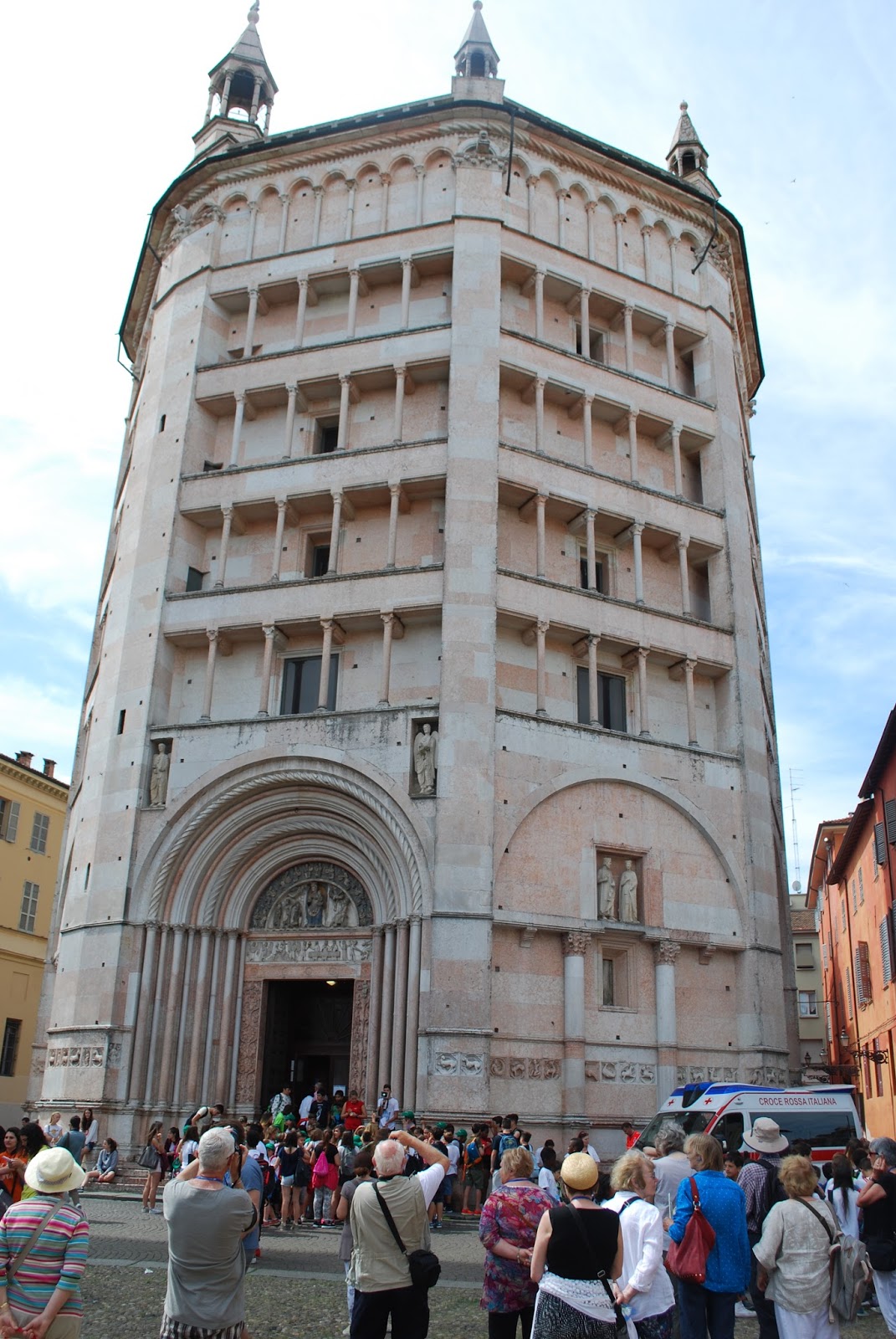
      The centre of the old town was just a short walk away: a piazza fronted by the cathedral, the baptistery and the episcopal palace.
This picture is taken from a postcard, because at our visit the area was full of thousands of small children celebrating the start of their summer holidays, being organised and addressed by a DJ on a disco system at maximum volume. Our guide abandoned her talk and we elbowed our way through the dense crowds.
   The cathedral dates from the 12th century, with the campanile a century later. Outside it is guarded by two impressive lions (described in the guidebook with the unusual word “columniferous”),
and inside the walls are covered with frescoes in the mannerist style. Two contrasting features are a 12th-century marble carving of the deposition from the cross
and a magnificent dome painted by Correggio in 1530. 
    The baptistery, dating from the 13th century, is even better, in pale pink marble, with splendid carvings above the portals
and inside, the walls and dome covered with mediaeval frescoes. 

     We could have done with more time to explore Parma, but instead we were whisked away to encounter local foodstuffs. First we were taken to what can only be called a factory producing Parma ham. We were shown literally thousands of pigs’ hind legs, hanging up to mature in near-freezing conditions (50,000 a year were processed, we were told); the man in charge explaining to us how he pricked them regularly with a large needle made from a horse’s tibia bone, and then sniffed to make sure they were up to standard. Then it was on to Modena, where the mysteries of making balsamic vinegar were explained to us. This bears no relation at all to what we buy in the supermarkets, and since it takes 12 years to mature (25 years for the best quality) it is incredibly expensive. Although it did indeed taste very nice, I didn’t buy any. Incidentally, despite this being a rich farming region, we didn't see a single cow or pig. They are all kept indoors for the whole of their lives!

The next day we were taken on a tour of Ravenna, but there’s so much to say about this that I’m leaving it for my next blog post.

Wednesday, 8 June 2016

Money: The Sinews of Power

   At the end of the 17th century, an amateur statistician called Gregory King attempted to count the population of England, based on tax returns. This was the first serious attempt at such a project in any country. He calculated the population of England and Wales at about 5 ½ million, and although he did not extend his researches to Scotland and Ireland, it is guessed that the Irish population was about 2 ½ million, and the Scottish, 1 million. Britain at the time was therefore a small and rather insignificant country, next door to a much bigger one, namely France, which had a population of about 19 million, as well as a very large army and an aggressive, militantly Catholic monarch, Louis XIV. Britain’s position thus looked distinctly insecure, and under Charles II (1660-85) Britain’s foreign policy consisted of following the French lead in return for financial subsidies.
   In 1688 Charles’s brother, James II, was overthrown in the “Glorious Revolution” and replaced by his cousin and son-in-law, the Dutchman William of Orange. The next three decades saw a constitutional transformation of Britain into a system of government based on Parliament, with two distinct political parties, and, closely linked with this, a revolution in foreign policy.
   It is worth remembering that, apart from some skirmishes under Henry VIII, England had not fought wars against France since the Middle Ages. But Louis XIV launched his armies into the Rhineland and present-day Belgium (then part of the Spanish Empire), and Britain now joined coalitions to stop him. William III was not a great general, but in the Nine Years’ War (1689-97) he fought the French to a standstill and an eventual peace settlement that restored the status quo. More significantly for the future, the British Navy gained a significant advantage over the French which it never subsequently lost.
   William died childless in 1702 and was succeeded by his sister-in-law, Anne, James’s younger daughter. Anne’s reign was to be entirely dominated by war, because at the same time the old ruling dynasty of Spain came to an end, and the succession was disputed between two claimants: Louis XIV’s grandson, Philip, and Charles, the son of the Habsburg (Austrian) Emperor. This was of great concern to Britain, for the Spanish Empire included Belgium, much of Italy, and the vast Spanish colonial possessions in the Americas and elsewhere. A compromise partition between the claimants could have been possible, but Louis XIV tried to seize the lot, thus precipitating the War of the Spanish Succession, which was only ended with a compromise treaty in 1713, a year before Anne’s death.

The war was marked by the Duke of Marlborough’s four great victories, but Britain’s other lasting contribution was in its financial structure, for in these wars there came about a financial revolution. A permanent direct tax, the Land Tax, was imposed for the first time. The Bank of England was created in 1694, enabling the wars to be financed by borrowing: the beginning of the National Debt. It was accepted that henceforth no taxes would be imposed save by vote of Parliament, and that the Debt was guaranteed by stable government. Henceforth Parliament would keep control of the national finances, voting on them every year. Within a few decades this annual financial statement was to be nicknamed “the Budget”. Furthermore, there were to be regular General Elections: every three years, under a Triennial Act. From this point, although the monarch’s wishes remained paramount, it became increasingly clear that no government could survive for long without a reliable majority in the House of Commons.
   The Nine Years’ War left England with a debt of £19 million, and by the end of the War of the Spanish Succession this had risen to £52 million. The sheer size National Debt alarmed many people, and still does. The Debt was thirteen times to government’s annual income from taxation, and the interest to be paid on servicing it made up over 30% of all government expenditure. How could it ever be paid off? It never was; and wars in the future were to be fought with borrowed money. What is more, servicing the Debt and providing for defence were to make up almost the whole of an 18th century budget: all other government costs put together totalled well under £2 million.
    Where did all this money come from? There must have been plenty of money kicking around in Britain, but before this time there were no reliable and secure banks to invest it in. Foreign money must have been involved, especially from Holland and the Spanish Netherlands. These countries were always open to invasion, especially from France, when any wealth would be threatened by plunder; but Britain was an island, defended by a strong navy, and with a government that looked dependable and unlikely to default on its debts, and was therefore a safe place to invest. Around the great institution of the Bank there grew up the financial centre that soon became the “city”, where all matters of loans, investment and insurance would be handled. Britain had a much more sophisticated financial structure than France, which had neither a national bank nor a national debt. Governmental bankruptcy was to be one of the principal causes of the French Revolution.

Money has been called “the sinews of power”. How was it used? The most obvious use was to finance the armed forces. Shipbuilding yards for the Royal navy were by far the biggest industrial works of the time, and supplying munitions, weapons or uniforms or food for the troops, swallowed vast sums, to the great benefit of the contractors. A new professional army had to be created, such as had not existed since the days of Oliver Cromwell, and which led some to fear the establishment of a military dictatorship. But there was more than this. The British army, even at the height of Marlborough’s campaigns, was tiny compared with that of the French, and it was rapidly reduced as soon as peace returned. Instead, British money was used to pay others to fight on our behalf, either by subsidising allies like the Habsburgs, the Dutch and the small German states, or by directly hiring foreign mercenaries. This practice continued throughout the 18th century and beyond: Britain paid vast sums to the Austrians and Russians to enable them to fight Napoleon, and much of Wellington’s army at Waterloo consisted of Dutch or German soldiers.

The great questions of war and peace and finance helped define and separate the political parties. The Whigs and Tories had their origins back in the 1670s, and originally been divided over questions of religion. Now, as the wars continued and the debt increased, the Whigs became increasingly identified with the land war and with the City financiers, whereas the Tories favoured a “blue-water” (that is, naval and colonial) strategy, or even outright isolationism: they were suspicious of the money-men of the City and resented paying the high taxes which paid for the war, and looked like continuing indefinitely afterwards, in order to pay the interest on the National Debt. William III attempted to form all-party ministries, which only caused political instability, and in the latter part of Anne’s reign single-party governments became the norm: Whigs from 1708-10, then Tories from 1710-14. At Anne’s death the Whigs again took power, and did not relinquish it until the late 1750s, by which time the old party labels had become more or less meaningless.   

In peacetime, efforts were always made to reduce the Debt, notably under Sir Robert Walpole (1721-42) and the younger William Pitt (1783-1801), but when the next war came, once again it was financed by borrowing. By the 1760s the War of the Austrian Succession, followed by the Seven Years’ War, had pushed the Debt up to £130 million, and the War of American Independence raised it further to £244 million by the 1780s; but all this was nothing compared with the expense of the Napoleonic Wars, which led to a Debt of some £844 million, incurring interest payments that formed a staggering 58% of all government expenditure. And yet, probably thanks to the start of the Industrial Revolution, the country never did go bust!


Victorian statesmen managed to keep Britain out of expensive continental wars, and in consequence had reduced the National Debt to under £600 million by the 1890s; and this, combined with enormous expansion of the economy, meant that interest payments made up only 10% of government expenditure. But then came the First World War, which as before was financed by borrowing. When the war was over, Britain was encumbered with a National Debt of around £800 billion, the servicing of which made up over 30% of annual expenditure. Some would maintain that the British economy has never recovered from this.   

Tuesday, 31 May 2016

Early British Demographics

In Britain before the 18th century, the government was wholly ignorant of the number of people living in the country, and estimates of, for instance, how much revenue a tax would bring, were founded on mere guesswork. This condition of ignorance continued even longer in other countries. Nevertheless, we can be certain that up to 90% of the population in all countries were peasant farmers: independent freeholders, slaves, and all conditions in between. (Many words of abuse, like villainous, churlish or boorish, only mean to behave like a farmer!). Cities like Athens, Rome, Constantinople and Paris were, as Marx said, “parasitic on the countryside”. The reason was that agriculture was not very productive (perhaps only 3 grains were harvested for every one sown), and a single bad harvest could bring famine. Also, many non-farmers were in economically unproductive roles: priests, soldiers etc.

It has been suggested that the Roman Empire had a population of around 70 million at peak, around 150 A.D. This enabled Rome to sustain an army of half a million. (By comparison, 18th century France had a wartime army of comparable size with half the population, suggesting that France was twice as economically productive). The population of the Roman Empire had probably fallen to 50 million by 400 A.D., as a result of plague, devastating civil wars and barbarian invasions. The population of Britain in Roman times was perhaps 1 to 2 million.
   The European population probably reached its lowest around 540, as a result of these same problems plus serious climate change. There were at least one, perhaps two, major volcanic eruptions at this time (Krakatoa or Tambora perhaps?), bringing cold and wet conditions which might have persisted for many years. The climate may not have recovered till the mid-7th century.

The climate was warmer in Viking and Norman times: grapes were grown in Yorkshire, and the “Anglo-Saxon Chronicle” records droughts rather than freezing winters. The milder climate enabled the Viking voyages to Iceland, Greenland and North America, and down the great rivers of Russia to Constantinople. The next generation of Viking descendants went from their settlement in Normandy (“The land of the Norsemen”) to Britain and to Sicily, and the generation after that to the Crusades!
   Our main source for the population of England at this time is, of course, the Domesday Book, compiled in 1085. It did not cover all of England (for example, not Yorkshire or London), and it recorded only the number of households in each village, with no indication of the size of families. It is guessed that the population of England at the time might have been perhaps 1 ½ million.  From here, the population grew steadily, to reach perhaps 4 million before the demographic disaster of the 14th century.

Everyone has heard of the Black Death, which struck in mid-century, but it seems clear that trouble had begun well before then, as once again the climate changed and the “little ice age” set in. Probably Britain already had as high a population as could be sustained, even in good years, by the primitive economic conditions of the time; very marginal land was being cultivated, and there are reports of disastrous famines. Then bubonic plague reached the south coast of England in 1348, and had spread to the extremes of Scotland and Ireland by 1350. Death-rates probably varied between 20% and 60%, the highest being in London. Perhaps 1 ½ million died in four years. The population total did not recover till Elizabethan times, and the sown area was not equalled till the reign of Victoria.
   Bubonic plague remained endemic until the late 17th century, with outbreaks every few years. Population levels only began to rise sharply after its disappearance.

In 1500 the population of England and Wales was about 3 ½ million. It was thus a small, thinly-populated country. By comparison, France had 12 million, Spain 6 ½ million, the Holy Roman Empire (effectively Germany, consisting of many small states) 13 million, Northern Italy (several small states) 6 million, Poland 8 million, and the Ottoman (Turkish) Empire, which included the Balkans, 12 million.
   There were no cities with a population of over 120,000 in Europe or the Mediterranean area. The largest, with populations of 80,000 or more, were Constantinople, Cairo, Naples, Venice, Milan and Paris. The largest cities in the world were in China.
     There were in operation by this time a number of inventions unknown to the Romans: windmills, the blast furnace, the printing press, gunpowder, and (a lesser but really useful piece of simple technology) the spinning wheel; but probably economic productivity hadn’t improved very much since Roman times. Central and Eastern Europe was now integrated with the west. The Ottoman Empire under Suleiman the Magnificent was a serious threat to Europe: in 1526 the Turks destroyed the kingdom of Hungary at the battle of Mohacs and swept northwards to attack as far as Vienna. The Venetian-held islands in the eastern Mediterranean fell to the Turks one by one, and pirates from the Algerian coast, in alliance with the Turks, terrorised the coasts. From 1520 the Holy Roman Empire was to be split by the Reformation, and permanently weakened. For the next century, Europe would be engulfed by religious wars.
    If a Martian had observed Earth around 1500, it is most unlikely that he would have predicted that over the next few centuries European civilisation would come to dominate the world. If he was looking for a future world leader, he would probably have picked the Ottomans, or perhaps Ming China or Mughal India. But he would have been wrong!

   Consider also the geographical situation. Until this time, the world as known to Europeans consisted only of Europe itself, the North African coast and the Near East, with vague stories derived from Marco Polo concerning a land called “Cathay” somewhere far to the east. Britain was only an insignificant collection of islands on the extreme fringe of the known world; thinly populated and of small concern to the greater powers.
   But then look what happened! As ships started to cross the Atlantic to America, and round the Cape to the Far East, suddenly Britain was more at the centre of things! The same applied to Holland, which only became an independent nation at the end of the 16th century. Spain and Portugal were the first states to profit from the new discoveries, but after 1600 were to be supplanted by England, Holland and France.

At the end of the 17th century, Gregory King conducted his own survey of the population of England and Wales. I have outlined his findings in an earlier Blog entry.
   King estimated the population of England and Wales at 5 ½ million. He did not investigate the rest of the British Isles; but it is guessed that Ireland had about 2 ½ million and Scotland 1 million.
By comparison: France had 19 million, Spain 9 million, the Holy Roman Empire 13 million, the Austrian Empire 11 million, northern Italy 8 million, Poland 9 million, and Russia, which was now expanding into Siberia, 15 million. The biggest state by far was the Ottoman Empire, which now included the Balkans, Iraq and Egypt, 25 million.
   The total population of Europe was about 100 million. This was still small-scale by comparison with Mughal India’s 130 million and China’s 170 million. Japan had about 20 million.

The Ottoman Empire was in fact on the verge of its long decline, though at the time few people realised this. Even with the acquisition of Scotland and Ireland by England, Britain was still a small nation next to a much larger one; namely France. How then did Britain survive and prosper? Partly it was simply by being an island: after 1700 the navy was much the strongest in Europe, and the country was only rarely faced serious threats of invasion. This also meant Britain could get away with only having a small army (which had important constitutional consequences, as will be discussed later) despite which, between 1689 and 1713 Britain fought two victorious wars against vastly superior French forces. How was this done?
   This will be covered in a later Blog entry!