Sunday, 25 March 2018

Ranji


The great batsman K. S. Ranjitsinhji, known to all and sundry simply as "Ranji", was born to an extensive family of princely Rajputs in 1872. His birthplace, Jamnagar, was a city in Nawangar; one of a cluster of native-ruled states on the north-west coast of India, towards what is now the frontier with Pakistan. The situation of these native-ruled states was anomalous: they were seen as part of Britain's Indian Empire, but were technically sovereign states in alliance with the British Crown. Ranji's home state contained about a third of a million inhabitants, and its princes lived extremely lavishly in vast palaces, but the land was arid, liable to droughts and subsequent famines; it was economically backward and riven with typhoid and cholera. One oddity was that its ruling princes, despite having extensive harems, often failed to father male heirs, thus leading to confusion over the succession. The Rajputs were traditionally ferocious warriors, and by Ranji's day supplied soldiers for the British army in India. 
   The British Viceroy in India kept a careful eye on the native states: British representatives "advised" their rulers, and the young princes were encouraged to attend special schools where they would learn English ways; sport being an essential part of the curriculum. Accordingly Ranji, at the age of 8, entered Rajkumar College in the town of Rajkot. (This began an odd coincidence, which endured throughout Ranji's life, with Gandhi, just three years older, whose father had been chief minister there for several years. Gandhi also received an English-style education, though not at Rajkumar). Here Ranji gained his first experience of cricket. By the age of 16 he was excelling at the sport, and also at gymnastics, tennis and racquets; and he won prizes for his recitation of English poetry. It was therefore no great surprise that in 1888 he and two other young Kumars (princes) were selected to be taken to England to further their education at Cambridge University.
   Ranji was at first educated by a private tutor, before matriculating at Trinity College in 1892. At Cambridge he was, from the start, determined to improve his cricket. Apart from playing in matches as often as he could (sometimes two in a day!) he hired some of England's leading Test Match players, like Richardson, Lockwood and Hearne, to bowl endlessly at him in the nets. (Imagine any student doing that nowadays!). Ranji was fast on his feet and was blessed with good eyesight and strong, supple wrists; and because he had never been formally coached as a youth, was willing to attempt shots no-one had ever seen before; particularly deflecting straight balls behind square on either side of the wicket.
  He duly achieved his "blue" for playing in the annual match against Oxford in 1893. He did not score many runs in that match, but, more importantly, he made the acquaintance of C. B. Fry, a member of the Oxford team, who was to have a tremendous influence on Ranji's life. Fry was one of Britain's greatest sportsmen of all time: he played in an F.A. Cup Final, broke the world record for the long jump, and was unlucky not to get to play rugby for England; but cricket was his greatest love. Unlike Ranji, who played by instinct, Fry had a scientific, analytical approach to the game. When Ranji produced the "Jubilee Book of Cricket" in 1897, it seems that much of the book was in fact the work of Fry. But Fry was also something of a "Renaissance man", who achieved a first class degree at Oxford and could have made a career as a senior diplomat or civil servant, but instead chose to play cricket. He inevitably became captain of England in the years before the First World War.                  

   It was largely because Sussex was Fry's county that Ranji decided to make it his cricketing home, for he had no previous connections there. Although he never took up permanent residence in the county, dividing his time between a hotel in Brighton and the rooms he retained in Cambridge, he played full seasons for Sussex every year from 1895 to 1908. Like all cricketers, he had the ocasional failure, but his batting average for each season never fell below 45, and his rate of scoring was always very fast. In all first-class cricket he amassed 72 centuries. He was also an excellent slip field, and could bowl off-breaks when required. Keen and knowledgeable followers of cricket who watched him bat were amazed. The more literary among them indulged in metaphors about the mysteries of the Orient, the bat as a wand, Ranji "conjuring" runs or springing like a panther on a loose delivery, and so forth; whereas the old professional Tom Wainwright was reduced to saying, "Ranji? He never made a Christian stroke in his life!"


   It came as no surprise that in 1896 Ranji was selected for the England team against the touring Australians. After having been surprisingly omitted from the first test, he was called up for the second, at Old Trafford, and although England lost, he enjoyed a sensational debut in an exciting match. Coming in at number 3, he scored 62, and then, as England were forced to follow on, dominated the second innings by hitting 154 not out in a little over three hours. The England total of 305 left the Australians needing just 125 to win the match, and although Tom Richardson then bowled 43 overs unchanged, taking 6 for 76, they sneaked home by 3 wickets. The press were loud in Ranji's praise. 
  Ranji toured Australia with A. C. Maclaren's team in 1897-8, and was personally successful, though the team was not; but his Test career was to be brief. He scored more runs against Australia in 1899, but then in 1902 only once reached double figures in four Test innings, and was never selected again. Nevertheless, an enduring legend had been established. (Gandhi was in England at the same time, studying to become a barrister, but it seems certain that he and Ranji never met)

  In his career in England, Ranji never encountered any serious racial prejudice or discrimination; and indeed spent two years as captain of his county. He was, after all, a prince, he had been to Cambridge, he was an excellent host, always very generous to guests and friends, a good speaker (described as "unaccented"), and loved the traditional country sports of shooting and salmon-fishing. In consequence he was always in demand socially, and was at ease in all company, up to and including members of the royal family. 

   Ranji's county career came to an abrupt end in 1908, though he did return for a full season in 1912. The reason was simple: after the death of a cousin he became the ruler of his state, with the approval of the British Raj, and was now officially the Jam Saheb of Nawangar. He threw himself into improving his impoverished state; clearing slums, building roads and railways, establishing irrigation schemes and creating a port for the pearl-fishing industry. This was how the British expected native princes to behave; though he also lived in great spendour and spent vast sums entertaining visiting dignitaries, as well as many of his old cricketing friends.
   He never married. He always enjoyed the company of attractive ladies, and it was said that he had a discreet relationship with an English girl, but as an Indian Hindu prince he could never marry her. All this was very different from his princely predecessors, who had numerous wives as well as the usual harem stock of eunuchs and dancing girls. Ranji dismissed all of these on his accession.

When war came in 1914, Ranji, in common with almost all the Indian ruling princes, immediately offered the services of his state to the British government. He provided soldiers and paid for medical facilities and transport, and was commissioned as an honorary Major, but, much to his disgust, was never allowed to go anywhere near the front line. He did, ironically, suffer a serious wound unconnected with the war, because in summer 1915, whilst with a shooting party in Yorkshire, he was blinded in the right eye by a clumsy friend. For the rest of Ranji's life he wore a glass eye, and a doctor had to bathe the eye socket every day.

   In 1920 there came a completely new development, when he was chosen to be one of three representatives of India at the Assembly of the League of Nations in Geneva. He took C.B. Fry along as an advisor, and when nominated to the Finance Committee, asked Fry to act as his Substitute Delegate. A few years later a crisis arose when Mussolini occupied the Greek island of Corfu, and the former British Prime Minister Arthur Balfour asked Ranji to deliver a speech in response. Fry wrote appropriate paragraphs which Ranji read out, and Mussolini withdrew.  It was at this time that Fry was approached by a delegation from Albania who offered to make him King of their impoverished mountain country; an offer which Fry, probably wisely, turned down. Ranji also turned down an invitation to become a member of the Permanent Council of the League.

Ranji's cricketing days were now behind him, but he found consolation in the success of his nephew Duleepsinhji, who by 1929 was playing, like Ranji before him, for Cambridge University and Sussex. Duleep was a more orthodox batsman than his uncle, but equally effective. Ranji was proud to be present at the second Test against the Australians in 1930, when Duleep scored 173 on the first day. As it happened, this innings was eclipsed by the young Don Bradman, who made 254, and Australia won the match comfortably. Bradman remarked that Duleep's off-driving was so powerful that, after fielding at cover and mid-off to him, he was obliged to get his hands bandaged. But, as with Ranji, Duleep's career was sadly cut short. His health broke down and he was unable to go on the 1932-3 tour of Australia (the infamous "bodyline tour"). His place was taken by another Indian nobleman, the Nawab of Pataudi, who duly maintained the tradition by scoring a century in his first Test. 

Ranji's world, the world of the Indian princes, was changing beyond recall. The Montagu-Chelmsford Reforms opened up senior ranks in the Indian civil service to native Indians, and the aim of the British government was clearly to bring a degree of self-government in India. Ranji attended the Round Table Conference on the future of India, but so did Gandhi, who had abandoned his career as a barrister and now wore just a loincloth and cloak, and brought along a goat to supply him with milk. Winston Churchill was disgusted. Caught between the British moves towards democracy and Gandhi's call for a boycott of British goods, what place was there for the independent princes? None at all, it would seem. Ranji had always been a strong supporter of the British Empire in India, but in 1933, in his capacity as Chancellor of the Chamber of Princes, he had to endure a public rebuke from the Viceroy, Lord Willingdon. It saddened him very deeply. In the Second World War the Indian princes, unlike Gandhi's nationalists, gave their full support to the British war effort, but in 1947 Mountbatten forced them to merge their states in an independent India, whether they wanted it or not.

Ranji did not live to see this. All his life he had suffered from asthma attacks and other respiratory problems, and in spring 1934 he fell seriously ill. After several days of violent coughing, he died on April 2nd. He was given lavish obituaries. The Ranji Trophy, the most prestigious contest in Indian cricket, is named after him.

Footnote.
C.B. Fry died in 1956, at the age of 84. In the 1930s he was puzzled by the career of Sir John Simon as Foreign Secretary and then as Lord Chancellor. "I knew him at Oxford, and I was much cleverer than him!" he complained. But Simon was making history while Fry was only been making runs. 
        
.

Sunday, 11 March 2018

Shrewsbury: Old and New St. Chad's

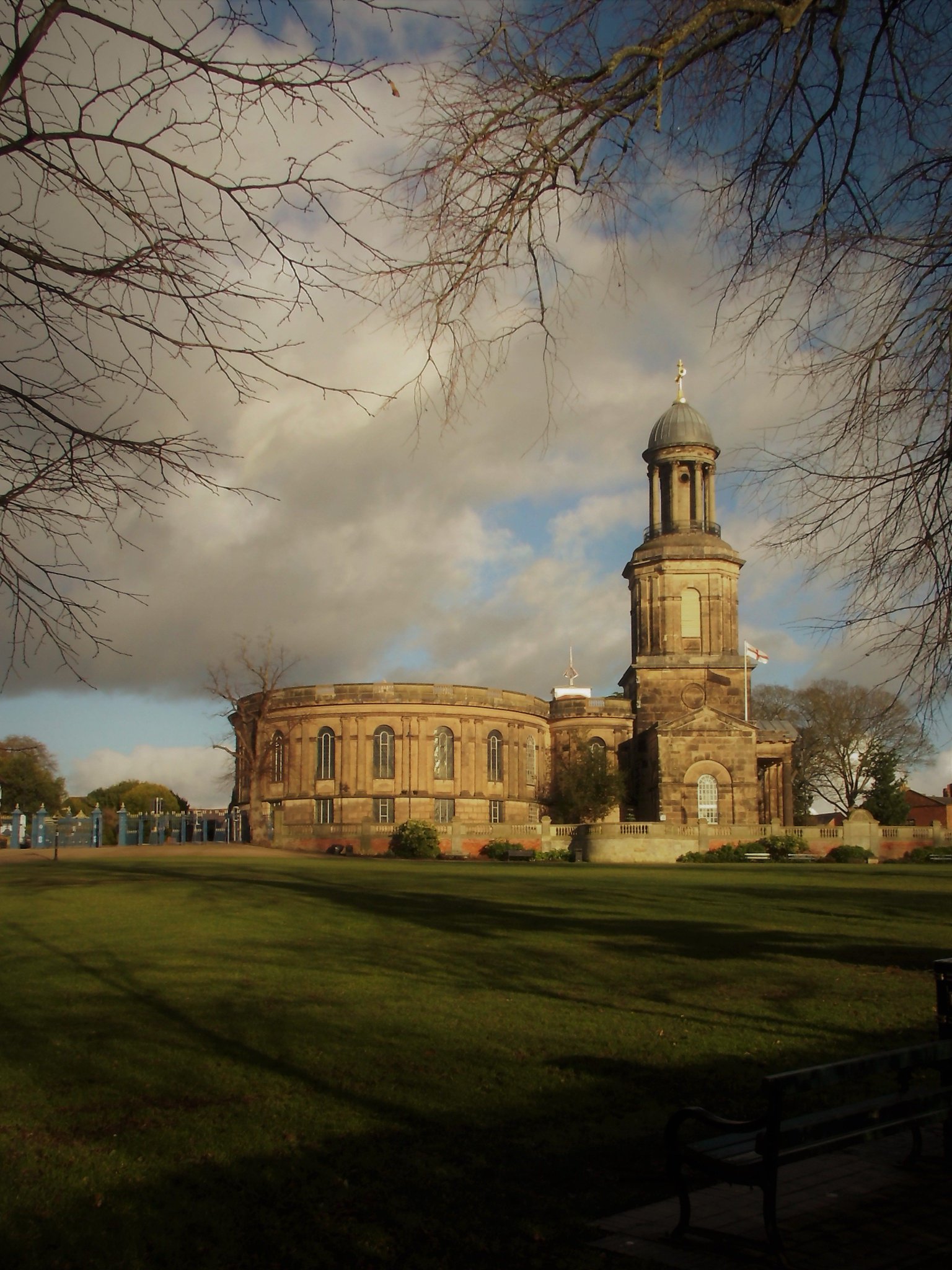
This is a print of the old church of St. Chad's in Shrewsbury. There was a church here from Anglo-Saxon times, when Shrewsbury was already a significant town,though this building was built in the early 13th century. Most of it has now gone

 By the late 18th century the building was plainly insecure, and in 1788 the churchwardens and other local dignitaries sought the advice of the great engineer Thomas Telford. Telford duly carried out a survey, then called them all together and gave them his advive, which was to evacuate the building immediately, before it fell down on top of them! "With scarcely a moment's warning", he told them, "the roof might come down!" 
   Telford's advice was ignored, and a few months later the tower of the church duly collapsed; fortunately in the middle of the night, so no-one was injured. Today all that remains is a chapel that was once on the south side of the chancel, all alone on a small patch of grass.

It was decided to build an entirely new church, and the great classical architect George Steuart (who had earlier built Attingham Park nearby) was called in to design it. 
   The new St. Chad's was built in 1792. It is a most unusual design, with at the west end a square tower that narrows to an octagon and then a cylinder, with Corinthian columns supporting a small dome. 
The entrance hall beneath the tower leads to a vestibule that is elliptical in shape, with sweeping staircases leading up to the gallery, and from there to a circular nave that includes a sanctuary at the east end.


Such a radical approch did not meet with universal approval. One contemporary called the new church "As ugly as improper", and Murray's Guide, in the Victorian era when Gothic was seen as the only valid style for churches, thought St. Chad's was in "execrable taste".
   Whatever one's views of the architectural style, it cannot be denied that the builders chose the finest location in the town. A section of the medaeval town walls was demolished and replaced with a classical balustrade, leaving for the church to dominate an open park, known as the Quarry, running down to the River Severn.   .

There is a magnificent view of the church, and the rest of the centre of the town, from Shrewsbury school, across the river.

The new St. Chad's is thus the most photogenic sight in the town. 

Thursday, 1 March 2018

Freedom

 Political freedom (sometimes called “liberty”) involves how we relate to constituted authority or power, especially when living in a state. It is therefore different from the philosophical concept of freedom; as in “free will” as distinct from determinism, fate, predestination, Pavlovian reactions etc).
Several questions emerge: are there different aspects of this political freedom; what restrictions may justifiably be placed on it, and why should a person be free anyway?
Two quite different types of freedom tend to crop up in political discussions, summarised under the general headings of “freedom to …” and “freedom from …” The latter concept will be discussed later; for the moment I am looking just at “freedom to”.
The simplest definition of “freedom to” is simply the ability to “do your own thing” without political restraint (often called by conservatives, “freedom of choice”). Thus, while I am not free to be an Olympic athlete (because I’m not strong, fast or skilled enough), I am free to attempt to become one, which would not be the case if I was subject to racial discrimination or some other politically-imposed ban.
It is immediately obvious that this freedom cannot be unlimited in an organised society. I am not free, for instance, to kill people I don’t like, and I am not free to drive my car wherever fancy takes me. Nor am I free to spread defamatory and malicious lies; though this raises the question of who decides that what I say is sufficiently false and malicious to merit being banned.
This reflects the fact that we are not isolated individuals. As Aristotle said, “Man is a political animal”: that is, we are herd-animals, like cattle or wolves, instinctively preferring to live in families or tribes, rather than solitaries like bears or tigers. This is why we become voluntary members of pseudo-families: clubs, gangs etc. We are also, from birth, involuntary members of states, and even when we become adults the only effective escape from this is to emigrate and join some other state. It is thus inevitable that any discussion of freedom will centre upon our relationship with the larger organisation of which we are members. (See the comment on Rousseau, below).
The aim of traditional liberalism has always been the maximum level of freedom compatible with life in an organised society. The ability to maximize my freedom was in the 18th century often called “independence”: the ability to do my own thing and make my own choices without being coerced. But it was quite obvious that this ability is massively constrained by economic forces. Thus, a small child cannot be independent; being unable to survive without the help of adults. Even for adults, independence is subjected to the need to earn one’s living, which leads to dependence on the employer. Very few people are able to be fully independent; mostly rich people; and the richer you are, the more meaningful choices you are able to make. This led to the Marxists denouncing what they called “bourgeois liberty” as a fraud as far as most people were concerned. (Conservatives would counter with the argument that the desire for greater freedom of choice is what keeps people working hard to earn more money; whereas socialism makes everyone dependent on the state).
There is a famous quotation from John Gray, serving as an exam question: “The beggar is always freer than the conscript soldier, even though the latter may have more to eat”. The obvious point to be made here is that there is very little that the beggar can do to make use of his freedom, simply because he has no money; though the fact that the beggar prefers to sleep on the streets rather than be better housed and fed in a barracks or in prison does seem to suggest that he values this limited freedom.

Then there is the question of "Positive Freedom", as discussed by Isaiah Berlin and others. This usually means the ability to fulfil our potential without interference, either external or internal. In this sense, a drug addict or an alcoholic is not really free: he is a "slave" to his addiction, even though he knows it is bad for him. What can, or should, be done about this? Can the state intervene with his freedom to take heroin, or drink vodka, or gamble away all his money, "for his own good"? Mill attempts to deal with the problem by suggesting that addicts should be treated like children, and may have their freedom restricted. But this does not mean that drugs, or alcohol, or gambling, should be forbidden to everyone.
It is also very probable that children brought up in extreme poverty, or without access to education, will never be able to "fulfil their potential", either physical or intellectual; and it is really only the state that will be able to improve this situation. What then should the state do? (This will be discussed below). Marxists also pointed out that in the times before the Industrial Revolution, the overwhelming majority of the population must of necessity have been poverty-sticken peasants with virtually no opportunity for self-development; but that with massive increases in production, there should be no need for so many people to be trapped in poverty and ignorance: a socialist society would be able to unlock their potential.  


Why should we be free anyway? There are two answers to this: one is that we have a natural right to freedom, and the second is that individual freedom serves some useful purpose. The second has been discussed most fully in John Stuart Mill’s “On Liberty”.
Mill’s fundamental argument is that freedom is progressive. If I am free to make my own ideas and life-choices then I can develop as an individual: if I am not, then I remain in the position of a child. And Mill also believed there was clear evidence that societies which allowed the most individual freedom were those which progressed economically and technologically: authoritarian states lagged behind. (Mill was a mid-Victorian: the evidence from the 20th century might be more ambiguous). Mill also introduced the notion of “social tyranny” and “tyranny of the majority”, realising that it is not only the state which restricts the individual’s freedom.
Conservatives, with their rather pessimistic view of human nature, tend to be suspicious of too much freedom. They fear “license”, in which freedom is abused by doing things that are harmful to society, or even to the doer; and therefore tend to favour a more paternalistic approach, in which freedom can be curtailed “for your own good”. Mill was suspicious of this, and tried to solve the problem with the formula of “liberty in all things which do not damage another person’s liberty”; but he admitted that freedom needed to be curtailed “for your own good” in the case of children, those with mental problems, and (more controversially) primitive peoples. Mill discusses at length three cases in which individual freedom might be restricted “for the public good”: alcohol, gambling and (rather tentatively) deviant sexual behaviour, coming to the general conclusion that what sane adults choose to do among themselves is no business of the state. He does not discuss two issues of importance today; drugs and firearms; because neither loomed large in the mid-Victorian consciousness. (I have outlined Mill’s views in an earlier essay).
   
 
Some philosophers have dismissed most of the above as a mere “liberty pile”: a list of the things you are permitted to do. Others have pointed out the unfairness of a greater freedom of choice being linked so closely with wealth; given that often the latter come merely through inheritance rather than from any personal merit. It is also argued that freedom of choice means little without a good standard of education, health and living standards, and that these cannot be achieved for everyone without the active involvement of the state. President Roosevelt’s famous “Four Freedoms” attempted to solve this dilemma: they were “Freedom of Speech”, “Freedom of Religion”, “Freedom from Want” and “Freedom from Fear”. A moment’s reflection will tell us that whereas the first two merely require that constituted authority leaves us alone, the third almost certainly involves the active participation of the state or of some other powerful body. As for the fourth: fear may be caused by a tyrannical state, but on the other hand a strong state apparatus may be needed to protect us from bandits.
The difficulty here is that state action to, for instance, raise living standards will almost certainly involve a restriction on individual liberty. Take education. It is obviously desirable that all children should receive as god a level of schooling as possible. (Apart from other considerations, having received an education undoubtedly increases the individual’s meaningful choices as regards a career) It is futile to hope that this can be achieved entirely by the operation of the free market. Schools are expensive, and the poorest parents will not be able to afford it: the state must intervene. This will mean raising taxes, and inspectors will have to be put in place to check that the taxpayers’ money is not being wasted or embezzled. Education will have to be made compulsory, and poorer parents who would prefer their children to be out earning money must not be allowed this freedom. Everything therefore points towards a state provision, or at least financing, of education. But Mill was worried at this prospect, since he did not see how any state could resist the temptation to use its schools to spread propaganda in children’s minds.
“Freedom from want” has presented problems for centuries. It has always been acknowledged that there are certain classes of unfortunates who are in need of help, either from individual charity or from local or national authorities: the blind or crippled, the very old and helpless, orphan children, etc. The real difficulty comes if help is needed by what used to be called “the able-bodied poor”: those who are physically capable of working, but for some reason or other do not seem to be able to support themselves and their families. What, if anything, should be done for them? Surely it cannot be right if it is more profitable not to work than to work? This problem has yet to be solved. But until recently, even in the most advanced countries, the people living in extreme poverty were very numerous. But the underlying assumption is; without a certain minimum standard of living, freedom is not really worth having: which takes us back to John Gray’s question, above.

There is an entirely different definition of freedom, found in the writings of Rousseau, and adapted by Hegel and the Marxists. It perhaps has its origins in the Jesuit prayer which refers to “Christ, whose service is perfect freedom”: in other words, you are only truly “free” when you are happily doing what you ought to be doing, and that to behave differently is not to be “free” but merely to be perverse: what a Marxist might dismiss as “bourgeois individualism”. Rousseau used the concept in his doctrine of the “General Will”: that to be truly free you should voluntarily subsume your personal desires in service to the collective; that if you refuse to do this you can be “forced to be free”. Bertrand Russell denounced Hegel’s adaptation of this as “freedom to obey the policeman”, and the Marxists took the line that if you opposed the Revolution you were perversely placing yourself on the wrong side of History. But such ideas have never really caught on in the Western liberal tradition, where the underlying assumption reamains that, in general, the ability to "do your own thing" is desirable in itself.  .

Wednesday, 21 February 2018

Fragment from a Border Ballad

Having been brought up in the Lake District, I've always loved the Border Ballads; those anonymously-composed tales of the turbulent, lawless world of the Scots-English frontier in the fifteenth and sixteenth centuries, when the region was the haunt of  the "rievers": clans of armed raiders such as the Armstrongs, Eliots, Nixons, Grahams and many others. No doubt this was the reason why one morning, awaking from a dream, I found I had the following lines of verse in my mind:-

"Young Jamie Hepburn was a braw lad,
He thought the Kirk ould no' do wi'out him.
He went to Bothwell Brig with a feather in his hat
And the Covenant lords all about him".

I tried to construct how these lines had come about. The start was easy enough: I once knew someone called Jamie Hepburn, and the Hepburns, Earls of Bothwell, were a powerful Borders family, the lords of Hermitage castle; their most notorious member being the lover of Mary Queen of Scots. The Kirk was the Calvinist Presbyterian Scottish church, established in the 16th century but outlawed when the monarchy was restored in 1660. But what was Bothwell Brig, and how did it link to what followed? This remained mysterious until I learned from Walter Scott's historical novel, "Old Mortality" that Bothwell Brig was a battle in which in 1679 the government forces under the Duke of Monmouth and James Graham of Claverhouse crushed the Covenanters: the extreme Calvinist rebels. This accounted for the references to the Kirk and the Covenant Lords. Now I suppose I must have come across the story of Bothwell Brig some time earlier, but if so, I had totally forgotten it. 

Of course, my fragment won't really do as a proper Border Ballad. The Border was pacified after the union of the Scots and English crowns under James I in 1603, and although the violent world of the ballads overlapped with the establishment of the Presbyterian Kirk in the 16th century, it was long past by the time of the Covenant and Bothwell Brig. Furthermore, the Border Ballads are notorious for their lack of any trace whatsoever of Christianity, whether Catholic, Anglican or Presbyterian. They are entirely pagan in spirit; telling of raids and feuds, heroism and betrayal, and the heroic deeds of men who were really no more than thieves, cut-throats and cattle-rustlers ("Ma name is little Jock Eliot; Wha dares to meddle wi' me?"); in fact, a world-view scarcely different from that of the Viking sagas, or even of Homer. 

(The story of the Borders and their violent history can be found in "The Steel Bonnets" by George MacDonald Fraser. I often thought that when Neil Armstrong returned from the moon and was met by President Richard Nixon and the evangelist Billy Graham, it would only have needed a celebratory poem by T. S. Eliot to have a full galaxy of notorious Borders names!)

Monday, 12 February 2018

The Very Short Government of 1746

February 10th-12th is the anniversary of the shortest-lived government in British history, in 1746. What happened was that the Prime Minister, Henry Pelham, was so annoyed at the complete lack of confidence in him shown by King George II that the entire cabinet resigned in protest on February 10th. The King then asked William Pulteney the Earl of Bath, and Lord Granville to form a government; but the pair were unable to attract any men of substance to join them, and had no chance of securing a majority in Parliament; so that after just two days they gave up, and the King had no option but to ask Pelham back. 
   Horace Walpole's comment on the episode was that "Men dared not walk the streets of London for fear of being press-ganged as a cabinet minister", and the satirists of the time had fun arguing that the Pulteney-Granville government would have to be rated the best in our history, since during its time in office it had not stolen a penny from the public purse, had not enacted a single oppressive law, had never engaged the country in a disastrous war, etc etc.
  Henry Pelham then remained as Prime Minister until his death eight years later. Although farcical, this incident was of considerable constitutional significance, since it showed that the King's right to choose his ministers was not absolute, but constrained by party political realities. 

Henry Pelham remains one of our least-remembered Prime Ministers. Consider this: very many people have heard of Bonnie Prince Charlie, but how many could name the Prime Minister who defeated his 1745-6 Jacobite Rising? Henry Pelham, of course!

Tuesday, 6 February 2018

Votes for Women!

This month sees the centenary of the 1918 Representation of the People Act, which for the first time gave women the vote in Parliamentary elections. The heyday of the Suffragette campaign had been in the years immediately before the First World War; so why had the campaign achieved no results until 1918?
   It is important to remember the political circumstances. From 1910, Britain had a hung Parliament, with the Liberals and Conservatives almost exactly equal in the House of Commons; the balance being held by the 80 Irish Nationalist M.P.s and the 40 of the new Labour Party. Asquith, the Liberal Prime Minister, was not a supporter of women's suffrage, but took no initiative of any kind on the issue; seeming to hope that it would all just fade away in time. Both the two main parties were hopelessly divided on the question of votes for women; but the Irish Nationalists were strongly opposed, and even the Labour Party was querulous. This was because at the time there was no universal suffrage even for adult males: a property qualification excluded large numbers of the poorest men. The Labour Party therefore thought it more important to achieve votes for all men as a priority. Also, since the Suffragettes campaigned principally for votes for better-off women, Labour feared, probably righly, that these new women voters would give their support to the Conservatives. Furthermore, the Trades Union movement was not sympathetic to women's causes, being strongly opposed to women being admitted to the skilled trades.
   In 1913 a Bill to bring about universal male suffrage attracted an amendment which would also give the vote to some women, but this led to the whole Bill collapsing, doubtless to Asquith's relief. There the matter rested till 1918. 
   It should be remembered that the movement for women's suffrage was overwhelming organised by middle-class or aristocratic ladies, like Mrs Pankhurst herself. Only her younger daughter, Sylvia, went to the East End of London to campaign with the poorest women workers. Sylvia later became one of the founding members of the British Communist Party. It would be more accurate to say that the Suffragettes campaigned for votes for ladies; for property-owners;  rather than for women as such.
   It is very doubtful if the militant Suffragettes' campaign of vandalism and arson actually gained them any support, though it undoubtedly won them many heroic martyrs and severely embarrassed the Liberal government. But when war broke out in summer 1914 they immediately called off their campaign and became ultra-patriotic, leading rallies calling for military conscription. Mrs Pankhurst ended her life as a prospective Parliamentary candidate for the Conservative party.  Meanwhile the economic demands of the war caused more and more women to take up full-time employment, and Lloyd George persuaded the Trades Unions to accept women into jobs from which they had previously been excluded, like engineering.
   Lloyd George, Prime Minister from December 1916, was sympathetic to the cause of women's suffrage (despite being the most openly philandering Prime Minister of the 20th century!), and in February 1918 pushed through the Representation of the People Act. (It is worth noting that, at this time, there was absolutely no reason to believe that the war would be won by the end of the year). The Act gave the vote to all men above the age of 21, but only to women of the property-owning middle class who were above the age of 30. The Suffragette leaders had been campaigning for no more than this. It was to be another decade before women were given the vote on the same terms as men. It is unlikely that many of the young working-class women who had been so crucial to the war effort by labouring in extremely dangerous conditions in the munitions factories were rewarded with the vote in 1918.
  A general election was called immediately following the Armistice in November, and women (or some of them) were able to vote for the first time. The first woman to be elected to Parliament was a true aristocrat. She was Countess Markievcz, formerly Constance Gore-Booth, whose youthful beauty had been much admired by the poet W. B. Yeats; but as an ardent Sinn Feiner who had been active in the 1916 rising, she refused to take up her seat. The first woman actually to do so was another aristocrat: Lady Astor. Inevitably, she was a Conservative. 

(The classic account of the Suffragette campaign, and the problems it caused to the government, can be found in "The Strange Death of Liberal England", by George Dangerfield).

Wednesday, 31 January 2018

The Tsar's titles

The full title of the last Tsar, Nicholas II, reflects the vast multi-racial empire which he ruled. It ran (with a few minor omissions) as follows:-

"Emperor and Autocrat of all the Russias: Tsar of Moscow, of Kiev, of Vladimir, of Novgorod; Tsar of Kazan, Tsar of Astrakhan, Tsar of Poland, Tsar of Siberia, Tsar of Georgia; Lord of Pskov; Grand Duke of Smolensk, of Lithuania, of Volhynia, of Podolia and of Finland; Prince of Estonia, Livonia, Courland, Bialystok, Karelia, Tver, Perm, Viatka, Bulgaria and other countries; Lord and Grand Duke of Lower Novgorod, of Tchernigov, Riazan, Polotsk, Yaroslav, Vitebsk, Mtislav and all the region of the North; Lord and Sovereign of the countries of Iveria, Cartalinia, Kabardinia and the provinces of Armenia; Sovereign of the Circassian Princes and the Mountain Princes; Lord of Turkestan."

This reflects how the Russian Empire was built up over the centuries; in contiguous territories, similar to the trans-continental expansion of the U.S.A., rather than scattered worldwide like the British Empire. Kazan and Astrakhan, on the Volga, were conquered by Ivan the Terrible in the 16th century; and this was followed by an expansion all the way across Siberia to the Pacific, overcoming and incorporating the Stone Age tribes encountered on the way, in much the same way as the United States defeated the Red Indian tribes.  The drive into the Baltic territories was begun under Peter the Great in the early 18th century. The ancient Kingdom of Poland was carved up between Russia, Prussia and Austria at the end of the century, and Finland was acquired from Sweden at the end of the Napoleonic Wars. At the same time as this, Russia took over the Trans-Caucasian kingdoms of Georgia and Armenia; but the mountain tribes of the Caucasus mountains: the Chechens and others, proved formidable foes; and it took half a century of bitter fighting before they finally submitted to Tsarist rule. Finally the Moslem emirates of Central Asia, present-day Kazkhstan, Uzbekistan and the others, here called "Turkestan", were conquered with enormous slaughter in the 19th century, leaving only the buffer-territory of Afghanistan between the Russian Empire and British India.

Image result for Russian-Empire

What is truly remarkable is that after the chaos of the Russian Revolution and civil war, Leninand the Bolsheviks managed to hang on to almost all this vast empire. Only the western fringes in the Baltic and Poland were lost, and even this loss proved temporary. Stalin was able to regain most of them in 1945, and even protected his neo-Tsarist empire with a string of Communist-ruled buffer-states. It was only under Gorbachev that the empire was lost as the Soviet Union broke up.
   Unlike the British, who are taught to be ashamed of their empire, the Russians are very proud of theirs. They do not forgive Gorbachev for losing it, and support Putin's attempts to regain control over it.