Saturday, 31 December 2016

Playing Cards, part 3: Political Packs

In England of the late 17th and early 18th centuries there was a craze for packs of cards illustrating some famous event, with a different picture on each card. Here are some examples. All are taken from modern reproductions, since the originals are extremely rare.

These cards are from a pack called "The Knavery of the Rump", produced soon after the restoration of the monarchy in 1660. (The "Rump" was the nickname given to the House of Commons after the expulsion of all the anti-Cromwellian members)

 The cards constantly denounce or ridicule Cromwell and his friends and military commanders, often drawing attention to their humble origins, sometimes inaccurately. Thus, the Seven of Clubs shows Major-General Thomas Harrison, who was in fact a lawyer, not a carpenter. Harrison was a "Fifth Monarchy" man; believing from prophesies in the Book of Daniel that Christ was shortly to return to earth and initiate the "Rule of the Saints". Harrison was hanged, drawn and quartered after the restoration. I particularly like the Four of Spades, with the Earl of Argyle, chief of Clan Campbell, described as "A muckle Scotch knave in gude faith sir"!


The next set is entitled "Marlborough's Victories", and celebrates England's triumph, led by the great Duke of Marlborough, over the French in the War of the Spanish Succession (1702-13) in the reign of Queen Anne. (It is worth remembering that this was the first major successful war that England had fought on the continent since the Middle Ages). The cards are in no particular sequence, and feature battles, famous incidents and leading personalities, and also make propaganda points. Anne is shown triumphing over Louis XIV of France, and also over the Pope, as on the Six of Clubs and the Ace (One) of Hearts 
The Five of Spades, where the devil is shown knocking together the heads of King Louis and the Pope, makes a crude reference to the fact that Louis, at the age of well over seventy, had had to undergo an operation for an anal fistula. The Knave of Hearts shows a government official embezzling money intended for the army. A spectator exclaims, "Oh rogue!", to which the official responds, "I am not the first!", and the lines underneath invite the reader to reflect whether he would have behaved any differently,given the opportunity.  Finally the Knave of Diamonds shows three nations each fighting for what each loves: The Frenchman exclaims, "Ambition!", the Englishman, running him through, exclaims, "Honour!", and the Dutchman, scrabbling on the ground between them, "Money!"


This card is from a pack of 1720, illustrating the "South Sea Bubble"; the world's first-ever stoack exchange "boom and bust". Each card illustrates some ludicrous prospect offered to gullible investors, with an appropriate verse underneath.
This one concerns one of the oddest invention of the time: "Puckle's Machine Gun", which was to fire round bullets against Christians and square ones against Turks. The verse below reads:-
   "A rare invention to destry the crowd
    Of fools at home instead of foes abroad:
    Fear not, my friends, this terrible machine,
    They're only wounded that have shares therein".


The nearest approach to these in my collection is this series, produced in the U.S.A. around 1970, with a different political figure on every card. The black suits are Republicans, the red suits Democrats.
Here we see President Nixon as King of Spades, Henry Kissinger as a puppet-master pulling the strings, Billy Graham with his flock, and Ronald Reagan (then Governor of California) jumping on a hippy. Below are Jane Fonda as Joan of Arc, Mayor Daley of Chicago (the ultimate "machine" politician, George Wallace of Alabama as a cop, and Teddy Kennedy as the would-be King Arthur, completely failing to pull the sword from the stone.

Nowadays a great many commemorative packs of cards are produced. They are colourful and inexpensive things to collect.

Thursday, 22 December 2016

Happy Christmas!

Happy Christmas everyone!


A mediaeval nativity scene. I love the baby Jesus stroking the animals, Mary looking suitably exhausted and the helpful angel filling a bath. The artist must have had great fun painting this!

Friday, 9 December 2016

Playing Cards, Part 2: The Origins of the English Pack

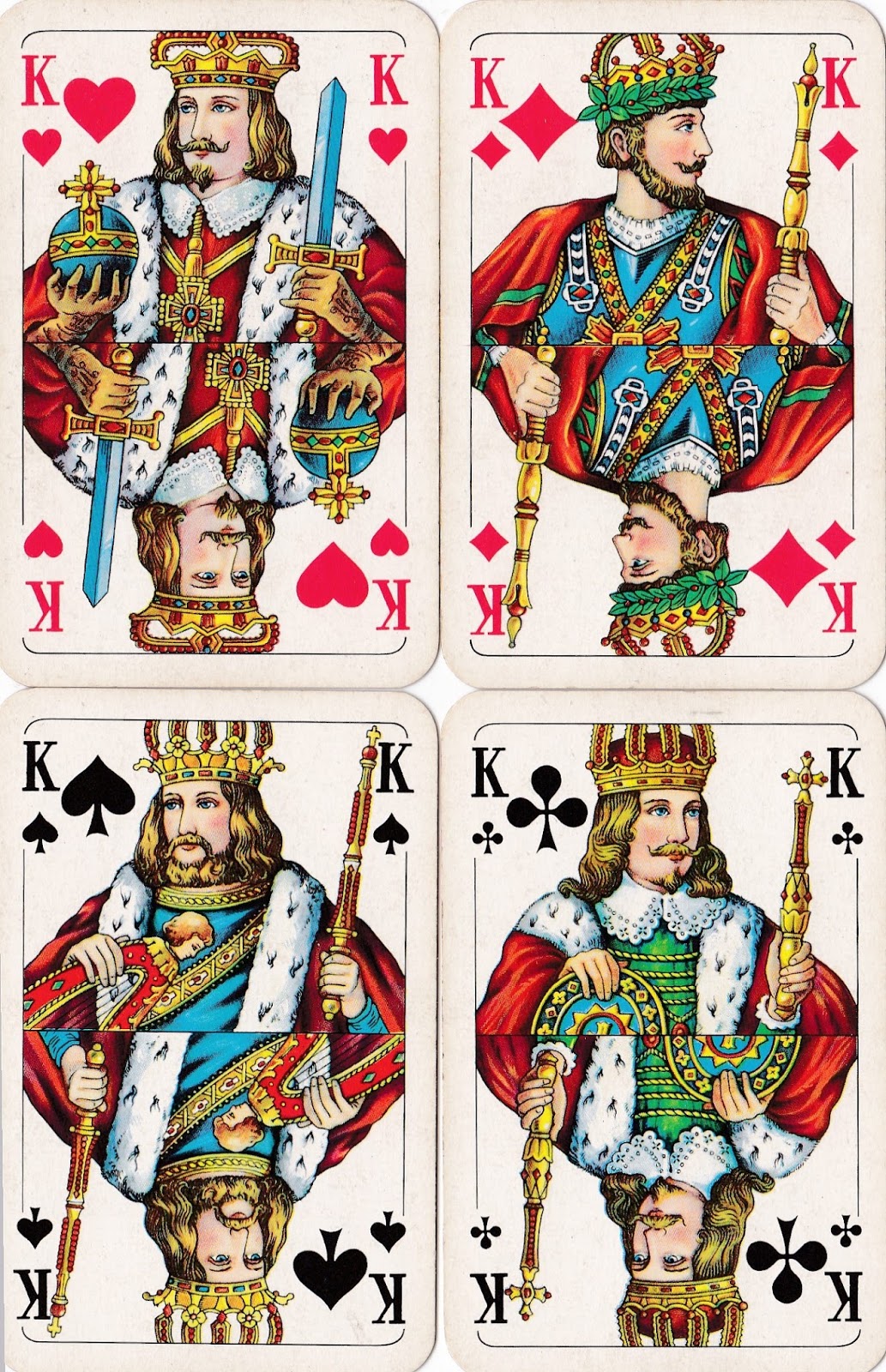
Here's a test of observation. You'll have seen these four Kings from a pack of cards literally thousands of times, and they're always the same, no matter which company manufactured them. So can you recognise which King is which, now I've removed the suit symbols? The answer will emerge later.
But how did they come to look like this? 
We saw in the first part of this essay how the four suits with which we are familiar appeared in France, probably in the 14th century, and the design of French court cards has changed little over the centuries. Our court cards copied the French system in having a King, Queen and Servant (called a Knave until the 20th century, but now better known as a Jack), followed by 10 pip cards.


The design of the English court cards  derive from a pack produced in the French city of Rouen in 1567. This is a rather crude modern reproduction of the four Kings from this pack:-      

By the end of the 17th century, English cardmakers had reduced these Kings to a more abstract form, though the derivation is obvious:-

These cards have been immortalised in Alexander Pope's mock-heroic description of a card game in "The Rape of the Lock". The game being played is called "Ombre", a game for three players, with one suit being trumps and tricks being taken, as in Whist or Bridge. Pope does not describe the King of Hearts, but the King of Diamonds is:-

    "Th' embroidered King, who shows but half his face"

 He is always the only King in profile, on British, French and German packs. The King of Spades is described in more detail:-

    "With his broad sabre next, a chief in years,
      The hoary Majesty of Spades appears,
      Puts forth one manly leg, to sight revealed,
      The rest, his many-coloured robe concealed"

It it clearly the King shown above who is being described.
   Finally, we have a mock-heroic description of how the King of Clubs is trumped by the Queen of Spades:-

    "The Club's black tyrant first her victim died,
      Spite of his haughty mien, his barbarous pride:
      What boots the regal circle on his head,
      His giant limbs, in state unwieldy spread,
      That long behind he trails his pompous robe,
      And, of all monarchs, only grasps the globe?"

The King of Clubs is still the only King to have an orb, though nowadays it usually floats unsupported in front of him. Only in the pack which Alfred Cook used to make for Woolworth's did the King of Clubs retain some vestigial fingers under his orb! 
  
    In the 19th century the court cards "lost their legs" and were turned upside down. It's easy to work out why this happened. With only one suit symbol on each card, a player who was dealt his court cards "legs upward" would have to turn them around to find the symbol, thus giving important information about his cards to his opponents!

So our court cards evolved, as shown here, left to right, from 16th century France to late 17th century England to the present day, becoming evermore less lifelike and more diagrammatic. These are three of the Kings, but the Queens and Jacks followed exactly the same path.
.


The King of Hearts has had his rather inappropriate little tomahawk changed to a sword held behind his head - though it clearly has a very short blade!

There is just one more curious detail to add, concerning the Ace of Spades, traditionally the highest card in the pack (as indeed it was in Alexander Pope's Ombre game). In the 18th century there was an excise duty levied on every pack of cards, which was enforced by means of a government duty stamp placed on the Ace of Spades. Here is an example from a 20th century pack:-
In 1805 there was even a case in which an unfortunate man named Richard Harding was sentenced to be hanged for forging the Ace of Spades!


Thursday, 1 December 2016

Playing Cards:Part 1: Their History and Geography

The earliest European playing cards which survive belonged to King Charles VI of France. In 1392 a painter called Jacquemin Gringonneur was paid for "Three games of cards, in gold and divers colours, ornamented with many devices, for the diversion of our lord the King". A few of these cards still survive: they formed part of a tarot pack.

These are cards from a modern reproduction of a slightly later tarot pack, produced in Marseilles in the 16th century. (All the pictures in this essay are of cards in my collection)
There are 78 cards in a tarot pack. The four suits are Cups, Swords, Money and Clubs, each of which have ten pip cards and four court cards: the King, Queen, Knight and Servant, making 14 cards in each suit. In addition there one card, "Le Mat" with value zero, who is clearly the ancestor of the modern Joker, and 21 "Atouts". These include such cards as the Sun, Moon and Stars, the Emperor and the Pope, and abstract virtues like Strength and Temperance. Death is, of course, number 13. Some are highly mysterious: there is a Lady Pope, "La Papesse", a Hanged Man, "Le Pendu" and "La Maison Dieu", which in mediaeval French meant a hospital, but which is always depicted as a tower struck by lightning.   

There are games which can be played with tarot packs, but nowadays they are mostly used for fortune-telling. Many magicians design their own tarot packs, and often alter them after their own ideas: the suits of Money and Clubs are changed to Pentangles and Wands, the Pope and Papesse become the Hierophant and High Priestess, and so forth.

There are strong grounds for believing that present-day cards derive from the tarot pack. In Spain and Italy the four tarot suits have been retained, and the Queen has been dropped from the court cards, leaving the King, Knight and Servant. This is from a modern Spanish pack:-

and one from Italy. It will be noticed that there are only 12 cards in each suit, with 9 pip cards; the Servant being number 10, the Knight 11 and the King 12. Spaniards and Italians thus cannot play whist or bridge with their native packs!

There are charmingly different suits in central Europe, such as Acorns, Daisies, Leaves, Bells and Shields; and the court cards feature an "Ober" who holds his suit symbol up, and an "Under" who holds it down. Here are a couple of examples:-


The pack of cards with which we are familiar today has its origins in France, probably some time in the 15th century. The French card-makers eliminated the Knight from the tarot pack, leaving a suit of 13 cards with the court cards of King, Queen and Servant (called the Valet in a French pack). The four suits became Coeurs (Hearts), Piques (Pikes, or Spear-heads), Carreaux (Tiles) and Trefles (Clover-leaves). These pictures are a modern reproduction of a French pack from the early 19th century:-


An unusual feature of the French pack is that the court cards all have individual names. The Kings are called Charles (Charlemagne), David (with the harp), Cesar and Alexandre; the Queens are Judith, Pallas, Rachel and Argine; and the Valets are famous warriors: La Hire, Hogier, Hector and Lancelot. (In case you are struggling to remember a Queen with the name of Argine, it is merely an anagram of the Latin "Regina"! I have no idea why)
   The only change in a modern French pack is that the court cards have "lost their legs". They retain their names, albeit partially obliterated by the suit symbol, and King David still has his harp. 

The French system was followed in Germany, where, as can be seen below, the court cards are by far the most beautiful in the world. They are no longer named, though "David" retains his harp and "Caesar" wears a laurel-wreath:-

The French system was also followed in England, and indeed is now familiar throughout the world, though the names of the suits were changed. Hearts remained Hearts, and it is easy to see how Carreaux became Diamonds; but the suit we call Spades is still obviously a Spear-head, and the fourth symbol remains obstinately a Clover-leaf, with no resemblance to a Club at all. Perhaps this is a reversion to the old tarot name for the suit?
 It will also be noticed that in the French and German packs only one King is shown in profile, and, as in British packs, it is the King of Diamonds.

How the British pack reached its present appearance will be explained in the second part of this essay, to follow shortly.

Thursday, 17 November 2016

Quiz: Kings and Battles

What battle is linked with the reign of each of these English Kings?


Kings:-

Edward III   
George III
Henry III
Richard III
William III


Battles:-

Agincourt
Blenheim
Bosworth
Evesham
Flodden
Killiecrankie
Poitiers
Naseby
Saratoga
St. Albans

(To make it a little more difficult, I have given more battles than kings!)

Tuesday, 8 November 2016

The Real Count Dracula

Dracula was a real person, though he wasn't a count, didn't live in Transylvania and didn't bite people in the neck.
   His name was Vlad, and he was an exact contemporary of Joan of Arc, being born around 1431 and dying in 1476, either assassinated or killed in battle. During his short but violent life he enjoyed one longish stint and two short ones as the elected prince ("voivod") of Wallachia, the southern province of modern Romania. There are various explanations of how he acquired the nickname of Dracula, which he used to sign his documents: one being that his father, another Vlad, was known as "Vlad Dracul": "Vlad the Dragon"; so his son naturally became "Vlad Dracula"; the "Little Dragon". He was also know as the Devil, the Blood-Drinker, and the Impaler ("Tepes"), all of which testify to his fearsome reputation.  


These were violent and frightening times. The Ottoman Turks had occupied Greece and destroyed the Serbian kingdom in the previous century, and were now advancing through the Balkans. In 1526 they were to overwhelm the Hungarians at the battle of Mohacs and extend their empire as far as the gates of Vienna. Dracula's grandfather, Mircea the Old, had been defeated by the Turks in 1396 and forced to recognise the Sultan as his overlord. Wallachia was allowed to remain self-governing, but paying an annual tribute of 10,000 ducats. And the Turks were not the only problem, for the Kings of Hungary ruled over Transylvania and wanted a client of theirs to rule Wallachia, and Stephen of Moldavia, to the north, was also a rival.
   Facing all these different pressures, Dracula's father attempted to remain neutral, and in 1443 he had to send Dracula and his younger brother Radu as hostages to Istambul. Four years later he was murdered by the Hungarians and his eldest son Mircea was buried alive. Dracula was freed by the Sultan Mohammed II and tried to establish himself in Wallachia by swearing oaths of obedience to both the Sultan and to King Mathias of Hungary. He established Tirgoviste as his capital and built or seized a number of castles
   In 1461 the Turks demanded a new annual tribute of 500 boys, to be raised as Moslems and trained as Janissaries; the elite slave-soldiers of the Ottomans. Dracula's response was war. He launched a great raid across the Danube, but his appeal for support was ingored by the Hungarians, and when the Turks counterattacked, his own brother Radu joined them. The Turks failed to take Tirgoviste, and Dracula was able to stage a night attack on their camp, inflicting heavy losses.
   When Stephen of Moldavia supported the Turks, and Dracula's own nobles recognised Radu as their prince, he fled to Brasov in Transylvania, where he was arrested by the Hungarians. He was held for several years, after which he decided to throw in his lot with them. Accordingly he converted to Catholicism and took a Hungarian princess as his second wife. King Mathias then restored him as Prince of Wallachia, but in 1476, fighting against the Turks near Bucharest, he was either killed in battle or possibly murdered. His descendants survived as members of the local nobility for the next two centuries.

Dracula would have been soon forgotten, but for the fact that his reign was marked by a degree of savage cruelty exceptional even by the standards of the time. His favourite technique for dealing with those who offended him was to impale them on a sharp stake, with the other end planted in the ground, and there they would remain until their bodies rotted away. There were many stories about this. In 1459 he invited 500 nobles to a banquet, accused them all of treason and impaled them. The Abbot of Snagov monastery, who protested, was also impaled. Soldiers with wounds in the back were impaled for cowardice. When the Turks attacked Turgoviste in 1462, they were so horrified at the spectacle of 20, 000 impaled bodies planted outside the town in a great forest of stakes that they withdrew. Other people who aroused his wrath were burnt alive, flayed, or dismembered by teams of horses. There were even rumours of cannibalism. Some of the tales about him had a certain grisly humour, such as the man who complained about the stink of rotting corpses, and was impaled on an especially high stake, to place him above the smell; or when Turkish envoys refused to remove their turbans as a mark of respect, saying it was against their religion, and he responded by having the turbans nailed to their heads. If we add up all his supposed victims, it reaches a total of at least 100,000; but since the population of Wallachia at the time can hardly have been more than half a million, this seems unlikely.

How did stories from distant Wallachia reach Bram Stoker in late Victorian England? The local peasants sang ballads about Dracula, portrayng him as a hero who resisted the Turks, and his name became known in Hungary and Germany. As the Turks were driven out from Romanian territory in the mid-19th century his reputation as a local patriot resurfaced. 
    Vampire legends, about the undead who walked at night and drank blood, were widespread, and vampire stories were written long before Stoker's famous work was published in 1897. Even in England there were instances of suicides being buried with a stake through the heart to prevent the ghost from walking (see footnote). Stoker himself never visited Romania, but merely combined the name of Dracula with the vampire legends and the sinister reputation of bats (though the vampire bat is a native purely of central America, and unknown in Europe). Stoker, incidentally, made little or no money from his book, and it was largely forgotten until made into a film in the 1920s. 

            Stoker's book wasn't translated into Romanian until 1973. It was about then that I visited the country, and the Communist regime had just cottoned on to the idea that the Dracula legend could well form the foundation of a profitable tourist industry. Already there were tours of sites associated with Dracula, and the shops sold his a great many items carrying his face or name: plaques, textiles, and even bottles of the lethal plum brandy.        

Since then, explotation of the Dracula legend has really taken off.

This is Castle Bran. Its link with Dracula is tenuous, but it looks good and is well-preserved.
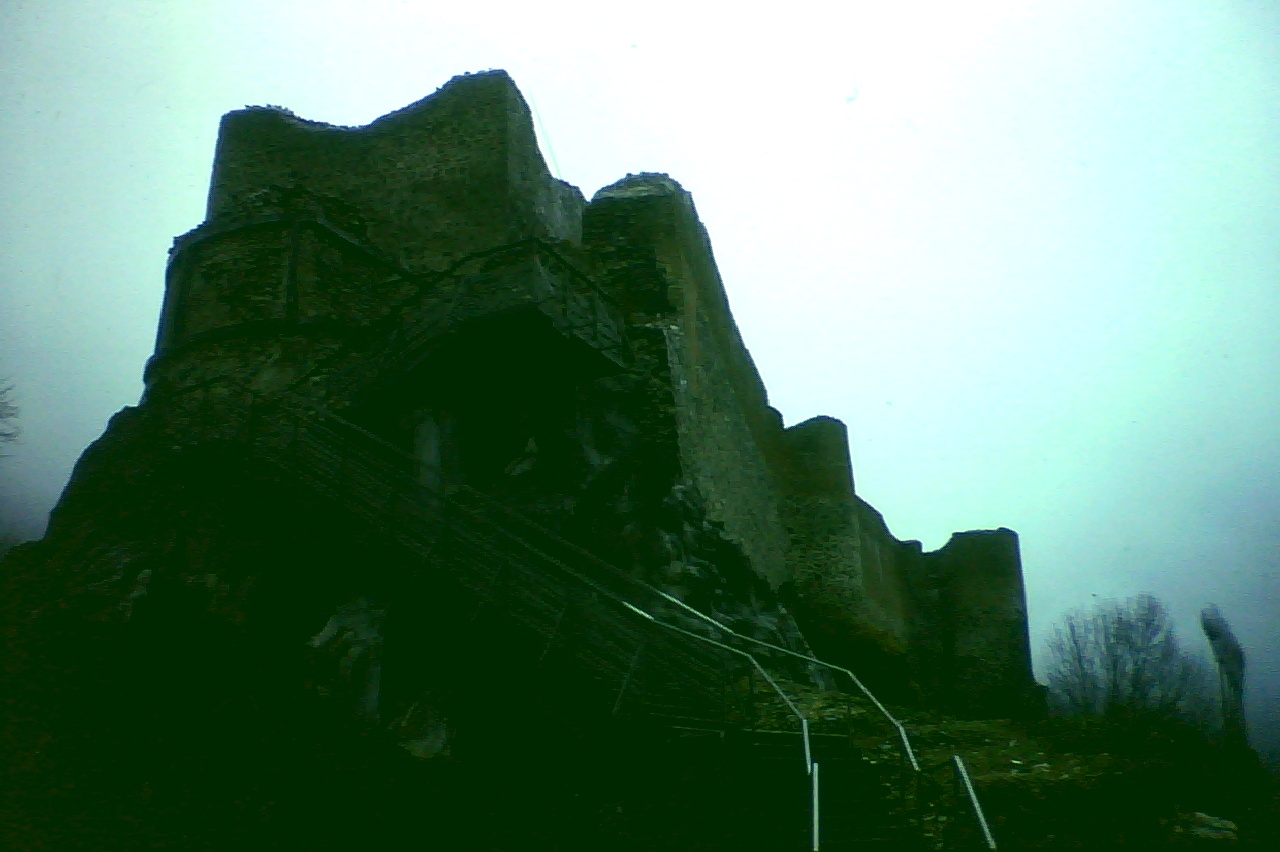
This is Dracula's principal stronghold, in the mountains above Curtea de Arges. The view down the valley was splendidly spooky for our visit. Dracula's first wife committed suicide here, by hurling herself from the battlements. 


The vast majority of Dracula's subjects would have been peasant farmers, and would have lived in huts like this

This is Snagov monastery, near Bucharest, where he is supposed to have been buried.

Footnote: 
Traditional fears of the ghosts of suicides walking, and how to prevent it, are shown in the poem "Faithless Nelly Grey" by Thomas Hood. A crippled soldier, home from the Napoleonic wars, hangs himself in despair, so:-
     "They buried Ben at four crossroads
       with a stake through his inside".

Monday, 31 October 2016

An American view of Brexit

There is an interesting sidelight on the Brexit vote in the “New York Times Review of Books”. The Brexit triumph is seen as a howl of rage on the part of the poor white working class in the old declining industrial areas, who were given the opportunity of venting their frustrations on a single target: Europe. Parallels are drawn with Donald Trump’s success in appealing to the same socio-economic groups in the so-called “rust belt” and the backwoods rural districts of America. Trump himself is aware of the parallels, and encourages his supporters by pointing out how Brexit was able to triumph, against all predictions and against the advice of almost all political and business leaders.

   None of this can be explained by traditional class-based theories. Contrast an area I know well: Stoke-on-Trent: rock-solid Labour; the home of traditional heavy industries (ceramics, coal and iron: all in decline for many years), with its own proud local traditions, and strongly Brexit; with another area I know: Richmond-on-Thames: rock-solid Tory, with some of the highest house prices in the country, and over 70% for Remain. To add to the confusion, the Stoke M.P.s backed Remain, but the Richmond M.P. backed Brexit!

The clearest divisions are in education. In America the majority of college graduates traditionally voted Republican, whereas blue-collar workers voted Democrat. This could well change: probably not many graduates are likely to support Trump, but on the other hand he could do well in a state like Pennsylvania, which is full of rust belt industrial towns (Does anyone remember Billy Joel's classic song "Allentown", about the decline of the steel industry there?). In our referendum, an overwhelming majority of people with university degrees voted for Remain, as did the inhabitants of London and the academic centres, Oxford and Cambridge. Following this, in the general election of 2019, the Conservatives took all the seats in Stoke (which had remained solidly Labour even in the Thatcher years) and cut a swathe through the old Labour seats in the north-east, but failed to win back any of the university towns like Oxfoed,Cambridge, Exeter and Canterbury, and even lost ultra-prosperous seats like Putney and Richmond-on-Thames! This the biggest political revolution in a generation!